Upper Funnel
Upper Funnel refers to the earliest stage in a person's path to purchase: the point at which they first become aware of a brand or product at all. Advertising at this stage isn't meant to generate immediate orders, but to build awareness.
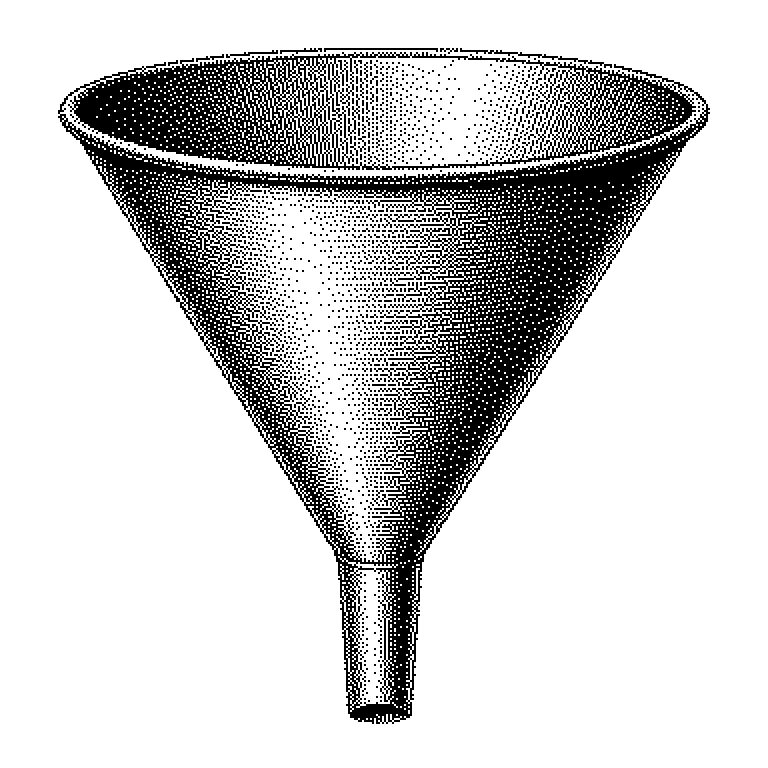
Marketing professionals like to think of the path to purchase as a funnel. At the very top are a great many people who don’t yet know a product at all. At the very bottom, only the few who actually end up paying remain. The English term for this shape is funnel, and Upper Funnel refers to the wide opening at the very top. There, the only goal is to be noticed at all. Anyone advertising at this stage doesn’t yet expect an order, but instead wants to plant a name in people’s minds.
Why companies pay for attention that sells nothing
No one buys a product they’ve never heard of. That’s why a brand’s awareness limits its revenue over the long run. A company can offer the best discounts imaginable: if the target audience doesn’t know the name, those discounts fall flat. Upper-funnel advertising, so to speak, fills the pool from which sales are later drawn.
The problem here is measurability. If someone clicks a search ad and orders two minutes later, the success can be attributed exactly to that one ad. If someone sees a commercial in February and buys in a store in October, that connection is barely provable. Many companies therefore cut upper-funnel spending first in times of crisis. Revenue doesn’t collapse immediately, but only months later.
For companies like Amazon, Netflix, or Spotify, this topic is a business model. They sell ad placements that primarily deliver reach. That’s exactly why the term regularly turns up in quarterly reports and stock market announcements.
From the wide rim of the funnel to the narrow opening
The funnel is usually thought of in three stages. At the top is awareness: someone notices the brand for the first time. In the middle comes consideration, the so-called mid funnel. There, someone compares prices, reads reviews, or watches videos. At the bottom, in the lower funnel, is the purchase decision.
Different ad formats suit each stage. At the top, broad-reach formats are used: TV commercials, online video, billboards, large display ads. At the bottom, the tools are search ads, discount codes, or reminders about an abandoned cart. A banner ad reading “Get 20 percent off now” is typical of the lower funnel and nearly ineffective at the top.
Measurement at the top uses different numbers than at the bottom. Instead of orders, one counts how many people saw the ad and how often. Added to this are surveys on aided awareness: people are read brand names and asked which ones they recognize. Increasingly, companies also rely on statistical models that compare ad spend and revenue over long periods. These models today often run on machine learning methods, meaning programs that derive patterns from historical data.
The term in advertising budgets and stock market announcements
As a consumer, you encounter the upper funnel constantly, without it ever being named. The spot before a YouTube video that shows a car brand without mentioning a price belongs here. So does a football club’s jersey sponsorship or the billboard at the train station. This kind of advertising wants nothing from you except that you remember the name.
In business news, you usually hear the term from the platforms' perspective. When Amazon or a streaming company says it wants to “move further into the upper funnel,” that means: it no longer wants to sell only click-based ads, but also wants a share of the large brand budgets that used to flow into television. These budgets are currently being fiercely fought over.
A common misconception is that upper funnel is simply another word for poor or imprecise advertising. That’s not true. The stage describes no judgment of quality, but rather the point in time within the decision-making process. A well-crafted brand campaign can drive revenue years later, while a discount ad merely captures people who would have bought anyway.