Loop-based architecture
A loop-based architecture is an AI model that passes data through the same group of computational blocks multiple times in a row, instead of having separate blocks for each step. This allows the model to "think" longer on difficult tasks without becoming larger.
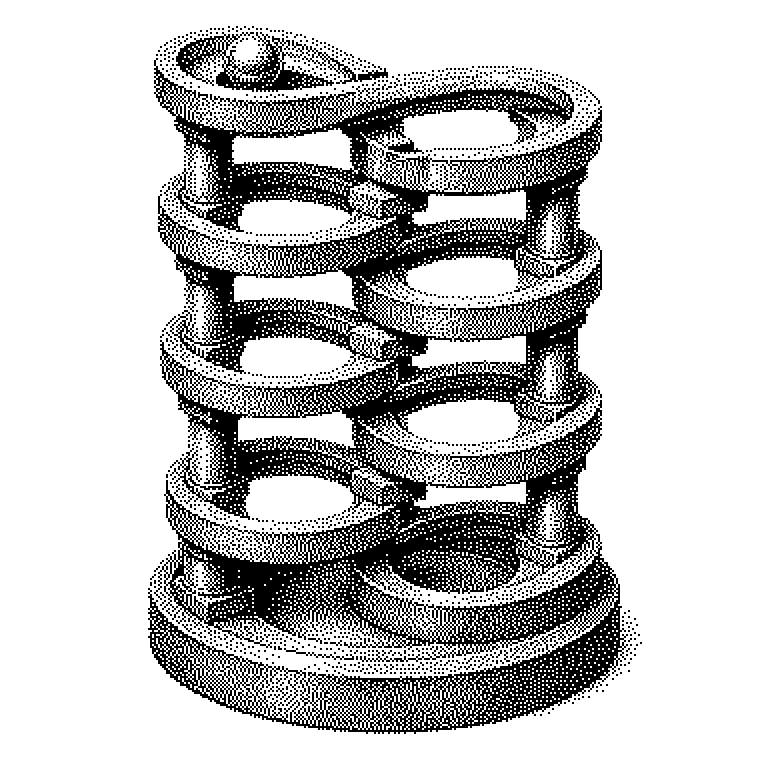
An AI model consists of many computational layers that transform an input step by step. Normally, each of these layers has its own learned numerical values. A loop-based architecture does things differently: it takes a small group of layers and sends the data through that same group multiple times. You can imagine this like a circular track that the intermediate result runs through again and again. The English term “loop” means exactly that. How often the loop runs can be adjusted — sometimes even after the question has already been asked.
Thinking time instead of model size
For years, a simple rule of thumb held in AI development: more layers and more learned numerical values mean better results. These numerical values are called parameters, and the largest models have hundreds of billions of them. The problem is memory. Every parameter has to sit on the graphics cards that run the model, and graphics cards are expensive and scarce.
Loop-based architectures break this coupling apart. A model with four layers that runs its loop eight times computes as deeply as a model with 32 layers. In memory, however, it only takes up the space of four. Anyone with little memory but spare computing time gets a very good trade-off here.
The second advantage is flexibility. A simple question about the capital of France needs only a few passes. A nested logic problem can be given twenty without any issue. The model can thus adjust its effort to the difficulty of the task. Classic models cannot do this: they always compute through all layers, no matter how trivial the question is.
What happens inside the loop
Technically, the model consists of three parts. An input block converts the text into sequences of numbers. This is followed by the loop block, which is called repeatedly. At the end, an output block turns the result back into a word. Only the middle part is repeated, and its learned values remain identical on every pass.
Importantly, the data still changes despite this. On the second pass, the block receives the result of the first pass as input. It thus works on a further-developed intermediate state. The comparison with a mental-arithmetic solver fits well: the same person is calculating, but each round builds on the previous intermediate result.
The difficult question is: when does the loop stop? Some systems fix the number of passes before training. Others train an additional small network that decides after each round whether to continue. A well-known failure mode is a model that produces almost the same result on every pass. In that case, it burns computing time without any benefit. Another drawback: the passes have to run one after another and are difficult to distribute across many chips.
From research papers to reasoning models
In the news, the term usually comes up in connection with so-called reasoning models. These are systems that visibly write out intermediate steps in text form before giving an answer. Loop-based architectures pursue the same goal, but without text. The thinking happens within the numbers and is never written out. Experts call this latent reasoning.
The approach is practically interesting for devices with little memory, such as smartphones or sensors in factories. A huge model won’t fit there, but a small model with many loop passes will. Research groups with small budgets are also taking a close look at this, since it lets them achieve competitive results with less hardware.
The term should not be confused with recurrent networks from the 2010s. Those repeated themselves along the text, i.e., word by word. Loop-based architectures repeat themselves along the depth, i.e., in the thinking about the same state. So far, the technique is mainly a research topic, but it is considered one of the serious paths out of the pure scaling race.