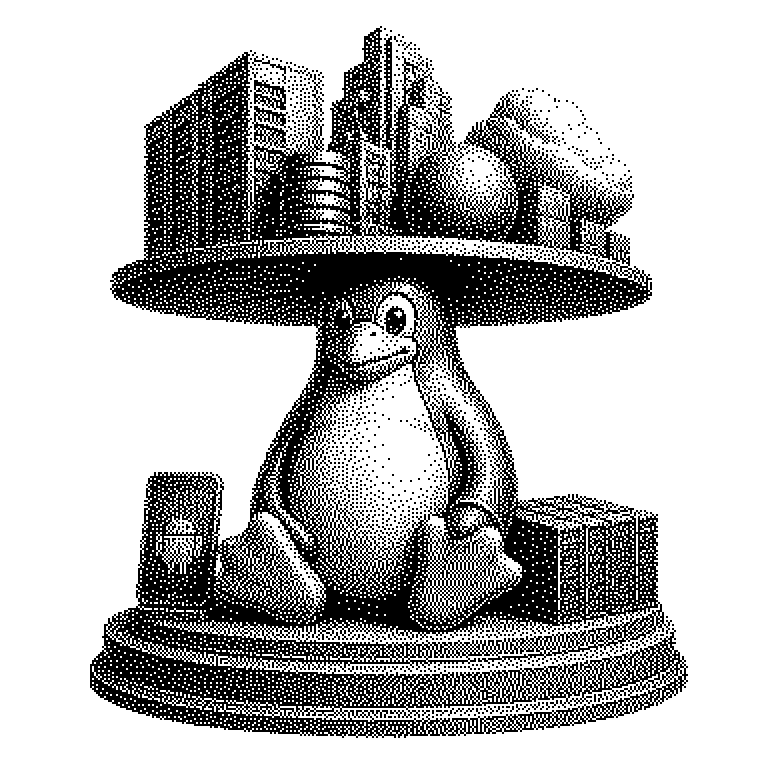
Linux
Linux is an operating system, that is, the foundational software that makes a computer usable in the first place. It is freely available and today runs on most servers on the internet, on Android phones, and in almost all data centers for artificial intelligence.
Every computer needs foundational software that drives the screen, manages files, and starts programs. This foundational software is called an operating system. On personal computers, this is usually Windows or macOS. Linux is a third option, and it differs in one decisive point: its blueprint is public, anyone may read it, change it, and pass it on. This began in 1991 with the Finnish student Linus Torvalds, who wrote such a system as a hobby project. Today, thousands of people from companies and universities work on it.
The invisible foundation of the internet
On ordinary desktop computers, Linux is rare. Everywhere else, it is the rule. The vast majority of servers, that is, the computers that deliver websites and apps on the internet, run under Linux. When you open a news site or stream a video, it is highly likely that a Linux machine is answering you.
Linux is also central to artificial intelligence. Large AI models are trained on specialized chips in enormous data centers. The software for this is built almost exclusively for Linux. Anyone reading about AI data centers, cloud providers, or chip drivers is always indirectly reading about Linux too.
There is also an economic point. No license fees apply for Linux. A company operating a hundred thousand servers saves considerable sums as a result. At the same time, no one is dependent on a single manufacturer that could raise prices or discontinue a product.
Kernel, distribution, and the role of the license
Strictly speaking, Linux is only the kernel. The kernel is the innermost part of an operating system. It distributes processing time among running programs, manages memory, and communicates with the hardware, that is, with the hard drive, graphics card, and network card. Programs do not talk directly to the hardware but submit their requests to the kernel.
A kernel alone, however, is unusable. Added to it are text programs, a graphical interface, a browser, and much more. Such ready-made combinations are called distributions. Well-known names include Ubuntu, Debian, and Red Hat Enterprise Linux. You can imagine it like an engine around which different manufacturers build different cars.
This is made possible by a special legal rule, the license. It permits any modification but requires that improvements be shared openly again. So no one can take Linux, alter it slightly, and keep the changes to themselves. As a result, the work of competing companies ultimately flows back into the same project.
From the Android phone to the refrigerator
The most common contact with Linux is unconscious. Android, the operating system of most smartphones, is built on the Linux kernel. Smart TVs, routers, cars, and many household appliances also contain a stripped-down Linux variant. Even the fastest supercomputers in the world run on it without exception.
In business news, the term usually appears in connection with cloud services. Amazon, Microsoft, and Google rent out computing power, and the rented machines are predominantly Linux machines. Companies like Red Hat make no money from the system itself, but from maintenance and support. IBM paid around 34 billion dollars for Red Hat in 2019.
A common misconception is that open software is automatically insecure because anyone can see the blueprint. In practice, the opposite tends to be true. Many eyes find bugs faster, and security vulnerabilities can be independently reviewed. Anyone who wants to try Linux themselves can download a distribution for free and boot it from a USB stick without changing anything on their own computer.