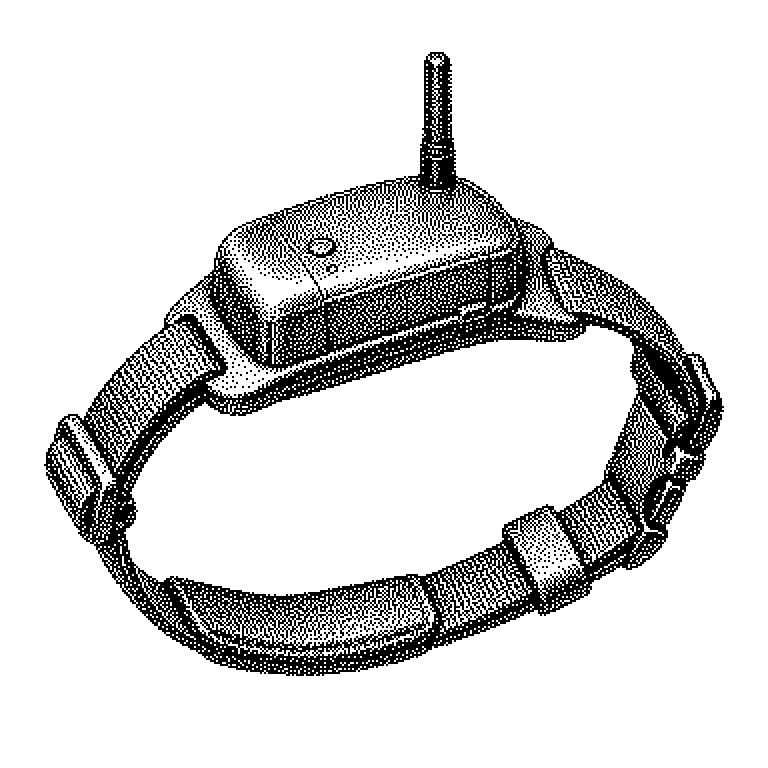
Biologger
A biologger is a small measuring device attached to an animal that records its movements, environment, and body values. From this data, researchers gain a precise picture of how animals live — nowadays often with the help of automatic analysis methods.
A biologger is a small measuring device that is attached to a living animal. It might be worn on a collar, glued to the back plumage of a bird, or fitted to a dorsal fin, for example. While the animal continues to live normally, the device continuously records measurements: position, acceleration, water depth, temperature, sometimes even heartbeat or sounds. The name is made up of “bio” for life and the English word “logger” for a recording device. Unlike a camera trap, which sits in a fixed location and waits, a biologger travels along with the animal. It doesn’t deliver images from a single point, but rather a seamless record of an entire stretch of an animal’s life.
What researchers would never learn without biologgers
Most animals live where humans cannot observe them. A whale dives hundreds of meters deep, a migratory bird crosses the Sahara at night, a fox moves through dense undergrowth. In the past, all researchers could do was mark animals and hope they would eventually turn up again. Between two sightings lay a huge gap that could only be speculated about. Biologgers close exactly this gap.
This has produced solid findings. We now know that some migratory birds fly for several days without a break. We know the exact routes storks take to Africa, and the places where many of them die. Such information forms the basis for establishing protected areas in the right locations. Without data, one would only be guessing where a protected area would actually help.
The data is also interesting outside of biology. Animals move through regions where there are hardly any measuring stations, such as the open ocean. Seals fitted with temperature sensors have for years supplied measurements from the Southern Ocean that feed into climate models. In this way, the animals incidentally become mobile measuring stations.
From sensor to analyzed movement
A typical biologger consists of several sensors, a memory chip, a battery, and often a small solar cell. The most important sensor is usually a receiver for satellite signals that determines position. In addition, there is an accelerometer, the same kind found in every smartphone. It measures hundreds of times per second in which direction the device jerks or moves. From this pattern it is possible to tell whether an animal is currently walking, resting, feeding, or feeding while digging.
This is exactly where artificial intelligence comes into play. A single logger quickly generates millions of data points that no one could review by hand. That’s why programs are trained to automatically assign movement patterns to specific behaviors. To do this, researchers first film a number of animals and note precisely what they do and when. The program learns from these examples the connection between the measurement curve and the behavior. After that, it can independently analyze the data of unobserved animals.
The biggest technical hurdle is weight. As a rule of thumb, a logger should weigh no more than three to five percent of the body weight. For a small songbird, that’s less than one gram. This is why memory, radio, and battery must be extremely economical. Some devices transmit their data via radio or satellite only once a day, for just a few seconds.
From weather apps to earthquake research
Biologgers usually appear in the news when a study reveals surprising animal routes. Well known is the Icarus project, in which transmitters on animals sent their data to a receiving station in space. Reports about wolves in Germany, too, almost always rely on individual tagged animals. Whenever a map shows an exact migration route, there is practically always a biologger behind it.
Related technology is closer to you than you might think. A fitness tracker is, at its core, the same setup: accelerometer, pulse measurement, memory, analysis software. The difference is that you can recharge your tracker yourself, and no one has to catch you to read out the data. Such devices are also common in agriculture, for instance as collars that detect illnesses in cows at an early stage.
A common misconception is that a biologger is the same as a GPS tracker on a dog collar. A tracker mainly shows the current location. A biologger, beyond that, collects behavioral and environmental data over months and is designed for scientific analysis. It is precisely this combination of long operating life, numerous sensors, and automatic analysis that makes it one of the most important tools of modern behavioral research.