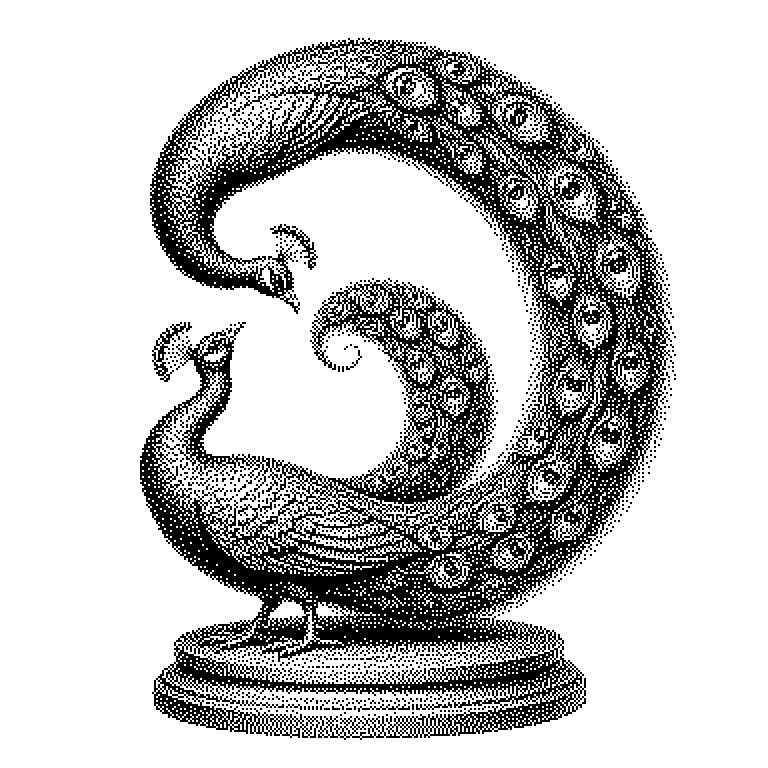
Runaway Selection
Runaway selection describes a self-reinforcing cycle in evolution: a trait is favored in mate choice, and this preference keeps intensifying together with the trait itself. In technology and AI debates, the term now serves as an image for systems that spiral toward an extreme through their own feedback.
Runaway selection is a term from biology. It describes how a trait in animals can become ever more extreme because it is favored in mate choice. The best-known example is the peacock’s tail. It is heavy, conspicuous, and makes the animal easy for predators to spot. Nevertheless, it grows larger over many generations because females specifically prefer these large tails. The English expression means literally a selection that “runs away”: the process drives itself forward and only stops once the trait becomes too costly for survival.
Why the peacock’s tail helps explain evolution
For a long time, biology held to a simple principle: traits prevail if they aid survival. A fast runner escapes the predator, a well-camouflaged animal is not found. The peacock’s tail does not fit this picture at all. It costs energy, hinders escape, and can be seen from far away. Charles Darwin himself wrote that the sight of a peacock’s feather made him feel almost sick.
The statistician Ronald Fisher provided an explanation in the 1930s. It shows that it is not only the environment that selects, but also fellow members of the species. This so-called sexual selection can pull in a completely different direction than pure survival pressure. In this way, runaway selection explains a whole group of traits that would otherwise remain puzzling: deer antlers, birdsong, bright colors.
It is important to distinguish this from a related idea. According to the handicap theory, a costly trait is an honest signal of good genes: only a strong animal can afford such a thing. In Fisher’s runaway process, this benefit is not needed at all. The trait can be entirely arbitrary and still prevail, simply because the preference for it exists.
The cycle of trait and preference
It begins with a small chance event. A preference for somewhat longer tails is slightly more common in a population than a preference for short ones. Females with this preference choose long-tailed males. Their sons inherit the longer tail, their daughters inherit the preference for it. From this point on, trait and taste are linked to one another.
It is precisely this coupling that produces the feedback loop. Whoever has a long-tailed son has a son who will later often be chosen. So the preference pays off, even though the tail itself is of no use. In the next generation, both traits are more common, and the effect intensifies. Fisher calculated that the trait does not grow at a steady rate in this process, but ever faster.
This is only stopped by the costs. At some point, males with exaggerated tails die so often that the advantage in mate choice no longer compensates for it. At this point, the trait settles into equilibrium. A common misconception is therefore to understand runaway selection as endless growth. It is a rapid process with a brake, not one without.
From the peacock to the attention economy
Outside of biology, the term is now often used as a comparison. It then refers to any system in which a selection process reinforces its own criteria. Recommendation systems on social networks are the standard example. They display content that receives a lot of attention, and precisely because of this, that content receives even more attention. Headlines and video thumbnails become ever more sensational over time, quite similar to how the peacock’s tail kept growing larger.
This pattern also appears in AI development. If language models are optimized so that people rate their answers highly, an agreeable style can prevail over factual accuracy. Experts call this sycophancy, meaning flattery toward the user. The model does not learn what is correct, but what goes over well. The mechanism is the same cycle of signal and preference.
In economic news, you encounter the term in the context of bubbles and hypes. When investors put money into a stock because others are investing, the movement reinforces itself. Such comparisons, however, are analogies and not a literal application of biology. Anyone who wants to use the term properly should always check one question: Is there really a feedback loop here between the trait and the preference for it?