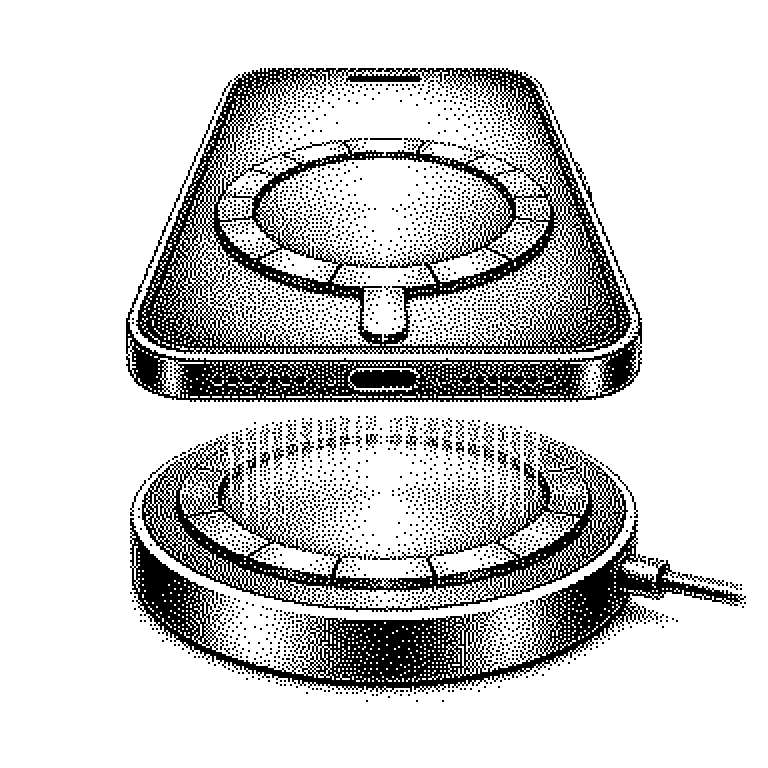
Qi2
Qi2 is the globally recognized standard for wireless charging of smartphones, in which magnets in the device and in the charging pad ensure that both align exactly with each other. It was introduced in 2023 by the industry association Wireless Power Consortium and adopts the magnet technology from Apple's MagSafe for all manufacturers.
A smartphone can be charged not only via a cable but also by placing it on a flat charging pad. The current jumps from the pad into the phone via a magnetic field, entirely without a plug contact. For this to work between devices from different manufacturers at all, shared rules are needed. These rules are called Qi, pronounced like the Chinese word “chi,” and Qi2 is their second generation. The most important difference: both the phone and the charging pad each contain a ring of magnets. It pulls both parts into exactly the position where energy transfer works best.
Why the magnet ring makes the difference
With the old Qi standard, you had to place the phone by hand in the correct position. If it was off by a few millimeters, it charged more slowly or not at all. Many people placed their device crookedly on the pad in the evening and found it almost empty in the morning. The magnet ring eliminates this problem entirely, because the phone snaps into place on its own.
Poor alignment also cost energy. Whatever doesn’t reach the battery turns into heat. This heat isn’t just wasted energy—it also harms the battery over time. That’s why Qi2 actually transfers a significantly larger share of the energy used into the device and stays cooler.
It’s also important to look at the competition: Apple had this magnet technology exclusively in the iPhone under the name MagSafe since 2020. Other manufacturers were not allowed to use it. With Qi2, the technology became an open standard that any manufacturer is permitted to build in. A Qi2 charger therefore works equally well with iPhones and Android phones.
From coil to battery
Inside the charging pad lies a coil, that is, a wound copper wire. When current flows through it, a magnetic field is created that changes very rapidly. Inside the phone sits a second coil. The changing field generates current in it again, which then flows into the battery. This principle is called induction, and it only works over a very short distance.
That’s exactly why positioning is so crucial. If the two coils aren’t aligned directly above one another, a large part of the field dissipates into the air. Qi2's magnet ring reliably keeps the coils exactly aligned. Additionally, both devices communicate with each other: the phone continuously tells the charger how much power it can currently handle.
The first Qi2 version allowed charging power of up to 15 watts. An extension from 2025 raised the limit to 25 watts. By comparison, a modern cable power adapter often manages 45 watts or more. Wireless charging is therefore still slower, but more convenient and it spares the charging port, which otherwise wears out over time.
How to recognize Qi2 while charging
You encounter Qi2 wherever a charging pad works without a cable. Typical examples are stands on the desk, mounts on the car windshield, and flat pads on the nightstand. Power banks also use the magnets: they simply stick to the back of the phone and charge it while you’re on the move.
When buying, it’s worth taking a close look at the labeling. Some accessory manufacturers advertise “magnetic” or “MagSafe-compatible” without actually meeting the official standard. Only a certified Qi2 product carries the corresponding logo of the Wireless Power Consortium. Uncertified imitations often charge more slowly than promised.
A common misconception concerns cases. A thick protective case without built-in magnets greatly weakens the hold, causing the phone to slip off. That’s why there are cases with their own magnet ring designed for Qi2. In tech news, the standard mainly comes up when a manufacturer unveils a new phone: whether it supports Qi2 is now considered a feature indicating equipment level and price class.