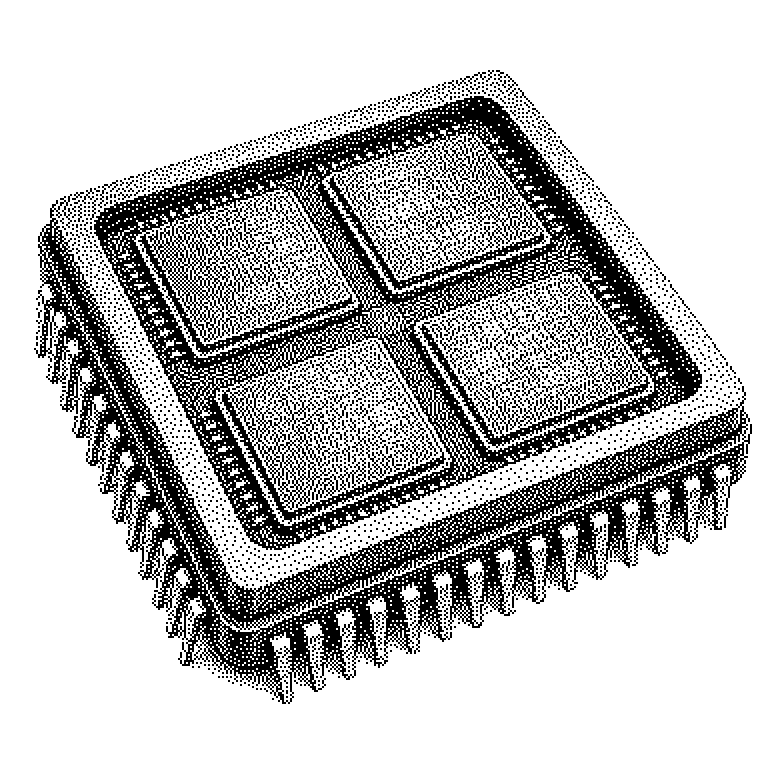
Quad-Die Architecture
In a quad-die architecture, four individual silicon dies sit within a shared chip package and work together as if they were a single large chip. This approach allows for more computing power than a single die could deliver from a manufacturing standpoint.
At its core, a computer chip consists of a thin slice of silicon into which circuits are etched. This slice is called a die. For a long time, a chip was equivalent to a die: a single piece of silicon, packaged in a black housing with connectors. In a quad-die architecture, however, there are four such slices, placed side by side or stacked on top of one another within the same package. From the outside, the result looks like a single component that can be soldered onto a board. Inside, though, four separate pieces of silicon share the workload via very short, very fast connections.
Why four small dies are cheaper than one large one
Silicon is manufactured on round discs known as wafers. Hundreds of dies are produced simultaneously on each wafer. In the process, tiny defects inevitably occur, such as a speck of dust in the wrong place. Any die affected by such a defect becomes scrap.
This is where the calculation behind quad-die architecture comes into play. The larger a die, the more likely it is to be hit by a defect. A die twice the size is therefore not merely twice as expensive, but significantly more expensive. Manufacturing and assembling four small slices is often cheaper than producing one giant die in a single piece. The proportion of usable chips per wafer is known in the industry as yield, and keeping that yield high is exactly the goal.
On top of that, there is a hard physical limit. The machines that expose the circuits can only process a field of about 26 by 33 millimeters at a time. A single die simply cannot be larger than that. Anyone wanting to pack more computing power into a component must therefore combine multiple dies. For modern AI accelerators, this has by now become the rule rather than the exception.
What holds the four slices together
The four dies sit on a shared intermediate layer known as the interposer. It can be thought of as a very fine circuit board placed directly beneath the slices. Thousands of tiny traces run through it, connecting the dies to one another. These connections are shorter and wider than anything that would run across a normal motherboard.
This is exactly what matters. For four dies to behave like a single chip, they must exchange enormous amounts of data. If the connection is too slow, the compute units are constantly waiting for data. The chip would then have plenty of transistors but little usable performance. In such a case, one speaks of a bottleneck.
A second problem is heat. Four dies packed into a tight space together generate several hundred watts of waste heat. The cooling system must dissipate this heat evenly, otherwise the chip throttles its clock frequency. A common misconception is therefore that four dies automatically mean four times the performance. In practice, noticeable losses remain due to communication overhead and heat.
Where quad-die chips are found today
This design is most visible in accelerators for artificial intelligence, that is, specialized chips for training and running large AI models. Manufacturers such as Nvidia and AMD have for several years relied on multiple dies per package in this segment. Product announcements then feature terms like dual-die or quad-die. These refer to the number of compute dies, often supplemented by additional dies for memory.
The principle has also arrived in ordinary processors for servers and PCs. There, the term chiplets is usually used instead. The difference from quad-die architecture is more a matter of terminology than of technology: chiplets are often different from one another and take on distinct tasks, whereas in quad-die designs typically four identical slices work together.
For investors and readers of tech news, the term is relevant for another reason as well. The process of assembling multiple dies, known in the industry as advanced packaging, has become a bottleneck of its own within the semiconductor industry. When reports state that an AI chip is in short supply, the cause is often not the chip fabrication itself, but a lack of capacity for exactly this kind of assembly.