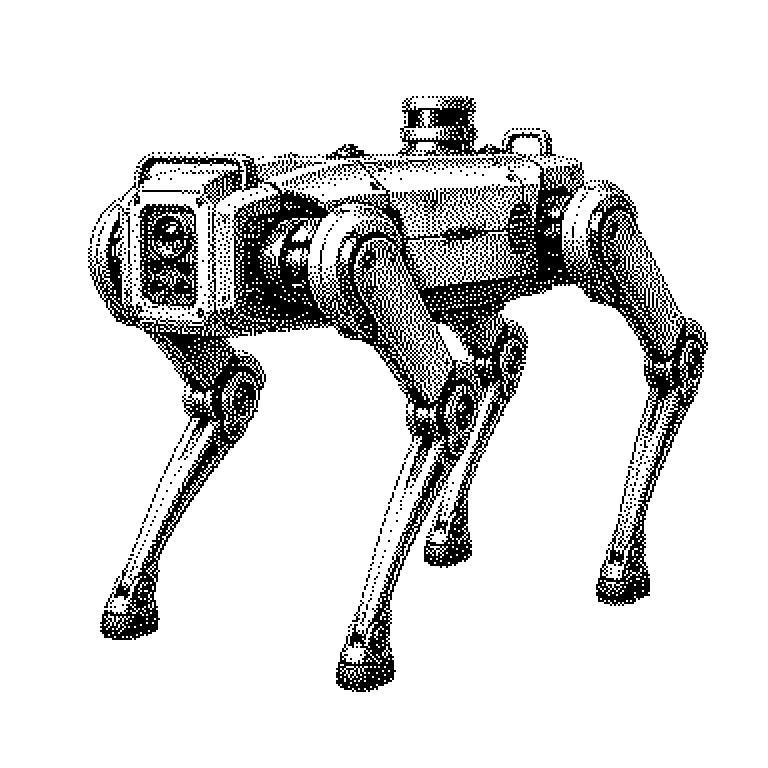
Quadruped
A quadruped is a robot that moves on four legs, similar to a dog or a goat. Because it can overcome steps, rubble, and mud, it is primarily used for inspections in factories, construction sites, and power plants.
A quadruped is a machine that walks on four legs. The word comes from Latin and simply means “four-footed.” It almost always refers to a robot that looks like a dog or a small headless goat. Instead of wheels or tracks, it has four limbs with movable joints. This allows it to climb stairs, scramble over rubble, and keep its footing on uneven ground. Well-known examples are Spot from the US company Boston Dynamics and the significantly cheaper models from the Chinese manufacturer Unitree.
Why four legs are often better than wheels
Wheels are unbeatably efficient on smooth ground. But they fail as soon as an obstacle is higher than the wheel’s radius. A normal stair step is enough to stop a wheeled robot. Legs, by contrast, touch down at individual points and can simply step over gaps. This is precisely why industry and rescue services are interested in quadrupeds.
The comparison with two-legged robots explains the second advantage. A biped is constantly on the verge of falling over and needs a great deal of computing power just for balance. A quadruped can always keep three feet on the ground and then stands as stable as a table. It is therefore technically easier to control than a humanoid robot, yet still able to go almost anywhere.
Then there’s the price. Early models cost six-figure sums; simple quadrupeds are now available for a few thousand euros. This has made them a standard device in research labs. Many advances in robot control are tried out on them first.
What happens in the legs and the computer
Each leg usually has three motors, at the hip, the knee, and the shoulder. The robot measures its position in space several times per second. This is handled by orientation sensors that detect tilt and acceleration, as well as force sensing at the feet. A controller uses this data to calculate where the next leg needs to step so that the center of gravity doesn’t tip over. This calculation runs hundreds of times per second.
In the past, engineers wrote these movement rules by hand as formulas. Today the controller is often trained instead. This involves reinforcement learning: the robot tries out millions of steps in a computer simulation. For every successful step it earns points, and for falling over it loses points. After a few hours of simulation, the learned controller is transferred to the real machine.
A common misconception is that such robots decide for themselves where to go. Walking itself is a solved problem, but goal-setting usually is not. The route typically comes from a human or from a previously recorded map. Cameras and laser scanners then only help to avoid obstacles along that path.
Where robot dogs are used today
The most common commercial use is inspection. In chemical plants, substations, and on oil rigs, a quadruped walks fixed rounds. It photographs gauges, measures temperatures, and listens for unusual noises. This is work that is boring or dangerous for humans. Such robots also regularly document construction progress on building sites.
There are also deployments in firefighting and disaster relief, for example in buildings at risk of collapse. Police forces in several countries are likewise testing quadrupeds, which regularly sparks debate about surveillance. Armed variants are contractually excluded by the major manufacturers, but are a topic in military projects from other providers.
In the news, quadrupeds often appear in videos where they dance or open doors. Such clips show the state of the art, but under ideal conditions. In everyday use, two things mainly limit their usefulness: battery life, usually under two hours, and the question of what the robot should actually do with its feet. That’s why newer models are additionally being fitted with a robotic arm on their back.