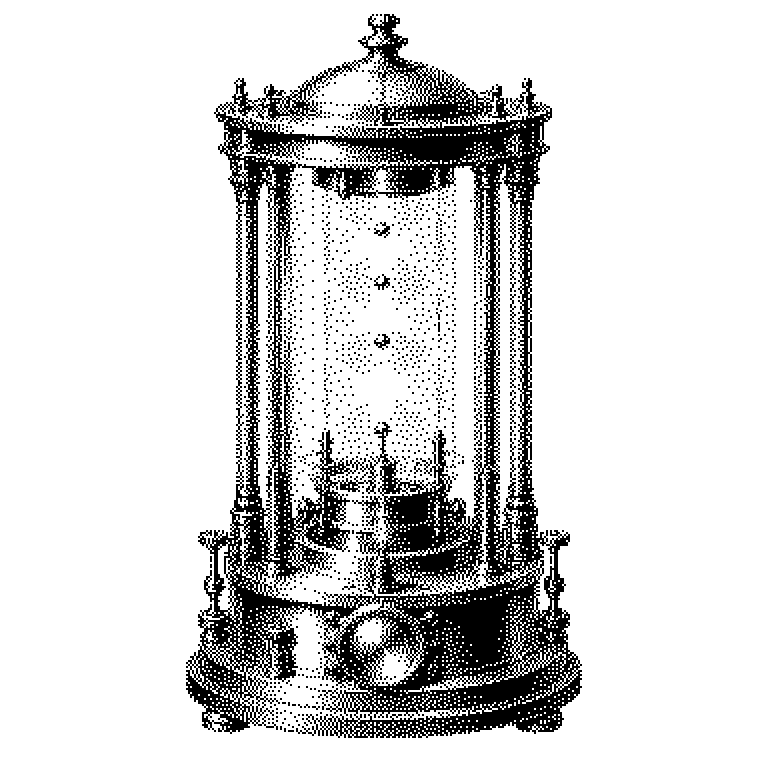
Quantum Galileo Interferometer
A Quantum Galileo Interferometer is a measuring device that sends individual atoms into free fall and determines gravity with extreme precision from their wave behavior. The name links Galileo's falling-body experiments with the quantum physics on which the measurement is based.
Over four hundred years ago, according to tradition, Galileo Galilei dropped balls to study gravity. A Quantum Galileo Interferometer essentially does the same thing, only with individual atoms instead of balls. The atoms are cooled with laser light almost to a complete standstill and then released. As they fall, they don’t behave like tiny spheres but like waves. The device lets two such waves fall along separate paths and then brings them back together. From the pattern that emerges, one can read off how strongly gravity acted at that location. The term is not yet a fixed standard name, but appears in research projects and company names for precisely this type of measuring device.
Why gravity is measured so precisely
Earth’s gravitational pull is not equally strong everywhere. Above a cavity in the ground it pulls a tiny bit weaker, above dense rock a bit stronger. These differences lie in the range of one billionth of normal gravity. A good atom interferometer can nevertheless detect them. This makes it possible to look into the ground without digging.
The practical benefit is considerable. Construction companies search for old mining tunnels beneath building sites. Water utilities observe how groundwater shifts beneath the surface. Geologists monitor magma beneath volcanoes, because rising magma measurably alters gravity. All of these are measurements that would otherwise require drilling.
A second reason is navigation. Aircraft and ships usually determine their position via satellites. If this signal fails or is disrupted, a map of local gravity can help. The vehicle measures gravity and compares it with the map. The military and space industry are highly interested in this technology because it works without a radio connection.
Atoms as waves on two paths
The core of the matter is a peculiarity of quantum physics. Very cold atoms no longer have a clearly defined location, but spread out like a wave on water. Such a wave can split and take two paths at the same time. In the interferometer, short laser pulses carry out this splitting. One pulse sends part of the atom upward, while the other part simply keeps falling.
After a few hundredths of a second, another laser pulse brings both parts back together. Now what matters is whether the two waves oscillate in phase or against each other. If they reinforce each other, the detector measures many atoms. If they cancel each other out, it measures almost none. This canceling and reinforcing is precisely what is called interference, hence the name interferometer.
The connection to gravity is direct. The stronger the pull, the further the timing between the two paths shifts. The result depends only on the fall height, the time, and the wavelength of the laser. All three quantities are known very precisely. That’s why the device needs no calibration against a reference weight, unlike a classical spring scale, which loses accuracy over time.
From the lab basement to the measurement van
The first devices of this kind filled entire rooms and stood on heavy foundations to dampen vibrations. Meanwhile, versions the size of a refrigerator now exist that fit into a van. Companies in the United Kingdom, France, and Germany sell such systems, among others to surveying authorities. In the news, they usually appear under keywords such as quantum sensing or second-generation quantum technology.
A common mistake is confusing this with quantum computers. Both make use of quantum effects, but pursue entirely different goals. A quantum computer computes, an interferometer merely measures. Measuring devices are technically much further along, because they get by with few atoms and don’t need to keep a long computational chain stable. Initial applications are therefore already running in the field, while quantum computers are still largely confined to the lab.
The connection to the Galileo satellite system is also obvious, but wrong. The name in the term refers to the physicist, not to the European navigation satellites. That both are related to navigation is coincidental. Anyone reading the term in technical texts should check whether it refers to a specific product or to an atom interferometer in general.