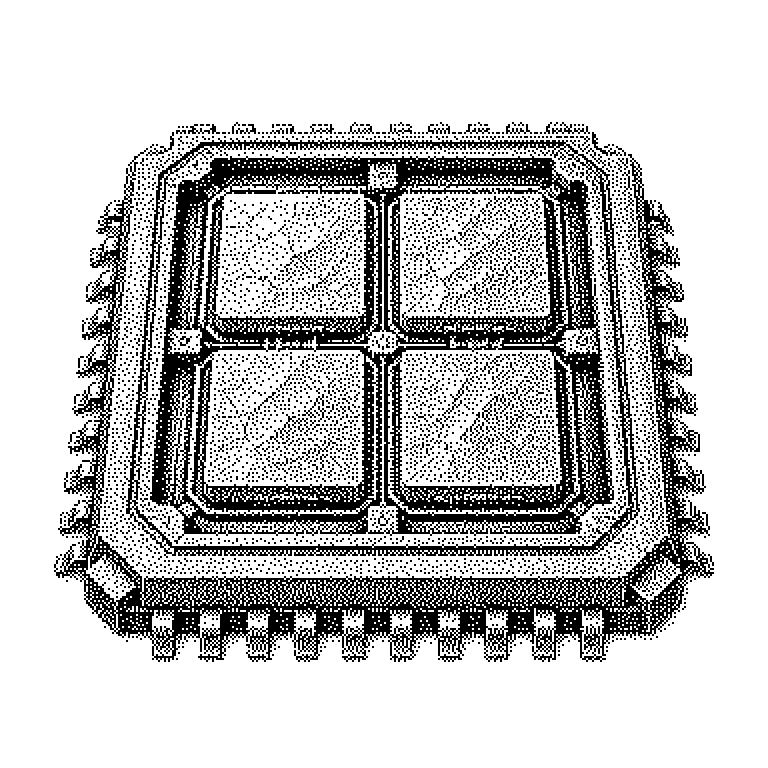
Quad-Die Design
A quad-die design is a computer chip made up of four separately manufactured silicon dies that sit in a shared package and function as a single chip. The approach increases computing power without requiring a single die to become prohibitively large.
A computer chip is made from a thin slice of silicon. Small rectangular pieces are cut from this slice, each carrying the actual circuitry. Such a piece is called a die in technical language, pronounced like the English word for a single dice cube. In a quad-die design, the manufacturer places not just one but four of these pieces into a shared package. They are connected to each other via very short traces and appear externally as a single chip. To the computer using it, this looks like one especially powerful component.
Why four small dies are cheaper than one
During silicon manufacturing, tiny defects inevitably occur. They are distributed more or less randomly across the entire wafer. A die with a defect in the wrong spot is unusable and gets discarded. The larger a die is, the more likely it is to be hit by one of these defects. The proportion of usable dies is called yield, and it drops dramatically for large areas.
This is exactly where the economic appeal lies. Four small dies, each a quarter of the size, together achieve a significantly higher yield than a single large one. If one fails, you only lose a quarter instead of the entire chip. With modern manufacturing processes, a single silicon wafer can quickly cost more than twenty thousand dollars. A few percentage points of yield can then make the difference between profit and loss.
On top of that, there’s a physical limit. The machines that expose the circuitry onto the silicon can only process a field of about 26 by 33 millimeters at a time. Technically, a single die can hardly be made larger than that. Anyone wanting more computing power in one component must therefore combine multiple dies.
Four dies, one shared package
The four dies sit on a shared carrier board, known as the interposer. This board contains thousands of fine traces and connects the dies to one another. Because the distances are only a few millimeters, data flows much faster there than between two separate chips on a circuit board. Some manufacturers even stack the dies on top of each other and connect them through vertical channels in the silicon.
Not all four dies need to do the same thing. Often two are responsible for computation and two for memory or input and output. They can even be manufactured in different factories using processes of varying maturity. This design approach built from specialized sub-components is called chiplet design, and the quad-die design is a special case of it with exactly four parts.
This advantage doesn’t come entirely for free. Every connection between two dies costs a bit of time and energy. Software that constantly shuffles data back and forth between the four parts runs slower than on a true single chip. Additionally, a lot of waste heat is generated in a tight space, which must be cooled.
Quad-die in graphics cards and data centers
Such designs are most commonly mentioned in the context of accelerators for artificial intelligence. The large chips from Nvidia, AMD, and Intel have long since stopped being made from a single piece of silicon. When a manufacturer announces a new generation and talks about doubled performance, this is often simply due to double the number of dies. Server processors have also used this principle for years.
In everyday life, the term is rarely encountered, but it appears all the more often in quarterly earnings and analyst reports. There, the discussion revolves around yield, packaging capacity, and supply bottlenecks for exactly these packages. Packaging has now become its own bottleneck: there are only a few factories worldwide capable of assembling multiple dies with sufficient precision. Anyone reading about chip stocks will regularly come across this topic.