Quantum Chromodynamics
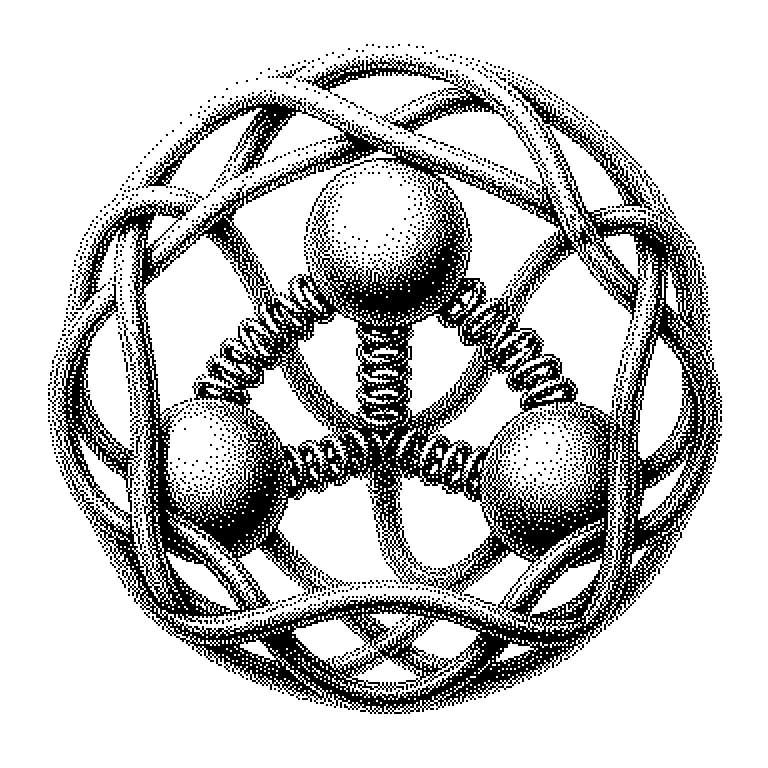
Quantum chromodynamics is the physical theory that describes how quarks – the smallest known building blocks of matter – are held together by the so-called strong nuclear force. It explains why protons and neutrons in the atomic nucleus are stable, and it is part of the Standard Model of particle physics.
Quantum chromodynamics describes the strongest of the four known fundamental forces of nature: the strong nuclear force. This force holds quarks – the tiny building blocks that make up protons and neutrons – together. Without it, every atomic nucleus would instantly fall apart. The name sounds complicated, but behind it lies a simple principle: “Quantum” stands for the world of the smallest particles, “chromo” comes from the Greek word for color – not because quarks actually have color, but because physicists named a property of quarks after the concept of color to make it mathematically tractable. The theory was developed in the 1970s and has since been a core component of the Standard Model of particle physics, the set of rules that describes all known fundamental building blocks of matter and their interactions.
Why quarks cannot exist on their own
A central result of quantum chromodynamics is the so-called confinement: quarks never occur individually in nature. They are always bound in groups – in pairs or in threes. If you try to pull a quark out, the force between the quarks does not weaken but grows stronger. This is the exact opposite of what we know from gravity or electricity, where the force decreases with distance.
This has a startling consequence: if you put enough energy into trying to separate a quark, that energy does not produce a free quark, but a new quark pair. Nature prefers to create new particles rather than release a single quark. This property makes quantum chromodynamics one of the most unusual theories in physics.
Color charge and gluons as carriers of the force
In quantum physics, forces are transmitted by particles. For gravity, this is theoretically the graviton; for the electromagnetic force, it is the photon – the particle of light. The strong nuclear force is transmitted by particles called gluons. “Gluon” derives from the English word “glue” – a fitting name, since gluons literally hold the quarks together.
Quarks do not carry electric charge, but rather a so-called color charge. This can take the values red, green, or blue – purely as a convention, not as an actual color. A stable particle must be “color neutral,” meaning it must contain all three colors in equal parts or combine a color with its anti-color. This explains why protons consist of exactly three quarks: red + green + blue yields color neutrality. Gluons are special in this regard: they themselves carry color charge and therefore also interact with one another, which is not the case with photons.
The mathematics behind this theory is considerably more complex than that of the other fundamental forces. Many calculations cannot be solved exactly, but only approximated through elaborate computer simulations – a field of research known as lattice QCD, which requires dedicated supercomputers.
QCD in experiments and in the news
Quantum chromodynamics is not a purely theoretical construct. At CERN in Geneva, home to the world’s largest particle accelerator, the LHC, predictions of QCD are tested daily. When scientists there collide protons at nearly the speed of light, conditions similar to those shortly after the Big Bang briefly emerge. The particle showers produced in the process can only be correctly described using QCD.
This research is also the origin of the term “quark-gluon plasma,” which occasionally appears in science news. It refers to a state of matter in which quarks and gluons are no longer bound within protons or neutrons, but move freely – just as they did in the first microseconds after the Big Bang. At CERN, researchers have succeeded in briefly producing this state in the laboratory.
A common misconception is confusing QCD with quantum electrodynamics (QED), which describes the electromagnetic force. QCD and QED are similar in mathematical structure, but the color charge of the gluons makes QCD considerably more difficult to calculate. Together, both are indispensable parts of the Standard Model.