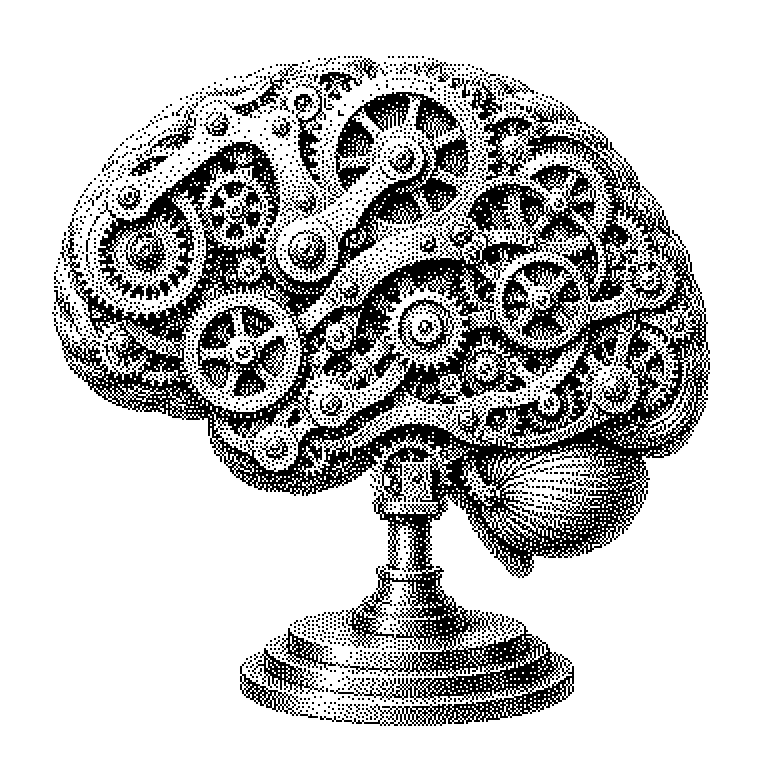
Functionalism
Functionalism is a philosophical thesis according to which mind and consciousness are not defined by their physical substrate but by what they do — that is, by their function. In AI research, this idea is fundamental: it suggests that a computer could think if it performs the same functions as a human brain.
Functionalism is a philosophical idea about the human mind. It holds that what matters is not what something is made of, but what it does. A mental state — pain, for example — is defined by its role within the system: it is triggered by a cause, it produces a response, it stands in relation to other states. Whether this state occurs in a brain made of neurons or in a circuit made of silicon is, according to this thesis, irrelevant. What counts is the function, not the material.
Why functionalism shapes the AI debate
Without functionalism, the question of whether machines can think would be quickly answered: a computer is not a brain, so it cannot think. Functionalism opens up this debate. It allows the question to be asked seriously, without dismissing it from the outset with a reference to biology.
This has far-reaching consequences. If thinking is a matter of function, then it is in principle executable on different substrates — on neurons, on transistors, perhaps on something entirely different. Researchers and philosophers then speak of “multiple realizability”: the same mental function, many possible physical implementations. This idea is the foundation on which a large part of AI research rests.
However, functionalism is contested. Critics ask: Is it really enough to deliver the right inputs and outputs? Or is something still missing — such as conscious experience, so-called qualia? This counter-position is the trigger for one of the most important debates in the philosophy of mind.
Functions instead of substance — the basic principle
The core of functionalism can be shown with a simple comparison. A mousetrap and a cat fulfill the same function: they catch mice. No one would say they are therefore the same. But when one asks what makes a mousetrap a mousetrap, the answer is functional — not material. Functionalism transfers precisely this principle onto the mind.
In technical language, mental states are therefore described through their causal roles: what triggers them, what they bring about, how they are linked to one another. Pain is not defined as a specific nerve, but as a state that arises from tissue damage, triggers withdrawal behavior, and influences other states such as fear or attention. This description holds regardless of whether it takes place in a human, an octopus, or theoretically in a machine.
An important objection is the thought experiment of the “Chinese Room” by the philosopher John Searle. In it, a person who does not speak Chinese follows rules to answer Chinese questions in writing — correctly, but without understanding. Searle argues that even a computer that fulfills all the functions does not truly understand anything. Functionalism and this counterargument remain unresolved side by side to this day.
Where the term appears today
When companies like OpenAI or Google DeepMind are asked whether their systems “understand” or merely “compute,” the core issue is functionalism. Anyone who says that a large language model — that is, an AI system that processes and generates text — truly understands what it writes is arguing functionalistically: the model produces the same outputs as a human, so it fulfills the same function.
In debates about AI consciousness, machine rights, or the question of whether AI systems deserve moral consideration, functionalism appears regularly — often without the word itself being mentioned. As soon as someone argues that a system is “intelligent” because it behaves like an intelligent being, functionalist logic lies behind it.
Functionalism also plays a role in research on so-called “artificial neural networks” — computer models loosely modeled on the structure of the brain. The question of whether these networks truly replicate the cognitive functions of the brain or merely produce similar results remains open to this day. Functionalism provides the framework within which this question can be posed at all.