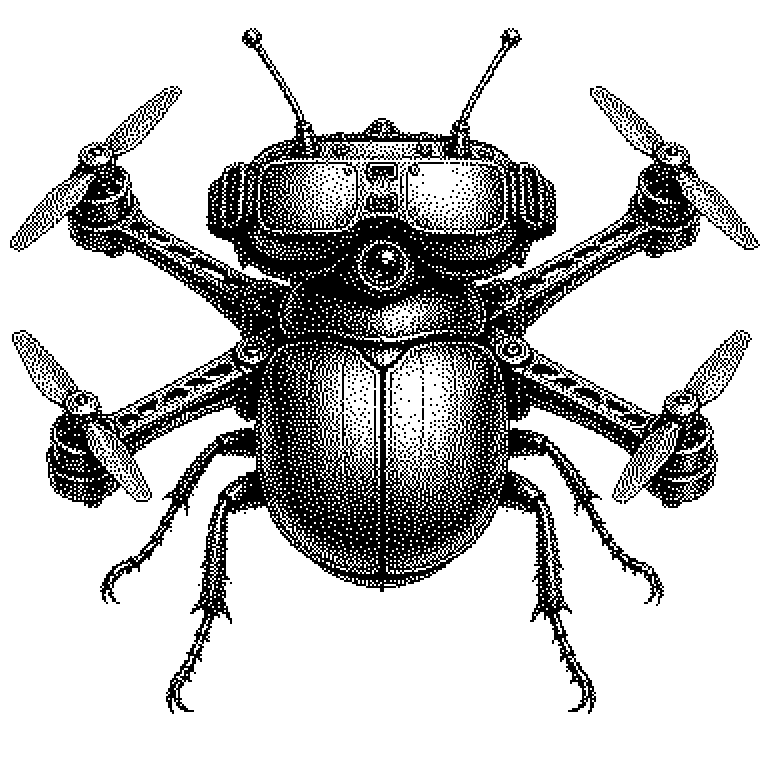
FPV Drone
An FPV drone is a small aircraft equipped with a camera whose image is transmitted live to a pair of goggles worn by the pilot. Instead of steering from an outside view, the pilot sees the world as if sitting inside the drone itself.
An FPV drone is usually a small, unmanned aircraft with four propellers and a camera mounted at the front. The abbreviation FPV stands for “First Person View,” meaning the view from a first-person perspective. The camera image is sent by radio in real time to a pair of video goggles or a screen used by the pilot. As a result, the pilot does not see the drone from the outside, but rather what the drone itself sees. It is controlled with a remote control whose sticks set thrust and direction of rotation. The difference from a normal camera drone is significant: FPV models are built for agility and speed, not for smooth, hovering shots.
From hobby sport to an instrument of war and industry
FPV drones originated in model building. In the 2010s, this gave rise to racing series in which pilots fly at speeds of up to 100 km/h through illuminated courses. Because the technology consists of standard parts, it has remained cheap. Depending on the equipment, a simple racing model costs a few hundred euros.
It is precisely this low price that has brought the term into the news. In the war in Ukraine, FPV drones are being used by the millions as weapon carriers. A drone costing a few hundred euros can hit a vehicle worth many times that amount. Military procurement, which usually operates on a timescale of years, here collides with DIY equipment from online retailers.
For business and politics, this is relevant for two reasons. First, entire branches of industry are emerging that manufacture drones, radio technology, and defense systems. Second, the question arises of how to detect and stop such devices near airports or power plants. Both factors are driving investment into a market that did not exist in this form ten years ago.
What happens between the camera and the goggles
At its core, an FPV drone consists of just a few components. Four motors with propellers generate thrust, a battery supplies power, and a flight controller regulates everything. This flight controller is a small computer equipped with attitude sensors. Thousands of times per second, it balances the rotational speed of the individual motors so that the drone does not tip over.
The camera sends its image to a video transmitter, which relays it by radio to the goggles. The crucial factor here is the delay, known in technical terms as latency. In good systems, it is under 30 milliseconds. If it were significantly higher, the pilot would be reacting to a situation that no longer exists.
Artificial intelligence is playing an increasing role, but it is often overestimated. Common are image-processing methods that recognize a target or a point on the ground and let the drone steer itself toward it for the final few meters. This helps when the radio link is disrupted. However, this does not amount to a drone that plans entirely on its own. A common misconception is to assume that every FPV drone is autonomous; as a rule, a human is sitting at the controls.
Racetrack, film set, and headline
FPV drones are most visible in film. Shots that fly in a single continuous take through an entire restaurant or a stairwell almost always come from a device like this. Ski races and cycling races are also covered with them, because the drone can closely follow the athlete. Major manufacturers now sell ready-to-fly models complete with goggles as a set.
Anyone who wants to fly one themselves needs to register as a drone operator in the EU and, in most cases, provide proof of an online training course. Flights over crowds, near airports, or beyond visual line of sight are heavily restricted. When flying FPV with goggles, the rules also require a second person to keep the drone in sight.
In business news today, the term mainly appears in two contexts: defense contracts and so-called drone defense. When an airport halts operations due to a sighting, it is almost always these small aircraft that are involved. The term thus links together a hobby, a filmmaking technique, and a security-policy debate.