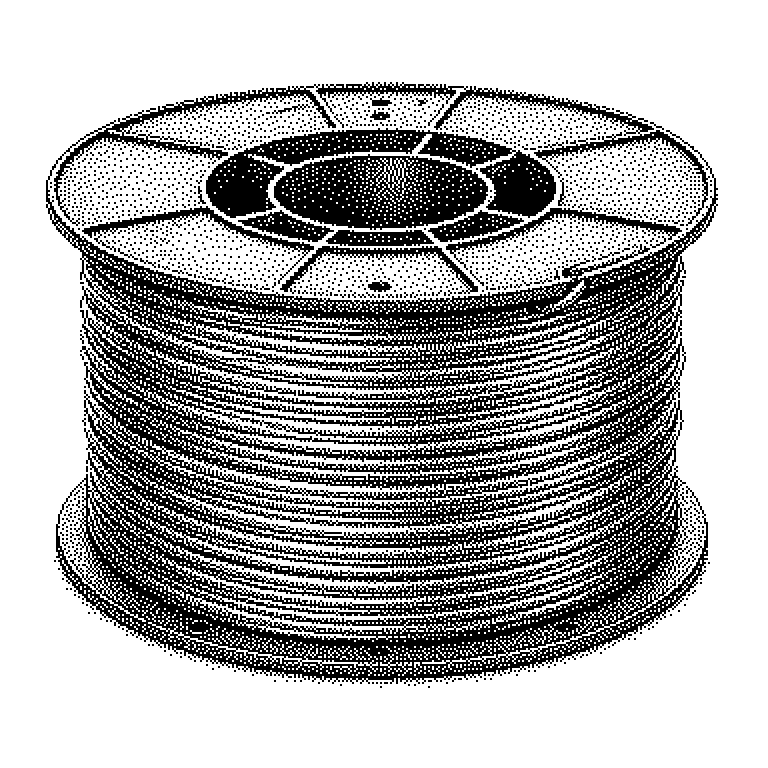
Filament
Filament is the coiled plastic wire that the most common type of 3D printer uses as material. The wire is melted in the print head and applied layer by layer to build up a workpiece.
A 3D printer doesn’t carve objects out of a block, but builds them up in thin layers. In the most common design, it needs a long, thin plastic wire to do this. This wire is called filament. It is usually 1.75 millimeters thick and comes on a spool with typically one kilogram of material. The printer draws in the wire, heats it to about 200 degrees, and pushes the soft mass through a fine nozzle. Think of it like a very precise hot glue gun controlled by a computer.
Why the spool determines the result
In 3D printing, the material is not a side issue. It determines how sturdy, how heat-resistant, and how attractive the finished part turns out. The same printer delivers very different results with different filaments. That’s why users in forums often talk more about material than about devices.
Filament is also the ongoing cost factor. The printer is bought once, but the material is consumed again and again. A standard spool costs roughly 15 to 40 euros depending on the type. A small component often needs just a few grams, meaning cent amounts. Large objects, on the other hand, can quickly devour an entire spool.
A common misconception: filament is supposedly just plastic and therefore interchangeable. In fact, cheap material often draws moisture from the air. When heated, this moisture evaporates and the print develops bubbles and cracks. Professionals therefore store their spools in airtight boxes with desiccant.
From wire to layer
The material’s path through the printer has just a few clear stages. A pair of gears, the extruder, grips the wire and pushes it forward. Behind it sits a heated metal block, the hotend, where the plastic softens. At the very front is the nozzle with an opening usually 0.4 millimeters wide. From it emerges a trace about as thin as a sheet of paper.
The print head moves this trace along the outlines of the respective layer. Afterward, the build plate lowers a bit, or the head moves up. Then the next layer follows, sticking to the still-warm layer beneath it. A palm-sized object can thus quickly consist of several hundred layers.
The most common types differ in their behavior. PLA is derived from corn starch, prints without much fuss, and is ideal for models and decorative items. PETG is tougher and handles moisture better, making it suitable for everyday brackets. ABS withstands higher temperatures but warps easily and smells unpleasant while printing. There are also filaments with additives such as wood fibers, carbon fiber, or metal powder.
From the hobby basement to the industry trade show
In schools, libraries, and open workshops, 3D printers are now often freely accessible. Anyone printing there usually pays according to the weight of filament used. Manufacturers of spare parts also use the process when an injection mold isn’t worthwhile. A single gear for an old device can thus be finished in an hour.
In business news, the term usually appears in connection with additive manufacturing, the technical term for all build-up manufacturing processes. Companies like Prusa, Bambu Lab, or Ultimaker sell printers and material as a package. The business model resembles that of inkjet printers: the device is cheap, the consumable generates revenue.
Filament also becomes interesting in debates about sustainability. Failed prints and support structures generate a lot of plastic waste. That’s why there are devices that shred old prints and draw new filament from them. Whether this works on a large scale remains an open question.