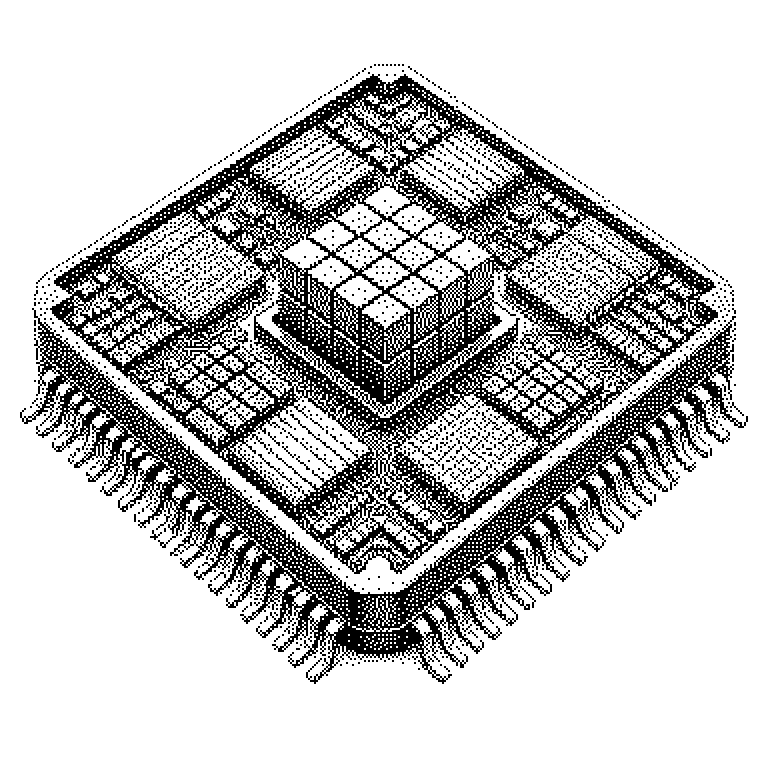
Turing AI Chip
The Turing AI chip is a generation of graphics chips from the company NVIDIA, introduced in 2018, that for the first time brought dedicated compute units for artificial intelligence to a consumer chip. These so-called tensor cores made Turing a forerunner of today's AI accelerators in data centers.
Turing is the name of a chip design from the US company NVIDIA, introduced in 2018. Chips of this design are found, for example, in graphics cards such as the GeForce RTX 2080. Graphics cards were originally meant to calculate images for computer games. Turing was one of the first designs to additionally bring along circuits specifically built for artificial intelligence. This meant that computing power for learning programs landed in ordinary gaming PCs for the first time, and not only in expensive servers. The name recalls Alan Turing, a British mathematician considered one of the founders of computer science.
The moment graphics cards became AI machines
At its core, an AI model consists of huge tables of numbers that are constantly multiplied with one another. A computer game needs exactly this kind of calculation too, when it renders light, shadow, and motion. That is why graphics chips were already interesting for AI even before Turing. With Turing, NVIDIA used this dual use openly as a selling point for the first time.
Economically, this was a turning point. Until then, NVIDIA had sold mainly to gamers. From Turing onward, the business with data centers grew strongly, and today it makes up the largest share of revenue. When business news reports that NVIDIA has risen to become the world’s most valuable company, this story begins with chip generations like Turing.
An important distinction: Turing is not the chip on which ChatGPT runs today. Newer generations, bearing names like Ampere, Hopper, or Blackwell, have long taken over that role. Turing is regarded as a precursor. That is why one often encounters the name in retrospectives or with used hardware.
Tensor cores, RT cores, and what they do
A Turing chip contains three kinds of compute units. The classic shader units handle the normal graphics work. In addition came so-called RT cores, which calculate light rays in games realistically. And finally the tensor cores, which are responsible for AI.
A tensor core can only do a single thing, but does it extremely fast: it multiplies small tables of numbers and adds up the result. You can think of it like a specialist on an assembly line. He knows no other task, but performs his own a hundred times faster than an all-rounder would need for one. AI calculations largely consist of exactly this kind of task.
On top of that comes a trick called low precision. Instead of storing numbers with very many decimal places, tensor cores deliberately calculate more coarsely. For AI this is usually enough, because the final result is a probability and not an exact number. Calculating more coarsely means less memory and more speed. All of today’s AI chips use this principle.
From DLSS in games to mentions in the business section
The most direct encounter with Turing happens while gaming. The technology DLSS lets the game render at a lower resolution and then upscales the image afterward using an AI model. The result looks almost as sharp as a genuine high-resolution image, but costs less computing time. The tensor cores run the model in this process.
Outside of games, Turing appeared in video conferencing, for instance when blurring the background or removing background noise. Students and small companies also used such cards to train their own AI models, because they were considerably cheaper than server hardware.
In the news today, the name is mostly encountered in connection with chip generations and export rules. The United States restricts which AI chips may be sold to China. Older designs like Turing often fall below the thresholds, while newer ones do not. A common misconception, by the way, is that Turing is a chip made only for AI. It is a graphics chip that can additionally do AI.