Thomson model
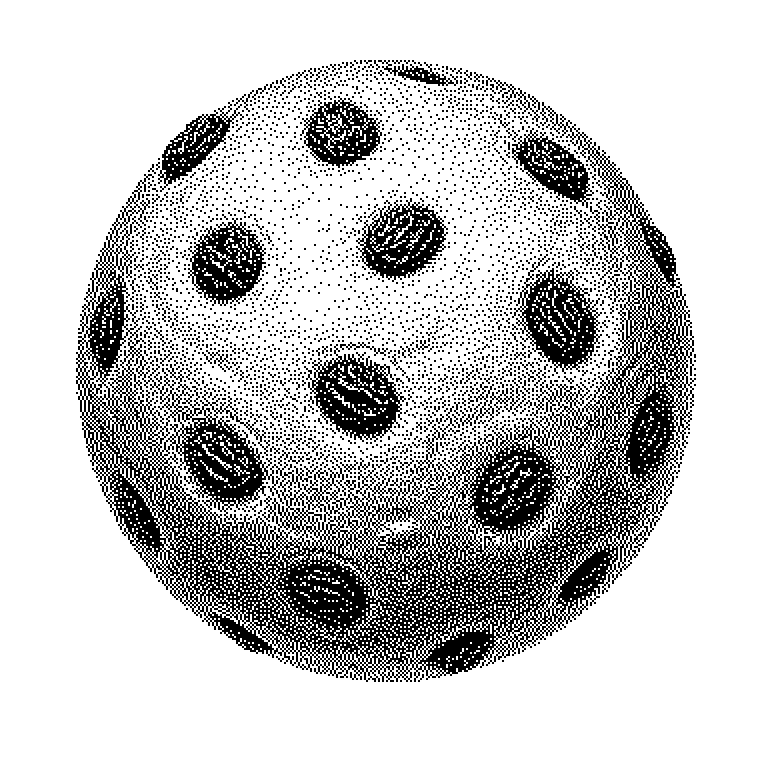
The Thomson model is a concept of atomic structure dating from 1904. It describes the atom as a uniformly positively charged sphere in which negatively charged electrons are embedded like raisins in a cake.
All substances are made up of tiny building blocks called atoms. For a long time, these building blocks were thought to be indivisible. However, in 1897 the British physicist Joseph John Thomson discovered even smaller particles, which we today call electrons. Electrons carry a negative electric charge, whereas atoms show no charge at all from the outside. In 1904, Thomson therefore proposed an image that brought both facts together: the atom is a soft sphere of positive charge, with the tiny electrons distributed within it. Because the positive and negative charges balance each other out, the atom appears electrically neutral from the outside.
The first glimpse inside the atom
The Thomson model was the first serious attempt to describe the interior of an atom. Before this, the atom was considered the smallest, indivisible unit of matter. Thomson’s experiments showed that this was wrong. This marked the beginning of modern atomic physics, from which chemistry, semiconductor technology, and nuclear energy later emerged.
The model is also important as a lesson in how natural science works. Thomson did not simply make a claim out of thin air; instead, he constructed an image that fit the measurements known at the time. Precisely because of this, it was testable. A model that predicts nothing cannot be disproven either.
As early as 1909, the model failed. Ernest Rutherford fired charged particles at an extremely thin gold foil. Most of them passed straight through, but a few bounced almost straight back. With a uniformly soft sphere of charge, this would be impossible. So the positive charge had to be concentrated in a tiny, very dense point: the atomic nucleus.
Raisins in the cake batter
The most well-known description of the model is the raisin cake. The batter is the positively charged mass that fills the entire space of the atom. The raisins are the electrons, small and scattered throughout the batter. In English, this image is called the plum pudding model, named after a British raisin dessert.
Behind this lies a simple physical reasoning. Like charges repel each other, unlike charges attract. The electrons are therefore attracted by the positive sphere but repel each other. These two forces result in an even distribution. Thomson even calculated in which rings the electrons should be arranged.
A common misconception: the Thomson model does not yet include an atomic nucleus or orbital paths. Both of these came later, with Rutherford and Niels Bohr. Even today’s picture is not the one proposed by Bohr. Modern physics does not describe electrons as tiny spheres moving in orbits, but as a probability of presence within a cloud surrounding the nucleus.
Where you encounter the raisin cake image today
The Thomson model appears in almost every physics and chemistry class. It stands at the beginning of a series of models that become progressively more accurate. No textbook claims that the model is correct. It serves as an intermediate step, showing how an experiment can overturn a theory.
Outside of school, the term is often used in a figurative sense. When someone says in a text that an idea is at the level of the raisin cake model, they mean it is outdated but historically understandable. Such comparisons can also be found in technology and business articles, for example when describing an early understanding of artificial intelligence.
Thomson’s work still has an impact on technology today. The tube he used to study electrons was the precursor to old television screens. And the electrons themselves are what flows through every cable and every computer chip. The model is outdated, but the particle it discovered is not.