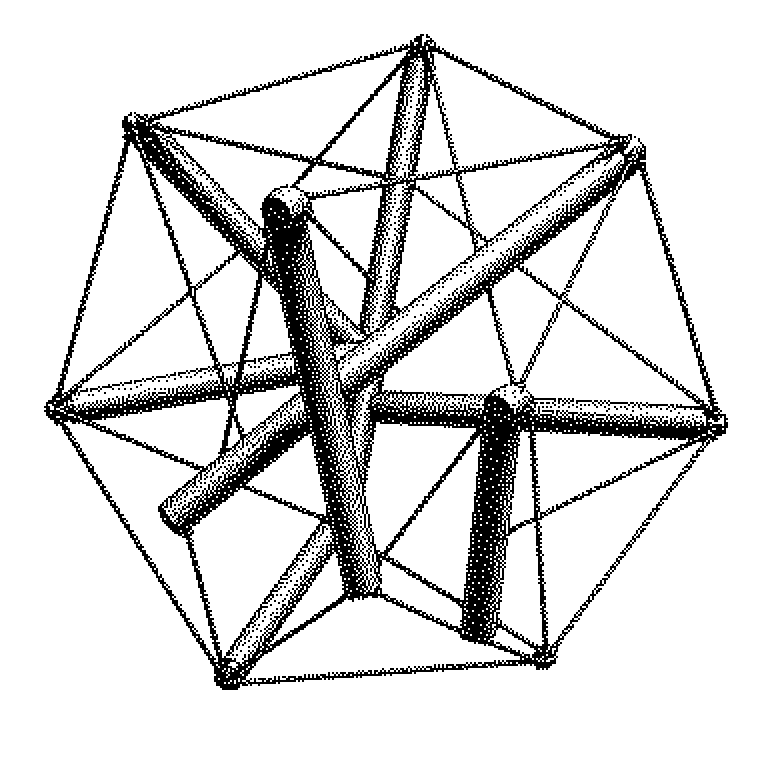
Tensegrity
Tensegrity describes a construction principle in which rigid struts and tensioned cables work together to create a stable structure, without the struts ever touching each other. The concept appears in architecture, robotics, and even in the biology of the human body.
Tensegrity is a construction principle in which solid struts and cables or cords under tension jointly produce a stable form. The special feature: the struts never touch one another. They appear to “float” in space, held together solely by the pulling forces of the cables. The name is a combination of the English words “tensional” (subjected to pulling force) and “integrity” (cohesion). The result are structures that are both lightweight and astonishingly load-bearing.
Stability without contact
In classic buildings, solid parts are stacked on top of one another — one stone carries the next, and pressure is passed downward. Tensegrity partially reverses this principle. Here, pulling forces hold the structure together, not pressure forces running from top to bottom. This makes the construction considerably more efficient: less material is needed for the same load-bearing capacity.
Another advantage is flexibility. Tensegrity structures can absorb shocks and deformations because the cables give way and distribute the force across the entire network. A rigid framework would break at a single point. A tensegrity structure yields and springs back — similar to a net that catches a ball instead of repelling it.
The interplay of compression and tension
Every tensegrity structure consists of exactly two kinds of elements. The struts carry compression forces: they are pressed together and want to move apart. The cables carry tension forces: they are stretched and hold the struts in place. Both forces are in equilibrium. If you change the tension of a single cable, the entire structure immediately feels this change.
This global equilibrium is the crucial difference from ordinary frameworks, where individual struts can often be replaced without the rest changing. In tensegrity, every element is networked with the entire system. This makes calculating such structures mathematically demanding — and at the same time particularly interesting for simulations and AI-assisted design processes.
A simple example to picture: take three struts and connect their ends with six cables so that no strut touches another. If the cables are tensioned correctly, the structure holds its shape — floating freely in the air, without a base, without glue. This exact model is the best-known tensegrity object and can be rebuilt with a bit of patience using wooden rods and rubber bands.
Tensegrity in architecture, robotics, and biology
In architecture, the American inventor and architect Buckminster Fuller made the principle well known starting in the 1940s. Today it can be seen in sports stadiums whose wide-spanning roofs are carried by a network of cables instead of massive supports. The roof of the Munich Olympic Stadium from 1972 is considered an early relative of this idea.
In robotics, tensegrity is used to build soft, shock-resistant robots. NASA has developed tensegrity robots intended to land on other planets: they can absorb an impact because their structure deforms instead of breaking. Afterwards, they roll across the terrain like a cage. Such robots have no rigid joints and are therefore robust against unforeseen obstacles.
A particularly surprising perspective comes from biology. The physician Donald Ingber argued in the 1990s that cells are built according to the tensegrity principle. The internal scaffolding of a cell — so-called cytoskeletal fibers, i.e. a network of thread-like protein structures — behaves like the cables and struts in a tensegrity model. This would explain why cells can sense and respond to mechanical forces from outside. Tensegrity is thus not just an engineering principle, but possibly a fundamental principle of life itself.