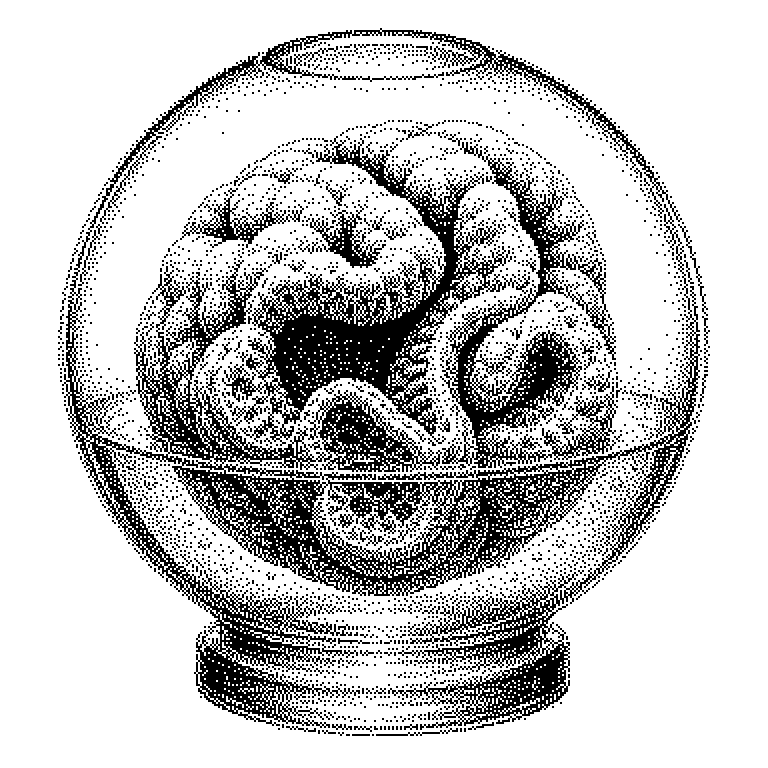
Organoid
An organoid is a tiny piece of tissue grown in the lab that replicates the structure of a real organ on a small scale. Researchers use these mini-organs to study diseases and medications without burdening humans or animals.
An organoid is a very small piece of tissue that grows in the lab from living cells. It is usually only about the size of a pinhead, sometimes a few millimeters. Inside, the cells arrange themselves similarly to how they would in a real organ, such as the intestine, liver, or brain. That’s why they’re colloquially called mini-organs. However, an organoid is not a functioning replacement organ: it has no blood vessels, no nerves connecting to the rest of the body, and cannot keep anyone alive. It is a model, a simplified replica used to observe something.
What mini-organs offer medicine
Until now, new medications have been tested in three steps. First on cells in a flat dish, then on animals, and afterward on humans. Each of these steps has weaknesses. Flat-grown cells behave differently than tissue in the body. And a mouse is not a human—its metabolism often reacts completely differently to a drug.
Organoids close this gap to some extent. They consist of human cells and are three-dimensional in structure. A liver tumor organoid reacts to a cancer drug more similarly to a real tumor than a layer of cells in a dish does. This saves time and reduces the number of animal experiments. Around nine out of ten drugs fail in clinical trials in humans, even though they worked in animal testing. Better models could improve this rate.
There’s also a point that makes medicine personal. Organoids can be grown from the cells of a single patient. These miniatures can be used to test which of five medications works for exactly this person. This is already being applied in cystic fibrosis, a genetic disease.
From stem cell to tissue clump
It always starts with a stem cell. This is a cell that can still transform into various cell types, such as an intestinal cell or a nerve cell. Such cells are obtained from a tissue sample. Ordinary skin cells can also be chemically reverted to a stem-cell-like state in the lab.
These cells are placed in a soft gel that resembles the connective tissue in the body. The gel provides support so the cells don’t spread out flat. Then signaling substances, so-called growth factors, are added. They act like instructions: become an intestinal cell, divide, migrate outward.
The crucial point is that no one builds the structure. The cells organize themselves. In a sense, they know the blueprint from embryonic development and form folds, cavities, and layers on their own. After a few weeks, a small clump lies in the gel that looks remarkably real under the microscope. But this is also where the weakness lies: each organoid grows somewhat differently, and the results vary.
Organoids in research, business, and headlines
In the news, organoids usually appear in three contexts. First, in cancer research and personalized therapy. Second, in the debate about animal testing, since authorities such as the US Food and Drug Administration now explicitly permit other testing methods as well. Third, in brain organoids, which raise ethical questions.
Brain organoids are small spheres of cells made from nerve cells that emit measurable electrical signals. Some companies connect them to electrodes and call this biological computing. It’s important to keep this in perspective: such spheres have a few million cells, while a human brain has around 86 billion nerve cells. This is very far from consciousness, even if headlines sometimes make it sound otherwise.
Economically, this field is interesting because biotechnology and artificial intelligence intersect here. Thousands of organoids generate huge amounts of microscope images. Software automatically detects which sample reacts to a drug. Several young companies sell exactly this combination of mini-organs and automatic image analysis to pharmaceutical companies.