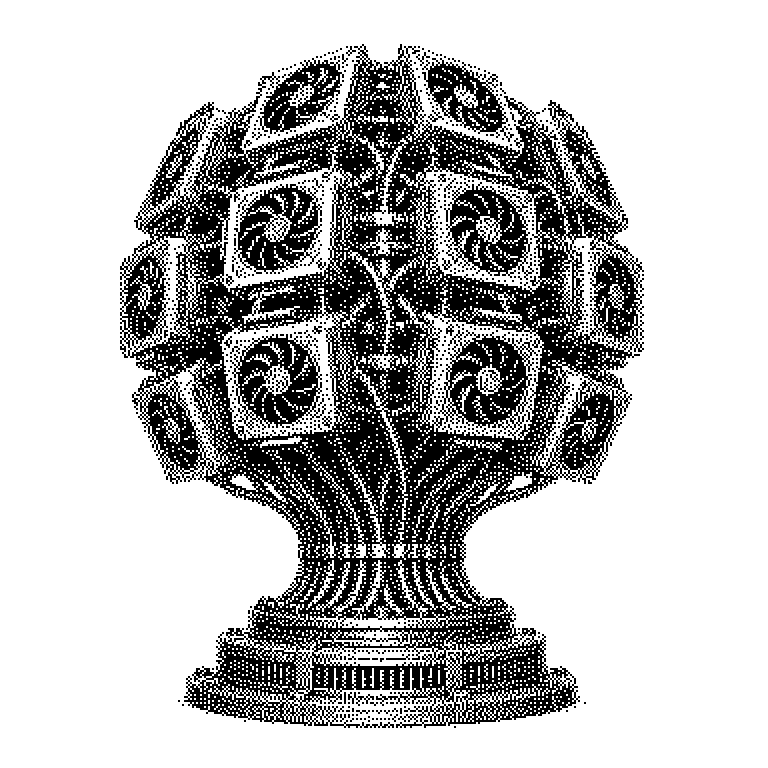
GPU Cluster
A GPU cluster is a large collection of specialized computing chips connected by high-speed cabling that work together on a single task. Such installations are the machines on which modern AI models are trained and operated.
Every computer contains a main processor that works through computational steps one after another. Alongside it there is a second type of chip, the graphics card, or GPU for short. It was originally intended for video games and can carry out thousands of simple calculations simultaneously. Artificial intelligence needs exactly this kind of calculation in gigantic quantities. Because a single such card is far too slow for large AI systems, many of them are connected together. An installation of hundreds or thousands of connected cards like this is called a GPU cluster.
Why no large language model can emerge without a cluster
A modern AI model learns by working through billions of text examples. In doing so, it repeatedly makes tiny adjustments to countless internal numerical values. On a single graphics card, this process would take many decades. Distributed across ten thousand cards, it shrinks to weeks. Large-scale AI is therefore not just a matter of good ideas, but also a matter of available hardware.
This makes such installations an economic power factor. A single high-performance AI chip often costs several tens of thousands of euros. Anyone buying ten thousand of them is spending sums in the billions, plus buildings, cooling, and electricity. Only a few corporations and states can afford this. That is why reports about new GPU clusters regularly appear in business news.
Energy consumption is also an issue. Large installations require power on the scale of a small city’s power plant. Operators therefore situate them where electricity is cheap and plentiful. Discussions about data centers and climate protection almost always revolve around these clusters.
How thousands of cards become one machine
The structure is layered. Several GPUs are housed in one server, a flat device about the size of a pizza box. Many servers are stacked on top of one another in a cabinet, the rack. Many racks stand in rows in a hall. Everything is held together by a network that connects the cards at extremely high speed.
This network is actually the tricky part. During training, each card computes on a portion of the problem and must then reconcile its intermediate result with all the others. If this reconciliation happens too slowly, the cards sit idle. This is often compared to group work: if everyone has to exchange intermediate progress after every sentence, it is not the speed of the individuals that matters, but the coordination. That is why operators rely on specialized connections that are much faster than ordinary network cables.
Practical problems come on top of this. The chips generate so much waste heat that air cooling is often no longer sufficient, and water is routed through the servers instead. With thousands of components, something is also constantly failing. The software must therefore regularly save the training run and, after a fault, resume from the last save point.
Clusters in the headlines and in your own power outlet
You practically never see a GPU cluster directly, yet you use one constantly. Every chatbot response and every generated image is produced in a data center on such cards. Translations, voice assistants, and recommendations on video platforms also run there. Your own phone merely sends the request and displays the result.
In the news, the term usually appears in three forms. First, as an investment announcement, when a corporation announces a new data center. Second, in connection with export rules, because states restrict the sale of AI chips abroad. Third, as an explanation for supply bottlenecks, when manufacturers cannot meet the demand for chips.
A common misconception is that a GPU cluster is simply a particularly fast computer. It is more like a team made up of many computers, whose performance depends heavily on how well they work together. Related, but not the same, is the term cloud: there, you rent computing time on someone else’s hardware instead of building your own hall. Small research groups and start-ups take exactly this route, because a cluster of their own would be unaffordable for them.
