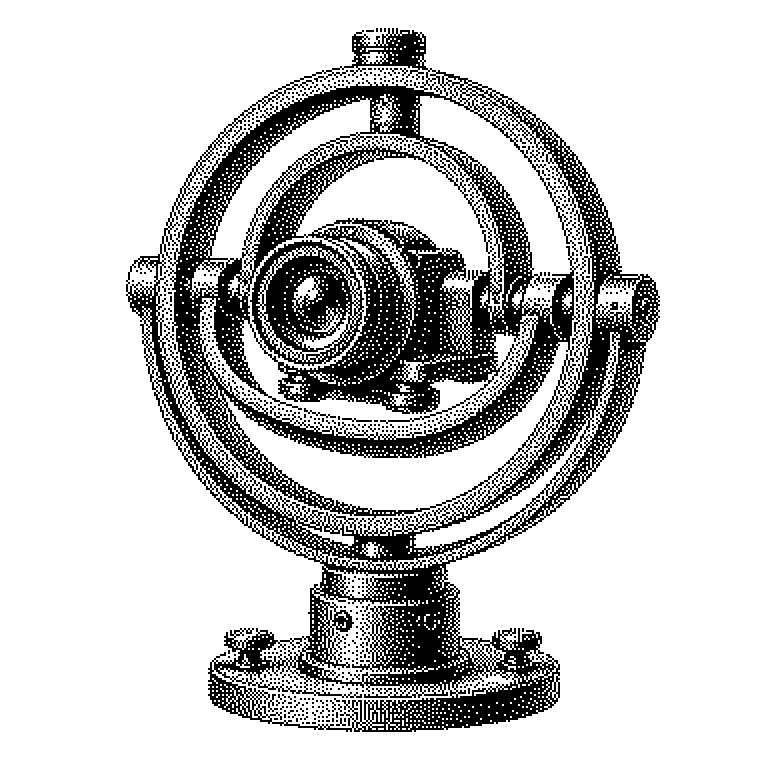
Gimbal
A gimbal is a movable suspension made of several rotating rings that holds an object steady while everything around it moves. It is best known as a mount that stabilizes cameras on drones or in handheld devices.
A gimbal is a movable mount for objects. It consists of several rings or brackets nested inside one another. Each ring can rotate around its own axis. This keeps whatever hangs in the middle steady, even when the outer frame tilts or wobbles. The best-known example is a camera under a drone: the drone tilts in the wind, yet the image stays level. The idea is old and was once used for ship compasses and oil lamps on board.
Why steady images are more than just aesthetics
A shaky image doesn’t just look unattractive. It’s also hard for software to analyze. Programs that recognize objects in videos need footage that is as stable as possible. Shaky images are blurry, and blur reveals very little.
That’s exactly why gimbals matter for many technical systems. A drone inspecting power lines for cracks must aim the camera precisely at a single point. A delivery robot detecting obstacles needs an image without jitter. Self-driving vehicles also use stabilized sensors so their measurements remain reliable.
There’s also an economic angle. Without a gimbal, one would have to remove shake afterward using software. That costs computing power and crops the edges of the image. A mechanical gimbal solves the problem directly at the source, usually more cheaply and reliably.
Three axes, motors, and an orientation sensor
Each rotational axis of a gimbal has its own name. Pitch means tilting up and down. Roll means tilting sideways. Yaw means turning left and right. A gimbal with all three axes is called a three-axis gimbal and compensates for practically any movement.
Early gimbals worked purely mechanically. The camera hung in such a way that gravity pulled it level on its own. Modern gimbals are actively controlled. A small orientation sensor measures many times per second how the mount is positioned. Electric motors then immediately counter-rotate.
The control system behind this is a simple feedback loop: measure, calculate deviation, correct, measure again. This is reminiscent of a person carrying a full glass through a moving bus. They feel every movement and constantly adjust their hand. The difference is speed. A gimbal corrects several hundred times per second, far faster than any human.
From drones to phone mounts
Gimbals are most commonly found on camera drones. Almost every drone made for filming has such a suspension built in. Gimbals are also sold commercially as handheld grips into which you clamp a smartphone. They often cost between 100 and 200 euros and keep videos steady while walking.
A related concept is optical image stabilization in phones. There, only tiny lenses or the image sensor are moved slightly. This compensates for small tremors, but not large sweeping movements. A gimbal, by contrast, moves the entire camera and achieves much greater ranges of motion.
In business news, the term usually comes up in connection with drone manufacturers, for instance regarding export rules or new models. It’s also known from spaceflight: there, engine nozzles are mounted on gimbals so they can pivot and steer the rocket. A common misconception, by the way, is that a gimbal absorbs shocks. It compensates for rotations, not impacts. Against hard vibrations, additional rubber dampers are needed.