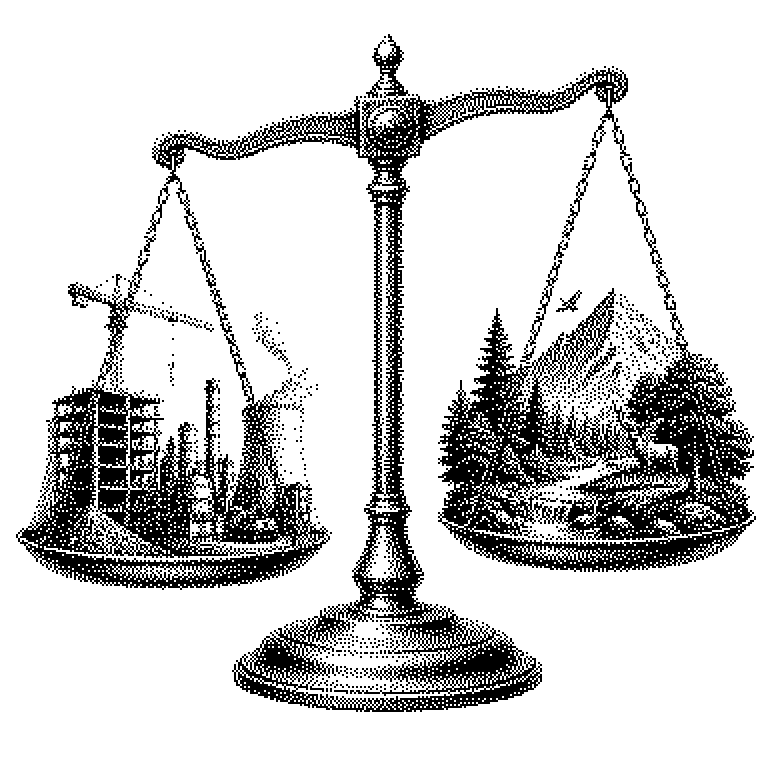
Environmental Impact Assessment
The Environmental Impact Assessment is a legally mandated procedure used by government authorities to examine, before approving large construction projects or industrial facilities, what consequences the project will have for nature, water, air, and people. The result feeds into the approval decision but does not replace it.
The Environmental Impact Assessment, EIA for short, is a legal procedure. Before an authority approves a major project — such as a highway, a power plant, or a factory — it must systematically examine what effects it will have on the environment. This concerns soil, water bodies, air, animals, plants, and the health of people in the surrounding area. The assessment does not replace an approval, but it must be completed before any decision is made. In Germany, the Act on Environmental Impact Assessment, abbreviated UVPG, precisely regulates which projects must undergo such an assessment.
Why the EIA is mandatory for major projects
Without a structured assessment, environmental consequences would often only become visible once the damage had already occurred. A new factory can contaminate groundwater. A road can fragment the habitats of animals. These consequences can hardly be undone once construction is complete.
The EIA is meant to make such consequences visible before the first shovel of earth is moved. In doing so, the procedure shifts responsibility forward: problems are identified, discussed, and, where possible, avoided through conditions. This is more efficient and cheaper than remedying damage afterward.
For companies, this means: a project that triggers an EIA requirement takes longer to obtain approval. This can act as a brake, but it also protects investors from later lawsuits and conditions. The EIA creates legal certainty for both sides.
Course of an Environmental Impact Assessment
At the outset is the so-called application of the project developer — that is, the company or authority that wants to build something. It must submit an environmental impact study: a document describing all anticipated environmental effects. It contains measurements, expert reports, and forecasts, for example on noise pollution or the impact on a nearby body of water.
Afterward, the public is involved. The documents are made available for inspection, and anyone can submit objections. This is not an optional step but a mandatory one. Affected residents, nature conservation associations, and other authorities can submit comments. These objections must be taken into account in the final decision.
The responsible authority then evaluates all the information and arrives at an assessment. If this turns out negative, the project can be rejected or significantly altered. Approvals are often tied to conditions — for example, the obligation to create compensation areas for destroyed habitats.
EIA in news and practice
The EIA regularly appears in business and political news. Large infrastructure projects — new rail lines, offshore wind farms, airport expansions — cannot get through the approval process without it. The construction of Berlin Brandenburg Airport (BER) is a well-known example: parts of the procedure were later challenged in court, partly due to issues arising from the EIA.
In the debate over the expansion of renewable energy, the EIA plays an increasingly prominent role. Onshore wind turbines require an EIA under certain conditions if they are planned near protected areas. Critics argue that the procedure takes too long and slows down the energy transition. Proponents counter that precisely fast approvals without adequate assessment lead to costly lawsuits in the long run.
At the European level, an EU directive from 1985 — revised several times, most recently in 2014 — requires all member states to introduce an EIA requirement for certain projects. The German rules are thus not a national special path, but part of a European framework.