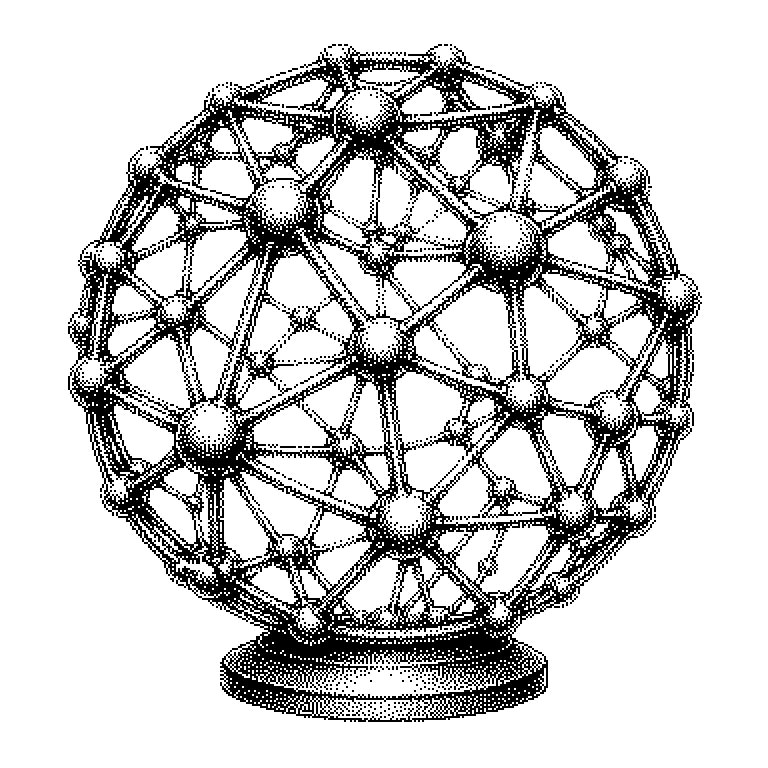
Network Analysis
Network analysis examines how individual things are connected to one another – people, accounts, computers, or companies. Using mathematical metrics, it measures who is important within the web, where groups form, and how something spreads through it.
Many things in the world are interconnected. People know other people, accounts transfer money to other accounts, websites link to other websites. Network analysis is a method that examines precisely these connections – rather than the individual things by themselves. To do this, the data is represented as points and lines: each point is a thing, each line a relationship between two things. From this web, questions can then be answered that could never be asked of a simple table. For example: Who sits at a key position? Which groups hold together especially tightly?
What connections reveal that individual data cannot show
A normal table looks at each row separately. An account might appear completely unremarkable there: small amounts, normal times, nothing conspicuous. Only within the network does it become apparent that this very account collects money from thirty other accounts and forwards it all to a single address. The information, then, is not contained in the individual data points, but in the pattern of connections.
That is why network analysis is central in areas where fraud or manipulation needs to be uncovered. Banks use it against money laundering, tax authorities against shell companies, social networks against coordinated disinformation. In all these cases, the perpetrator alone is hard to detect, but the network of accomplices stands out.
A second reason concerns the question of spread. Whether a disease, a rumor, or a computer virus spreads quickly depends heavily on the structure of the network. A few highly connected hubs can dramatically accelerate a spread. Anyone who knows these points can intervene in a targeted way instead of acting everywhere at once.
Nodes, edges, and the question of importance
The basic building blocks are called nodes and edges. A node is a single element, such as a person. An edge is the connection between them, such as a friendship or a money transfer. Edges can have a direction – I transfer money to you, not the other way around. They can also carry a weight indicating the strength of the relationship.
Metrics are then calculated on this structure. The simplest one just counts the connections of a node. Often more important are finer measures: a node is considered central if many short paths run through it. Such nodes are bridges between otherwise separate groups. If a bridge disappears, the network often falls apart into pieces.
A well-known example of such a metric is PageRank, which Google used to rank websites in the past. The idea: a page is important if important pages link to it. Other methods search for so-called communities, i.e., groups of nodes that are much more densely connected to each other than to the rest. Modern AI systems, so-called Graph Neural Networks, additionally learn such patterns on their own from the data.
From friend suggestions to the supply chain
Most often, you encounter network analysis without any indication of it. When Instagram suggests people you might know, behind it lies the simple observation: you have many connections in common. When Spotify recommends a band, it evaluates which artists often appear in the same playlists. Route planners, too, work with networks of intersections and roads.
In business news, the term usually comes up in connection with risk. After disruptions in the supply chain, companies analyze which suppliers they depend on indirectly. It often turns out that dozens of manufacturers ultimately depend on a single factory. At banks, regulators similarly examine which institutions are so tightly interlinked that their failure would drag others down with them.
A common misconception is that network analysis reveals causes. Initially, it only reveals structure. The fact that two accounts are connected does not prove collusion, and a central node need not be a mastermind. This is precisely why such analyses are controversial in investigations and advertising profiles: they provide strong indications, but no proof.