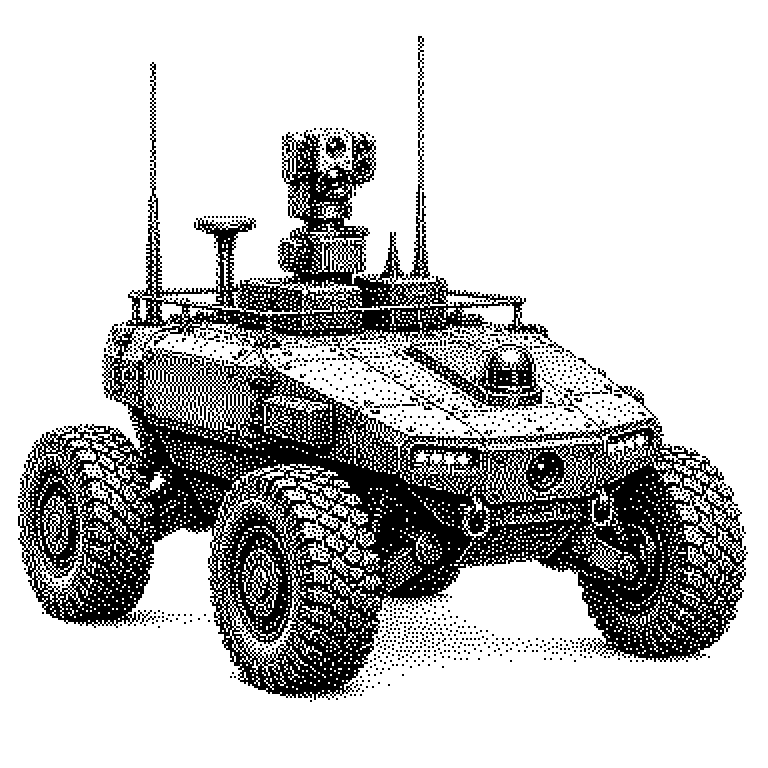
UGV
A UGV is a vehicle that moves on the ground without a human on board – controlled either remotely or fully autonomously through built-in software. UGVs are used in military technology, logistics, and reconnaissance, and their development is closely tied to advances in artificial intelligence.
A UGV – short for “Unmanned Ground Vehicle” – is a vehicle on wheels or tracks that drives without a driver on board. It is either operated remotely by a human or moves independently using software and sensors. The difference from simple remote control lies in the fact that many UGVs make their own decisions: they detect obstacles, plan routes, and react to their surroundings. The term originates from the military but has long since expanded into civilian fields. Today, warehouse robots, delivery vehicles, and reconnaissance robots also fall into this category.
UGVs as the key to dangerous environments
The most important reason for UGVs is simple: humans no longer need to be put in dangerous situations. A vehicle can drive into a contaminated area, scout a minefield, or search a burning warehouse for the trigger – without putting anyone’s life at risk. This characteristic makes UGVs particularly attractive for the military, disaster relief, and law enforcement.
In the business world, the argument is different: cost and efficiency. An autonomous warehouse vehicle runs 24 hours a day, needs no breaks, and makes no fatigue-related mistakes. Amazon and other logistics companies already deploy thousands of such vehicles in their warehouses. The pressure to automate supply chains is significantly accelerating development.
At the same time, as the capabilities of these vehicles grow, so does the societal debate. If an autonomous military UGV decides to ram an obstacle or take a route through a populated area, the question arises: who bears responsibility? This discussion runs parallel to the one about autonomous weapons and AI ethics.
Sensors, maps, and the problem of the real world
A UGV perceives its surroundings through sensors. Cameras provide images, radar measures distances using sound or radio waves, and LiDAR – a method that uses laser pulses to create three-dimensional maps – gives the vehicle a precise picture of its environment. From this data, the software continuously calculates a map and its own position within it. This process is called SLAM, short for “Simultaneous Localization and Mapping.”
The vehicle plans its route on this map. Simple algorithms follow fixed paths, as warehouse robots often do. More advanced systems use machine learning – that is, software that has learned from examples how to handle unexpected situations. A military UGV in rough terrain needs the latter: it encounters mud, fallen trees, and objects that no programmer entered beforehand.
The biggest technical challenge is reliability under real-world conditions. In a controlled warehouse, UGVs already function very well. Outdoors, in rain, poor lighting, and unforeseen situations, they fail more often than expected. This is why many UGVs today still operate in “teleoperated” mode – a human retains control and intervenes when necessary.
UGVs in products, news, and everyday life
In news coverage, the term mainly appears in connection with defense projects. The USA, Israel, and several European countries are testing autonomous patrol vehicles at borders and on military grounds. Russia has occasionally deployed remote-controlled ground vehicles in the war in Ukraine. These developments are driving the political debate about autonomous weapons systems forward.
In civilian everyday life, one encounters UGVs rather inconspicuously. Automatic lawnmowers are, technically speaking, simple UGVs. Delivery robots that transport packages on sidewalks in some American and European cities are already in regular operation. Companies like Starship Technologies use such vehicles to deliver food and packages daily in several university towns.
A common misconception is equating UGVs with autonomous cars. Both drive without a driver, but they stem from different lines of development, operate in different environments, and are subject to different regulations. A self-driving car must comply with traffic rules and interact with other road users. A UGV in a warehouse or on a military training ground often moves in restricted or structured areas – with entirely different requirements for safety and certification.