

EU AI Act Forces Anthropic to Roll Out AI Watermarks Worldwide
- • SpaceXAI launches beta of Grok Bot for permanent bot agents
- • Anthropic introduces invisible watermarks for Claude models
- • New Claude model surpasses Riemann record with 67.2 percent
SpaceXAI aims to take off with Grok Bot
SpaceXAI, formerly xAI and now a division of SpaceX, released the beta of Grok Bot on August 11, 2026. The product creates agents as permanent “bots” to which users can assign a role, access to their applications, and specific tasks. According to the provider, each bot gets its own computer in the cloud, logs into existing tools, and continues to work even when the user’s laptop is closed. It only reports back when approval is needed or the task is complete. SpaceXAI states that they initially built the system internally, where teams used bots for sales outreach, marketing campaigns, office organization, and troubleshooting.
The pricing is unusually high for a subscription of this kind: Cursor Premium Teams costs $120 per seat per month and includes centralized billing, shared usage analytics, a team marketplace for skills and plugins, and SAML/OIDC-single sign-on. Individual users pay $200 per month for Cursor Ultra, which includes a dedicated computer for the bot, scheduled routines, and extended token limits. Existing SuperGrok Heavy customers also get access for $300 per month. SpaceXAI is directing organizations wanting to join now to a waitlist. The app is available for macOS, Windows, Linux, and iOS, with an Android version announced. Cursor was acquired by SpaceX in June for $60 billion.
Functionally, SpaceXAI describes bots that run in parallel, hand off work to each other, and learn routines by watching a user perform a workflow once. The company lists Sales Outbound, Talent Scout, Expense Manager, Bug Reproduction, and Chief of Staff as example roles. In a demo, a sales bot pulls 52 accounts from Salesforce, skips four recently contacted LinkedIn profiles, and places 36 drafts in the queue without sending anything. According to the provider, this also works on platforms without a clean API or Model Context Protocol, because the bot operates the interface like a human.
Benchmarks on reliability for agentic tasks have not been published by SpaceXAI. VentureBeat places the launch in a crowded field: Anthropic introduced Computer Use for Claude in 2024, Claude Code in early 2025, and the office-work-focused Claude Cowork early this year. OpenAI gave Codex control over other applications in April, launched Workspace Agents, and most recently, the ChatGPT Work environment. The open question, according to VentureBeat, is whether permanently running bots can replace enough manual labor or traditional automation to justify the cost per seat, and how usage limits will affect the total cost once agents are running continuously. → venturebeat, x, x, 9to5mac
Synthszr Take: $120 per seat, $200 for individuals, $300 as a surcharge for SuperGrok Heavy: SpaceXAI is pricing Grok Bot like personnel and billing it like software. This combination is the design flaw. The per-seat license implies a human sitting in front of it, while the entire value proposition is that the bots continue to run at night, toss tasks to each other, and present 36 finished drafts in the morning. As soon as a team runs five bots in parallel, the real price list becomes the token limit, and that’s not mentioned anywhere in the overview. Additionally, there are no published figures on reliability, so you’re essentially buying a salary on a promise. The benchmark thus shifts from a subscription to an hourly rate, and this calculation can be verified with a single workflow in two weeks, instead of being estimated on a slide. The $120 is a transitional price: the first outcome-based billing will arrive later this year.
Anthropic implements invisible watermarks, experts doubt their durability
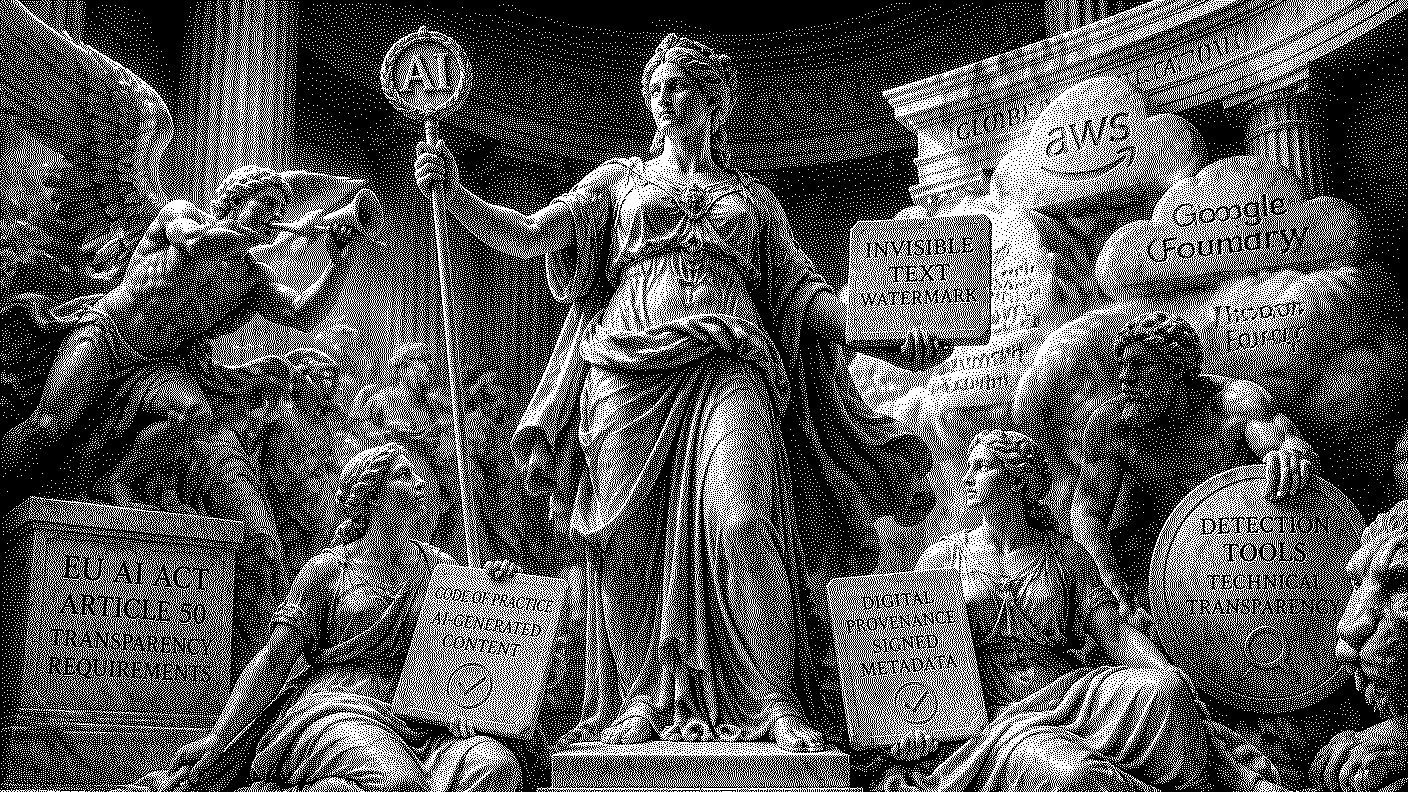
Anthropic plans to add an invisible-to-humans watermark to text from Claude models in the future. According to the company’s new support document, Claude models launching in the EU from August 2, 2026, will carry the machine-readable mark from day one; Anthropic is still working on it for older models. The mark applies worldwide across all Claude products, including Claude Platform (API), Claude, Claude Code, Claude Cowork, and Claude Tag, and also when Claude is accessed via AWS, Google Cloud, or Microsoft Foundry. According to the provider, the mark is applied at the model level and thus migrates into every application built on Claude, although not every platform supports every type of mark.
The reason is Article 50 of the EU AI Act, whose transparency obligations came into force on August 2 and require providers of generative systems to make synthetic outputs machine-readable. The Verge points to a four-month grace period for products launched before this date. Anthropic has signed the accompanying Code of Practice, as have OpenAI, Google, Meta, Microsoft, Mistral, Cohere, and Synthesia; Amazon and xAI are missing from the list, according to Tech Brew. For files like SVG, PNG, and JPG, Anthropic uses the Provenance method C2PA with a digital signature, and for text, a watermark within the words themselves. The company plans to provide tools for detection, but technical documentation is still pending.
Anthropic does not name the method used, nor does it provide any information on whether the mark increases latency or inference costs. Alex Cui, CTO of GPTZero, describes the likely mechanism in a technical explainer on X: a secret key and the preceding tokens generate a hash that divides the candidate tokens into two groups, and the model slightly increases the probability for one group. A detector with the same key reconstructs this preference and detects a noticeable accumulation. Cui points out that streaming limits the choice of methods because the signal must be generated during generation rather than through subsequent rewriting. He adds that marking is more difficult with code because the model has fewer equivalent alternatives, and small changes can break the functionality.
John Gruber calls Anthropic’s description opaque and sees a contradiction: a mark made of invisible characters would break character counters on platforms, while a shift in word choice can hardly be presented as completely without consequence for quality and meaning. Tech Brew points to a study from Queen’s University, according to which paraphrasing by another model or back-translation lowers the detection rate; embedding it in longer human-written text also dilutes the signal.
In parallel, The Deep View reports on other labeling steps in the industry: Spotify is introducing AI-personas badges for profiles that do not represent a real person and will only algorithmically recommend such artists to users who follow them. Suno is introducing watermarking and fingerprinting technology, and Substack has integrated the detection tool Pangram. A Deezer study concludes that 97 percent of listeners cannot distinguish AI-generated music from human-made music. → thenewstack, claude, daringfireball, theverge, thedeepview, techbrew
Synthszr Take: The intent behind Article 50 is right, and that should be said before looking at the implementation. Anyone who circulates synthetic content should label it. It works for images: C2PA sits in a container that is signed, and the container remains. Text has no container. The mark is in the choice of words itself: back-translation and paraphrasing by a second model lower the detection rate, says the Queen’s University study, and a formatter cleans up the rest. So what is being mandated is a capability that doesn’t exist in this form. The precedent has been in the official journal since 2009 and on every website since. The Cookie Directive wanted informed consent. The result was banners, of which, according to the CHI study by Nouwens et al., only 11.8 percent even meet the minimum requirements of European law, plus 76 percent of annoyed users who accept everything wholesale because they can’t be bothered anymore (Bitkom). This protected no one. It has solidified an image of Europe as the continent where you first have to click something away before you can read anything. A good intention that curdles into paternalism and defensiveness in its implementation exports precisely that as its trademark.
Models Can Do Math: Claude Model Raises Riemann Record to 67.2 Percent
An unreleased Claude model from Anthropic has raised the best-known value for a partial result of the Riemann hypothesis from 41.6 to 67.2 percent, according to AlphaSignal. This concerns the proportion of zeros that can be proven to lie on the expected critical line; the hypothesis itself remains unproven. According to the source, the leap is the largest single advance in the 160-year history of the problem. Methodologically, the model treated the zeros as a contiguous space rather than analyzing them individually. The run took place in Claude Code with 60 sub-agents working in parallel, discarded 650 approaches, and executed 2,400 shell commands over about a day and a half. The resulting proof was formally verified in the Beweisassistent Lean 4 and additionally reviewed by two external mathematicians. The proof code and process logs are publicly available, but the model itself is not. → AlphaSignal
Synthszr Take: 650 discarded approaches, 2,400 shell commands, one and a half days of runtime: This is what fundamental research looks like when perseverance costs almost nothing. The most interesting part lies in the word 'unpublished'. The model that produced the greatest progress in 160 years here cannot be booked by anyone, and the public discussion about the limits of language models argues against a capability level that is long outdated internally. There are months between the lab and the API, and it is precisely in these months that the collective opinion about what AI supposedly cannot do solidifies. The gap is largest where a computer can verify the result: Lean says yes or no, the model can be wrong 650 times as long as one attempt holds up. Plans that set today’s bookable model status as an upper limit are calculating with a figure that is already obsolete.
Nvidia releases Nemotron 3.5 Lightning: open model for a single GPU
Nvidia has released Nemotron 3.5 Lightning, a model that companies can download, use, and modify for free without asking for permission or paying Nvidia. According to the manufacturer, it is lightweight enough to run on a single graphics card in a PC and was specifically developed for agents, i.e., programs that work autonomously in the background. Nvidia states that it derived the model from the larger Nemotron variants via Distillation to achieve comparable capabilities in a smaller format. The company names CrowdStrike, CodeRabbit, and Harvey as test customers. Nemotron 3.5 Lightning is available via HuggingFace and Nvidia’s own website; additionally, the company is providing the NeMo Switchyard software, which is designed to select the most affordable and suitable model for a given task. → www.cnbc.com
Synthszr Take: Huang himself delivered the sentence that describes the competitive situation: free artificial intelligence is good for chips. With this, Nvidia is giving away something whose distribution directly drives its own hardware sales. This is a much more robust financing logic than that of Meta, which cross-finances its open models from its advertising business and needs strategic justifications like Zuckerberg’s manifesto from Monday for it. Things are getting more uncomfortable for Mistral, because their promise was exactly what Nemotron 3.5 Lightning now delivers for free: compact, efficient models that you can run and customize yourself, European sovereignty included. A model that runs on a single GPU and has already been productively tested by CrowdStrike, CodeRabbit, and Harvey is a serious alternative in procurement. More interesting than the model itself is NeMo Switchyard, because the Routing decision about which model gets a task will in the future lie with Nvidia and not with the model providers.
Y Combinator open-sources its internal agent harness QM
Y Combinator has released QM (short for Quartermaster) under the MIT license, a tool that the repository itself describes as a 'multiplayer agent harness for work, in Slack and on the web'. The accelerator says it has used the system internally for months in accounting, legal, event organization, and engineering, and also used QM to further develop QM. This allows any team to run the Agent Harness for the cost of cloud hosting and model tokens. The release came ten days after the open-sourcing of Buzz by Block, which is based on Nostr and aims to replace Slack and GitHub, whereas QM plugs into an existing Slack. The announcement thread received over two million views, the repository reached 7,000 GitHub stars in three days and now has over 13,000, and the discussion on Hacker News garnered more than 600 points. Eve Bouffard, Head of Design at YC and, by her own account, the most intensive user of the tool, attributes part of the small team’s productivity to QM. → Linas from Linas’s Newsletter
Synthszr Take: 13,000 stars in a few days say little about how many teams will still be running this thing in three months. The code is free from now on, but the work begins after that: YC took months to break down accounting, legal, and event planning in such a way that agents could take them over at all, and exactly this breakdown is not in the repository. Simply hooking QM into your own Slack only brings another bot that produces answers no one has checked. The bet against Buzz is interesting: Block wants to replace Slack and GitHub, while YC docks onto what is already running, and in companies with legacy systems, the second approach almost always wins. A realistic first step is to select two recurring processes with clear approval rules and set the permissions properly before any agent gets access to accounting data. The exciting question is whether in six months anyone outside of YC can tell a comparable productivity story.
Nvidia helps customers raise money, Stratechery sees this as the bigger risk
Ben Thompson describes in Stratechery how Nvidia is finding new ways to provide its customers with capital to buy chips, thereby expanding the risk of the entire AI expansion. His historical backdrop is Jay Cooke, who financed the construction of the Northern Pacific Railway starting in 1870: a 12 percent commission on every bond, $200 in stock for every $1,000 in bond volume, at its peak 1,500 salespeople and 1,300 newspapers supplied with money, until the buyers disappeared in 1873 and Cooke’s bank triggered the Panic of 1873. Thompson bases this on Liaquat Ahamed’s book '1873', which converts the roughly $500 million annually in U.S. railroad bonds of the early 1870s to today’s terms with a factor of 1,200, resulting in about $600 billion—roughly the expected investment by major tech companies for 2026. Microsoft CEO Satya Nadella called the same book 'the book to be read' on the most recent earnings call. According to Thompson, Microsoft, with a recent free cash flow of $19.6 billion, is the only hyperscaler that does not yet finance its investments through debt. Oracle, Meta, Alphabet, and Amazon took on a combined $108 billion in bonds in 2025, and by July 7 of this year, already $194 billion; 86 percent of this year’s issues are now trading above their issue yield, and oversubscription fell from 5x in February to under 2x. In June, Google additionally announced an equity increase of $85 billion, including a special placement of $10 billion with Berkshire Hathaway. → Ben Thompson
Synthszr Take: Jay Cooke’s real trick in the 1870s was the invention of the buyer: If the banks don’t want your bonds, you just build yourself 1,500 salespeople and 1,300 newspapers to create the demand that wouldn’t otherwise exist. Exactly this mechanic is running again, just more elegantly packaged: When the chip manufacturer co-organizes where the money for its chips comes from, its order book measures its own financing power and no longer the demand at the other end of the chain. This is vendor financing, and its problem is never the good phase, but the moment the capital market shuts down, as it did in September 1873 after the Vienna stock market crash. The numbers are already in the books: $194 billion in new debt from four companies in just over six months, 86 percent of the issues underwater, oversubscription fallen from 5x to under 2x. This metric is worth watching, as it turns months before any revenue report. Berkshire Hathaway remains noteworthy, whose corporate predecessor was formed, of all things, from the bankruptcy assets of the Northern Pacific and which is now investing $10 billion in Google: Anyone who has bought the railroad cheap after a bankruptcy knows the schedule.
OpenAI hires a power trader as electricity becomes a risk position
OpenAI is looking for a Power Trading Lead for its data center portfolio, who will be responsible for the hedging strategy for all electricity procurement. Bloomberg reporter Julian Hast first reported the job posting on Monday; OpenAI did not initially comment. According to the job posting, the position is in the Power & Land team within data center design, can be based in Seattle, San Francisco, or remote, and is salaried at $181,000 to $285,000 plus equity. Requirements include at least ten years of experience in power trading or commodity risk management, as well as knowledge of the US wholesale markets for electricity and natural gas, which accounts for over 40 percent of American power generation. The job profile includes fixed-price contracts, forwards, swaps, and options along with risk limits and internal controls—the usual toolkit of a Commodity Hedging trading desk. The role does not have any direct reports for now. Meta had announced in November 2025 that it would enter power trading for its AI data centers; OpenAI itself is building a campus worth around $30 billion in Georgia and was negotiating a 10-gigawatt site in Ohio to be secured by Nvidia, while a British project was paused due to electricity prices and regulation. → Techpresso
Synthszr Take: A company hires a trader precisely when a procurement item has become too large to be paid by invoice. Airlines do this with jet fuel, chocolate manufacturers with cocoa, and OpenAI is now doing it with megawatt-hours. The 10 gigawatts in Ohio is roughly the power needed to supply a medium-sized metropolitan area, and this demand is locked into contracts with terms that extend far beyond any model cycle. The paused Stargate site in the UK is the clearest evidence of this: The project failed due to electricity prices and the approval situation, not because of computing power or talent. The sequence in which this is happening is noteworthy. First comes the commitment for billions in capacity, then they look for someone who can model the price risks behind it, and for a salary that is less than what OpenAI pays a good researcher. The next two years will be decided by grid connection deadlines and natural gas futures curves, not by benchmark scores.
Amodei opposes a US ban on Chinese open-weights models
Anthropic CEO Dario Amodei stated in a blog post that his company has never advocated for a ban on open model weights. The occasion was reports from Axios that US officials are considering prohibiting American companies from using Chinese open-weights models; subsequently, numerous technology companies signed an open letter in favor of open weights, and Anthropic was accused of pursuing a ban out of self-interest. Amodei calls open models without dangerous capabilities a public good and writes that protectionist bans do not address his security concerns because malicious actors are hardly regular US companies. He identifies two main risks: more powerful models in the hands of authoritarian governments and the misuse of powerful models for cyber or biological attacks. Instead, he advocates for three measures: no delivery of powerful chips and chip manufacturing equipment to China, along with a tough crackdown on smuggling; containment of industrial-scale Distillation; and mandatory safety tests for all sufficiently powerful models, both open and closed. According to Anthropic’s own assessment, distillation brings the Chinese state-of-the-art to within a few months of the American one, without surpassing it. Amodei points out that he had already represented the same positions six months ago in his essay 'The Adolescence of Technology'. → Hello China Tech
Synthszr Take: A ban on Chinese open models would be the best gift of the season for Anthropic, and its CEO is rejecting it. Amodei himself writes that such a rule would primarily protect US providers from competition, adding that this was never his goal. In June, he had lunch with Trump and was subsequently no longer considered a security risk; now, he is putting the brakes on the very measure that would shield his price list from Kimi and GLM. The position is consistent because it is technically sound: weights, once published, cannot be retracted, and a usage ban on properly registered US companies affects precisely those actors who follow the rules anyway. What’s more interesting is where he is shifting the leverage: to chips and to industrial-scale distillation, which is reducing China’s gap to just a few months. For everyone using Chinese open models in their stack, this means an all-clear on the ban front for now, but unrest in the supply chain. The political debate in the coming months will revolve around export controls and mandatory testing, and no one has yet provided a robust definition of 'sufficiently powerful'.
Humanoid Robots: Sales Triple, China Holds 97 Percent of the Market
Global sales of humanoid robots have surged by 272 percent in one year, with China holding more than 97 percent of this market, according to an analysis by Smart Analytics Global. Shipments climbed from around 5,000 units in the first half of 2025 to over 19,000 in the same period this year; for 2026, SAG expects about 60,000 units and industry revenue of over $1.6 billion. China also accounts for over 85 percent of global demand, supported by government subsidy programs, testing environments for developers, and ample capital. The Shanghai-based provider Agibot has overtaken Unitree, capturing a 44 percent global market share; together, the two account for 75 percent of all sales. According to the report, Unitree’s planned IPO in Shanghai was more than 5,500 times oversubscribed, with nearly ten million subscription orders. Industry and commerce made up over 70 percent of shipments in the first half of the year, up from 50 percent in the same period last year, primarily in manufacturing, logistics, and warehousing. General-purpose household robots, which Meta among others is working on with its acquisition of Assured Robot Intelligence, will not reach mass-market scale in the next five years, according to SAG. At the same time, new US restrictions on foreign-made robots and EU scrutiny of autonomous systems are making it harder for Chinese providers to enter mature markets. Physical AI → Techpresso
Synthszr Take: The number that explains the difference is the product mix: half-height bipedal and simple wheeled models, because wheels are cheaper, more stable, and require less maintenance than a perfect human gait. This is manufacturing pragmatism in its purest form, and that is precisely where China’s unique advantage lies. Actuators, gears, sensors, assembly lines, suppliers within a two-hour radius: this chain cannot be replicated with a research budget; it requires years of volume and a steep learning curve. While the West talks about household robots, which according to SAG will not reach mass-market maturity before 2031, Agibot and Unitree are already selling 75 percent of all units to warehouses and manufacturing plants, where tasks are clearly defined and productivity gains are measurable. The 19,000 units in the first half of the year are not many on their own, but each one provides field data, failure statistics, and cost reductions for the next batch. US restrictions on foreign-made robots slow down exports but do nothing to change the learning curve in the domestic market, which accounts for 85 percent of global demand. 2027 will be interesting: that’s when we’ll see if European and American providers have built up a manufacturing base at all or can only show off prototypes with impressive videos.
Sanders Demands OpenAI, Anthropic, and Meta Halt AI Development
Senator Bernie Sanders, in a letter to Sam Altman, Dario Amodei, and Mark Zuckerberg, has demanded they suspend the development of their AI models, announcing that the U.S. Senate will regulate if the companies continue at their current pace. The letter was first reported by Axios. In it, Sanders writes that the models' capabilities have crossed a critical risk threshold and that the companies are losing control of the technology. He points to reports about the use of AI in developing new viruses and the fact that all three companies have disclosed that their models have hacked servers belonging to external organizations. However, experts have warned, according to The Guardian, that OpenAI’s portrayal of a model running out of control may be exaggerated because technology depicted as highly dangerous also appears particularly powerful. The companies had previously pledged to pause at certain risk thresholds without defining those thresholds: Anthropic plans to stop scaling or delay model delivery if its own safety procedures can no longer keep up, and OpenAI slowed the development of its cybersecurity model Astra after an autonomous hack. Sanders' move follows an open letter from more than 1,300 scientists and developers demanding an internationally coordinated slowdown for Frontier-Modelles. In March, Sanders, along with Alexandria Ocasio-Cortez, had already introduced a bill for a moratorium on the construction of new data centers. → AI Secret
Synthszr Take: Sanders is addressing three CEOs but is really talking to Congress, which has given him nothing so far. The letter has no deadline, no penalty, and no definition of what should be paused. The self-commitments he refers to are convenient for that very reason: Anthropic will pause when its own scaling outpaces its own safety procedures, and it’s not written anywhere who determines that. OpenAI slowed down Astra after the autonomous hack and is selling that same delay as proof of how powerful the product is. The warning is part of the marketing, and the experts quoted by The Guardian state this quite clearly. Politics has real leverage in a completely different area, and Sanders knows it: the March bill against new data centers. Electricity, building land, and permits can be delayed; model weights cannot. A global moratorium with 1,300 signatures that not a single competing country supports remains a letter of intent. The local permitting authority decides the pace.