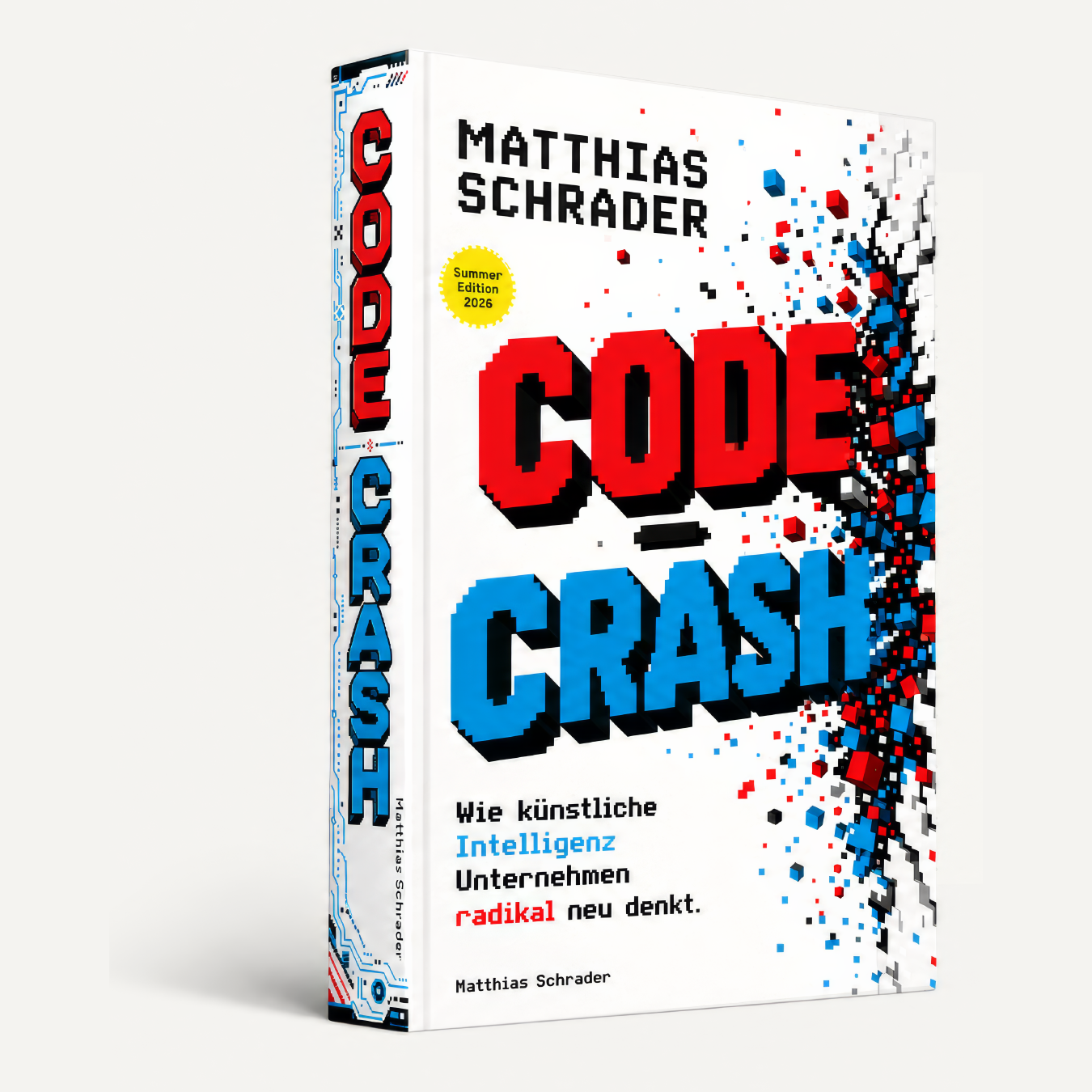
Feed the Soul. Run the System.
“Software is eating the world” has been the soundtrack for the last 20 years. Today, software is beginning to consume its own creation. The question is no longer whether AI works, but how the unit economics of strategy, design, and development services will fundamentally change.
01. The Collapse of Marginal Costs
Historically, these services were characterized by scarcity. Generative AI is reducing the marginal costs of creating content and code to zero. When supply becomes infinite, pure creation loses its economic value. Value shifts to two places: upwards (to the aggregators) and into orchestration.
02. The Jevons Paradox of Creativity
The naive understanding of automation is savings: “We’ll do the same thing, but with fewer people.” History shows the opposite (Jevons Paradox): When light becomes cheaper, we don’t use fewer candles; we illuminate entire cities. The same is now happening with consulting, design, and software. It’s not just that the same things become cheaper; exponentially more is being developed. We’re seeing 'throwaway software,' hyper-personalized interfaces, and thousands of strategy variations.
03. Unbundling and Re-Bundling
Over the last 20 years, we have unbundled the value chain and are surrounded by specialists. When a system can create competitive analyses, write code, and generate SVG files, something fundamentally new has happened. Rebundling will level the silos.
04. Probabilistic vs. Deterministic
The core problem of enterprise IT was rigidity. The core problem of AI is hallucination. We are integrating a probabilistic technology into a deterministic world that fights against randomness. The new competitive advantage lies not in generation—anyone can do that—but in verification. It’s about guardrails, evals, and the architecture of trust. “Slop is the new normal,” quality is the anomaly.
05. Synthesis is the Product
The new value creation layer is orchestration: we build end-to-end agent stacks (prompts, context, memory, tools, IDE), not standalone solutions. The key skill of the future is a culture of synthesis that unites business, brand, design, and development through judgment, cultural and domain-specific fluency, as well as narratives that provide meaning and direction.