

Chinese Labs Launch Even More Efficient Models and Apple Sends an Invitation
- • Two new Chinese models aim for price leadership: Alibaba presents Qwen 3.5 and ByteDance launches Seed 2.0
- • Apple invites guests to a mysterious “Special Experience” on March 4
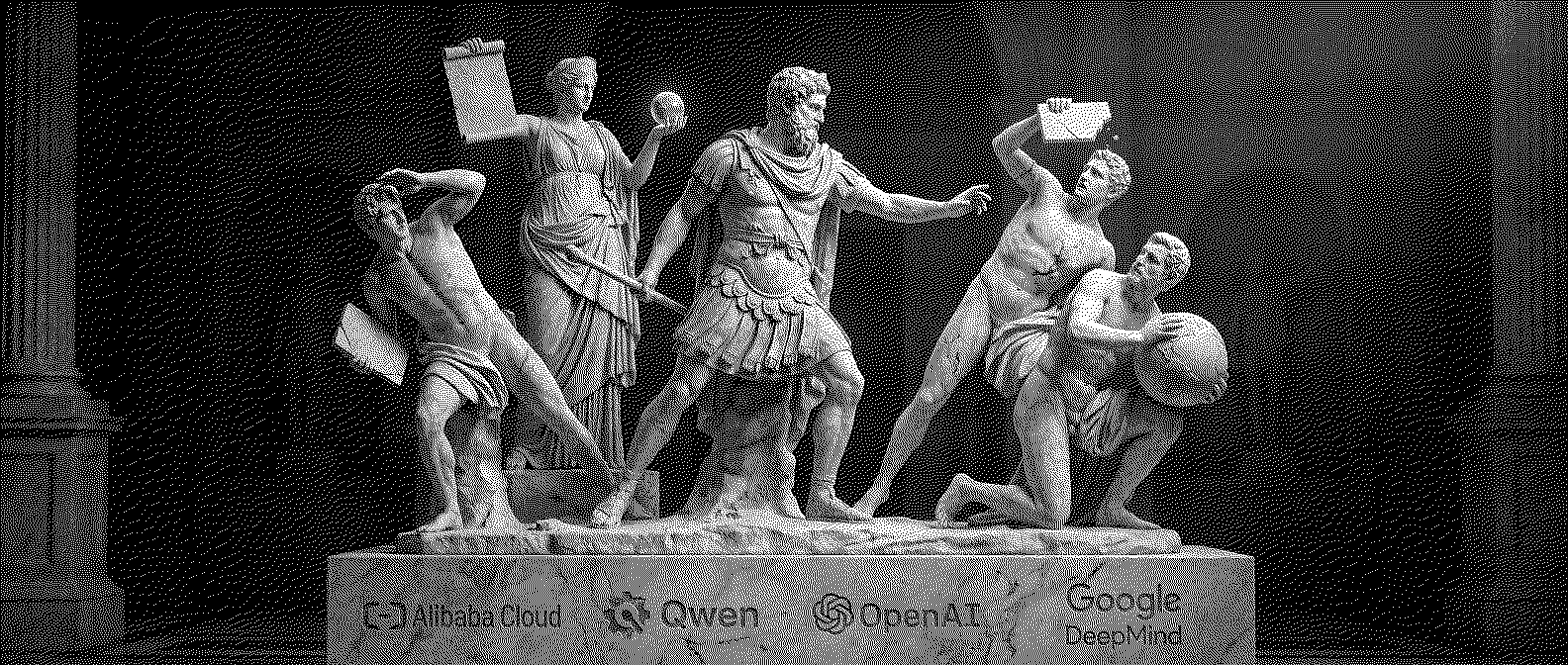
Alibaba counters with Qwen 3.5
Alibaba has introduced Qwen 3.5, a new language model for “agentic AI.” The company claims the model can autonomously handle complex tasks and outperforms leading US systems like GPT-5.2 and Gemini 3 Pro on several internal benchmarks. Qwen 3.5 is said to be 60% cheaper to operate than its predecessor and processes large workloads up to eight times more efficiently. Alibaba also released an open-weight version with 397 billion parameters (Sparse Mixture-of-Experts) under an Apache 2.0 license. This version promises up to 19 times faster decoding performance than the previous top model, Qwen3-Max. → Techpresso
Synthszr Take: Benchmark comparisons are now just a snapshot in time; each new release will surpass the previous one. The key signals here are price and architecture. Alibaba is explicitly competing on cost per token and agent capabilities, directly targeting enterprise developers. The release of a powerful open-weight model is a targeted attack on the closed ecosystems of OpenAI and Anthropic. China’s strategy is clear: commoditize the model layer to win at the application and integration layer. Western labs focus on building the best brain; Chinese companies focus on building the most efficient factory.
ByteDance escalates the model race with Seed 2.0
ByteDance has released Seed 2.0, a new family of AI models that, according to the company, outperform GPT-5.2 and Gemini 3 Pro on dozens of benchmarks—at one-tenth the price. The models are designed for practical agentic tasks; demos show the autonomous execution of 96-step CAD modeling workflows. The release follows shortly after the viral video model Seedance 2.0, which caused controversy in Hollywood for using copyrighted characters. Seed 2.0 is available via ByteDance’s Doubao app and through an API, but its availability outside of China is still limited. → The Rundown AI
Synthszr Take: Two major Chinese models aiming for price leadership within days is no coincidence; it’s a concerted industrial offensive. ByteDance is not building a mere ChatGPT competitor, but an engine for complex, real-world automation, as the CAD demo unequivocally shows. The IP controversy surrounding Seedance is a feature of their strategy, not a bug: move fast, absorb all available data, and sort out the legal consequences later. While Western AI ethics debates focus on abstract risks, China’s labs are stress-testing the global intellectual property system with working products.
Apple announces “Special Experience” for March 4
Apple has invited select media representatives to a “Special Apple Experience” on March 4 in New York, London, and Shanghai. The invitation is vaguely worded and contains no details about what will be presented. The invitation’s design features a 3D Apple logo made of yellow, green, and blue discs. The choice of the word “Experience” instead of “Event” suggests a potentially smaller, decentralized gathering, as opposed to a large livestream from Apple Park. New products such as the iPhone 17e, MacBook Pros with M5 chips, and new iPads are expected to be announced in the near future. → unknown
Synthszr Take: The decentralized “Experience” in three global metropolises is a test run for a post-keynote era. Apple recognizes that a single, monolithic event is losing its impact in an age of fragmented attention. Instead of flying the world to Cupertino, Apple is bringing the product to the global press—a logistical effort that ensures maximum, time-zone-spanning media coverage. The word “Experience” also signals a shift from a pure product launch to a demonstration of the ecosystem in action. It’s no longer just about showing a new device, but about how it integrates into daily life.
The One-Person Unicorn and the Battle for the Agent Layer
Peter Steinberger, the sole developer of the viral open-source agent OpenClaw, is joining OpenAI. His project, which generated no revenue, had previously received billion-dollar acquisition offers from Meta and OpenAI. Steinberger chose OpenAI. OpenClaw runs locally on the user’s device, connects to messaging platforms, and has deep system access, allowing it to perform actions that are off-limits to cloud-based chatbots. The project reached nearly 200,000 GitHub stars in record time. → Linas from Linas’s Newsletter
Synthszr Take: This was no ordinary acquisition, but a strategic realignment for the entire industry. The billion-dollar valuation of a non-revenue-generating open-source project confirms that value is shifting from the model layer (intelligence) to the agent layer (action). Steinberger’s core insight—a moderately capable model with unrestricted permissions outperforms a genius in a sandbox—is now OpenAI’s official strategy. They didn’t buy code; they acquired an architectural philosophy and the developer community that validated it.
The Future of the “Side Hustle”
A report from Business Insider examines the economics of side hustles in the US. It has never been easier to start a side business, thanks to platforms like Shopify and a wide range of digital tools. At the same time, competition has never been greater. More than 60 million Americans have some form of “side hustle,” a practice particularly common among Gen Z and Millennials. The article highlights that success lies not in starting, but in persevering. The ability to quickly adapt to trends and find a niche is crucial for longevity. → Business Insider
Synthszr Take: The “side hustle” is the atomization of entrepreneurial activity, enabled by digital platforms. It’s the gig economy expanding into the knowledge and creative sectors. The low barriers to entry are both a blessing and a curse: they enable participation but also lead to a hyper-commodification of skills. The long-term winner isn’t necessarily the individual “hustler,” but the platform that provides the market and takes a fee on every transaction. This is the structural logic of platform capitalism: risk is outsourced to the individual, while profit is centralized at the infrastructure level.
Demand for Designers Rises in the Age of AI
Contrary to fears that AI could replace designers, the demand for them is increasing. A recent study shows that the rise of artificial intelligence is leading to a new dynamic in hiring designers. Companies are realizing that designing AI-powered products and experiences presents new and more complex design challenges. Hiring managers are now placing a greater emphasis on skills like systems thinking, strategic understanding, and the ability to navigate the “messy middle” between technology and user needs. → TLDR Design
Synthszr Take: Of course demand is rising. AI doesn’t automate design; it automates the production of design artifacts. The real work of the designer—problem definition, systems understanding, user empathy, and strategic alignment—becomes more important, not obsolete. An AI tool can generate 100 variations of an interface, but it cannot decide which interface is right for the business and user context. The designer’s value is shifting from manual execution to strategic orchestration. Companies that understand this are hiring more designers, not fewer. They are looking for architects, not draftspeople.
Airbnb tests AI-powered conversational search
Airbnb is testing a new, AI-based search that allows users to express their wishes in natural language. Instead of using filters, guests can describe their ideal stay and ask follow-up questions. The goal is to improve the discovery of listings, reduce friction in the booking process, and increase conversion rates. This is part of a broader strategy to create a personalized, AI-native platform that supports travelers throughout their entire journey. → TLDR Design
Synthszr Take: This is the logical evolution of search from a database query to a dialogue. Airbnb understands that a user’s intent is often more complex than a set of checkboxes and sliders can capture. AI search transforms the platform from a catalog into a concierge. The strategic value lies in replacing the 'cold' transaction of a booking with 'warm' consultation, thereby building deeper customer loyalty. In the long term, this could reduce the need for external travel blogs and inspiration sources, as the discovery phase is integrated directly into the platform. The real disruption isn’t in the technology, but in the simplification of the customer journey.
Adobe and the Loss of the UX Design Market
An opinion piece analyzes how Adobe lost its former dominance in the web and UX design market. The decision to discontinue popular tools like Fireworks and instead force designers onto unsuitable alternatives like Photoshop created a vacuum. This was filled by more agile competitors like Sketch and later Figma, which scored points with better-suited tools and collaboration features. Adobe’s attempt to catch up with XD ultimately failed. Now, with Canva’s acquisition of Serif and the free availability of the Affinity suite, the company faces new challenges to its expensive subscription model. → TLDR Design
Synthszr Take: Adobe is a classic example of the Innovator’s Dilemma. Trapped in the highly profitable ecosystem of the Creative Suite, they were too slow to recognize the tectonic shift from file-based, single-user applications to cloud-based, collaborative tools. They tried to serve the new market with old tools instead of radically cannibalizing their own business model. Figma and Canva didn’t win because they were better versions of Photoshop, but because they were fundamentally different products for a fundamentally different way of working.
The PRD in the Age of AI
The Product Requirements Document (PRD) isn’t dead; it’s evolving. Once a rigid, multi-page document from the waterfall era, it became user stories in the agile world and a living collaboration hub during the pandemic. Today, AI can quickly generate PRDs, but it lacks a deep understanding of customers, product history, and business context. The real competitive advantage is no longer in rapid creation, but in deciding what should be built in the first place. As AI compresses the entire product development cycle, the strategic advantage shifts “upstream” to choosing the right problem and ensuring team alignment. → TLDR Design
Synthszr Take: AI commoditizes execution, which makes strategy all the more valuable. When everyone can build quickly, the winner is the one who builds the right thing. The PRD is transforming from a specification ('How do we build it?') to a justification ('Why are we building it?'). It is becoming the central document that defines the strategic intent, hypotheses, and success metrics. The AI can then work out the details. The product manager is becoming less a writer of requirements and more a curator of company strategy at the product level. This is an elevation of the role, not an elimination of it.
AI as a Physicist: GPT-5.2 Makes an Original Discovery
OpenAI has published a preprint in which GPT-5.2 identifies an established formula in particle physics as flawed, proposes a correct alternative, and autonomously writes the formal proof within 12 hours. According to OpenAI, this is the first original contribution by an AI to theoretical physics. Physicists from Harvard, Cambridge, and Princeton verified the proof. The specialized research model chose a solution path that, according to the researchers, no human would have taken. The debate over whether AI can “think” thus gains another facet. The question is shifting from the ability to contribute to science to the speed at which AI can rewrite established knowledge. → The Rundown AI
Synthszr Take: The discussion about AI’s ability to think is a philosophical smokescreen. The relevant metric isn’t consciousness, but scientific and economic output. This isn’t about sentience; it’s about a new class of tools that can challenge established human domains of knowledge at machine speed. The bottleneck is shifting from hypothesis generation to human validation. We are entering an era where scientific progress will be limited by the speed of human verification, not machine discovery. This completely upends the scientific method as we have known it for centuries.