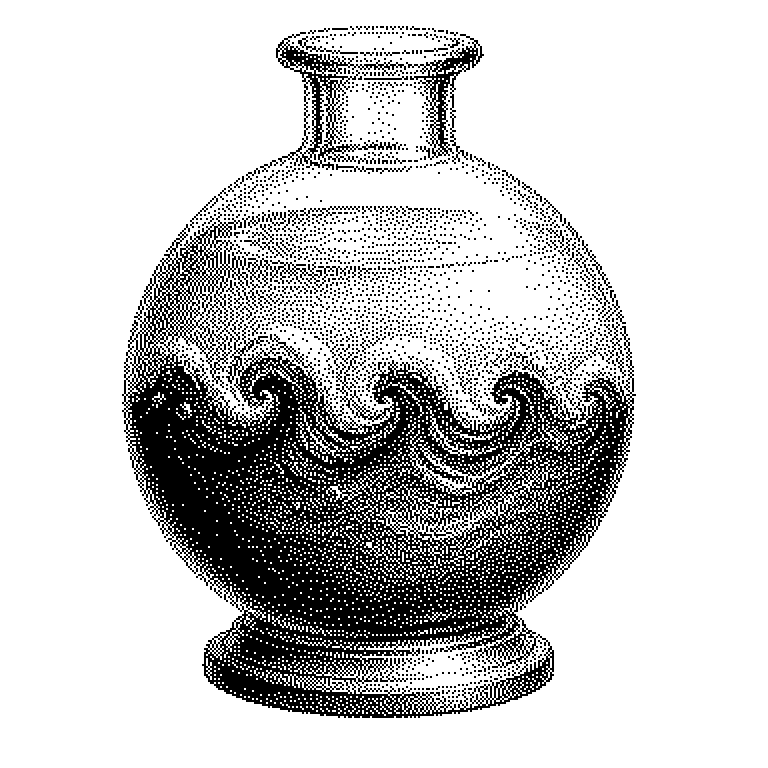
Kelvin-Helmholtz Instability
The Kelvin-Helmholtz instability occurs when two layers of a fluid or gas flow past each other at different speeds. The smooth interface then turns into waves that curl up into characteristic vortices.
When wind blows across a water surface, the water doesn’t stay smooth. Waves form, and given enough wind, their crests topple forward. This exact pattern is what the Kelvin-Helmholtz instability describes. It occurs whenever two layers slide past each other at different speeds. These can be air and water, two layers of air, or even two gas streams in space. What starts as a straight boundary first turns into waves and then into a series of curled vortices. The effect is named after the physicists William Thomson (Lord Kelvin) and Hermann von Helmholtz, who described it in the 19th century.
Why flows rarely stay smooth
The effect explains why ordered flows spontaneously turn into disorder. Physicists call this turbulent state turbulence. Turbulence is not a special case but rather the normal state of affairs in nature. The Kelvin-Helmholtz instability is one of the most important paths leading there.
This has very practical consequences. In aviation, the effect causes clear-air turbulence, meaning bumpiness without visible clouds. Such zones arise wherever two layers of air with strongly differing speeds lie on top of each other. For pilots, they are unpleasant because they can’t be seen from the cockpit.
The effect is also important for weather forecasting. It mixes warm and cold air, humid and dry air. This mixing plays a role in determining how much heat and moisture gets distributed throughout the atmosphere. Anyone wanting to simulate climate and weather must represent such mixing processes in their model.
From a small ripple to a curled vortex
The trigger is a tiny irregularity at the interface. At such a bulge, the faster layer has to take a small detour. It accelerates there, and wherever a flow speeds up, its pressure drops. This relationship is called the Bernoulli principle. The lower pressure pulls the bulge out even further.
This causes the disturbance to reinforce itself. The small dent turns into a wave, and the wave into a crest. Because the upper layer is faster, the crest gets tipped forward. Eventually it curls up into a spiral. Side by side, these spirals look like a row of equally sized curls.
Whether this happens depends on a balance of forces. The difference in speed drives the instability. Gravity and surface tension work against it, trying to smooth out the interface. A common misconception is that any swirling flow is a Kelvin-Helmholtz case. What’s truly decisive is the shear, meaning two layers with different speeds sliding past each other.
From cloud waves to Jupiter’s atmosphere
The effect is most beautifully seen in so-called Kelvin-Helmholtz clouds. They look like a row of breaking ocean waves in the sky. Such photos regularly go viral on social media. They are rare because the cloud has to make the interface visible by chance.
In astrophysics, the effect is an everyday occurrence. The famous Great Red Spot on Jupiter is surrounded by such vortex patterns. At the edge of Earth’s magnetosphere too, where the solar wind flows past, satellites measure these vortices. In doing so, they funnel particles from the solar wind into the vicinity of Earth.
In engineering, the effect shows up in simulations. Engineers use it as a standard test for flow simulation software because the result is well known. AI models for weather and flow prediction are also tested against such cases. If a model fails to reproduce the typical vortices, it hasn’t truly learned the physics.