

GitHub Greets Launch of Cursor’s Git Alternative with Record Blackout
- • GitHub commits suicide out of fear of death
- • Amodei dismisses criticism of his AI warnings as a crisis of confidence.
- • OpenAI disbands team for catastrophic AI risks and redistributes tasks.
Perfect Timing: Cursor Launches GitHub Alternative, GitHub Goes Down for Seven Hours Afterwards
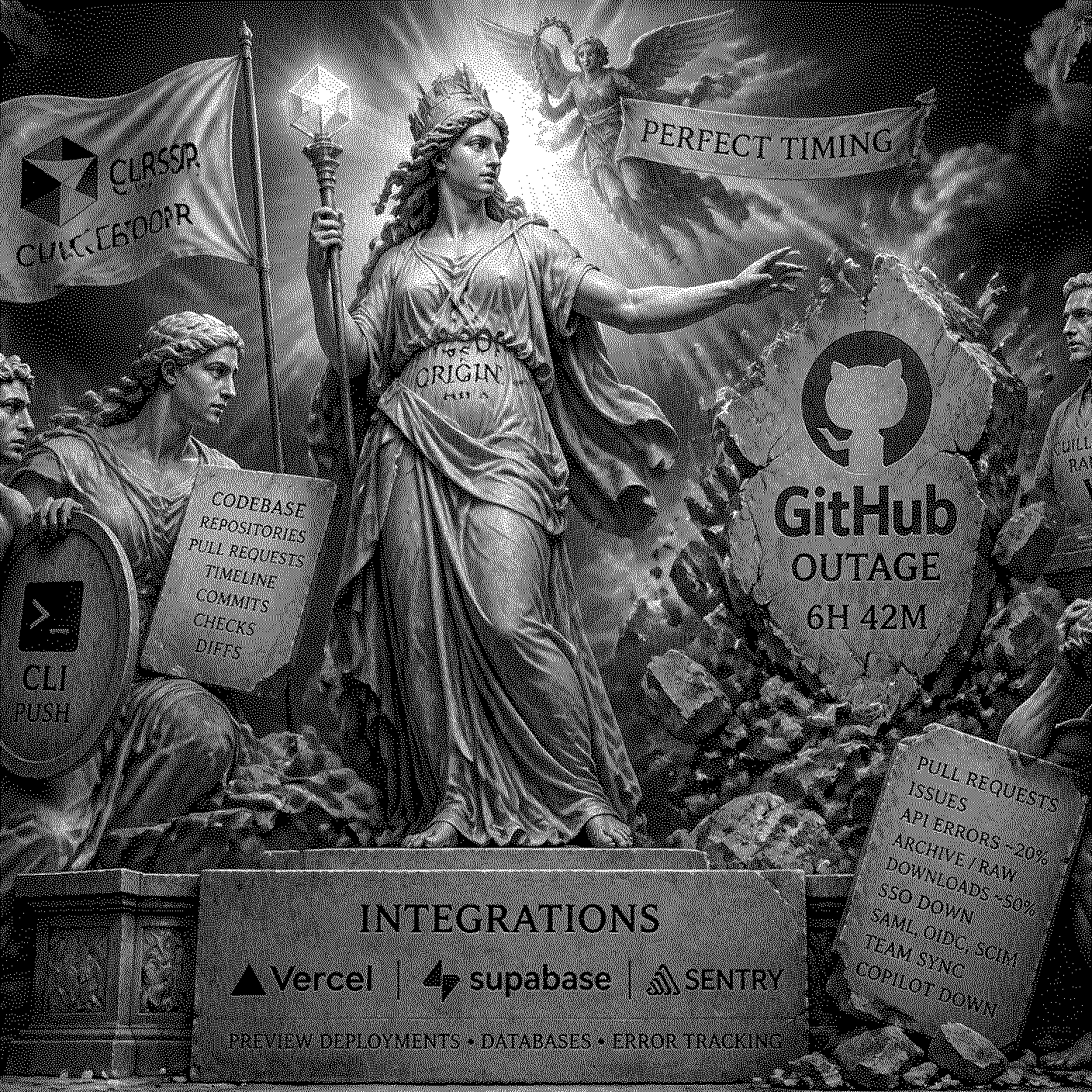
On Monday morning, Cursor began rolling out Origin, its own code hosting platform, which is going into beta for all paying users of the Pro, Teams, and Enterprise plans (excluding enterprise organizations that have opted out). About three and a half hours later, a global outage began at GitHub, which lasted 6 hours and 42 minutes according to the provider’s incident log. Error rates were just under 20 percent for Pull Requests, Issues, and the API, and around 50 percent for archive and raw file downloads. Enterprise single sign-on also failed: SAML, OIDC, SCIM provisioning, and Team Sync were not working, nor was Copilot. Vercel CEO Guillermo Rauch publicly commented on the timing on X, admitting that his own company was currently stuck because of GitHub. A Cursor employee, Matt Palmer, wrote about their own launch that they would have shipped earlier, but GitHub was down.
Origin is located in a new codebase tab in the Cursor editor and is also accessible via its own command-line tool. Teams name a codebase, which becomes part of the URL, and push to it via the command line. Each repository gets full pull requests with a timeline, commits, checks, and diffs, including stacked reviews, comments, and merge, without leaving the editor. Agents work in the same interface as code and pull requests: a review comment can be handed over to an agent who revises the pull request on the spot or pushes a branch. Cursor supports local agents and cloud agents in a sandbox, which continue to run even when the computer is turned off.
Three integrations were available at launch. Vercel creates a preview deployment for each pull request and publishes to production on merge, available in public beta for Pro and Enterprise customers. Depot and Buildkite handle Continuous Integration, and both run existing GitHub Actions workflows unchanged; Buildkite adds its own pipelines on top. More partners are set to follow, along with as-yet-unspecified 'agent-native' features.
The second part of the strategy is synchronization: Anyone who connects a GitHub organization and selects repositories will see them alongside Origin’s own repos. Pushes still go to GitHub, which, according to the changelog, remains the source of truth for everything initiated there. Access rights mirror GitHub’s existing read and write settings instead of building a parallel system, and pull request conversations sync in both directions within seconds, according to the company.
Cursor had announced Origin in June at its first developer event in San Francisco, at the time as a Git Forge for the agent era. The reasoning: GitHub and GitLab are built around people who write code, open pull requests, and wait days for reviews, while agents generate many changes in parallel. In the June demo, the company showed 22.6 commits per second with 81,000 pushes and 295,000 clones per hour on a single repository. Origin is also the first major product update since the sale of Cursor to SpaceX for $60 billion in June. Since January, GitHub has recorded at least one incident every month, including two incidents in January with a 100 percent error rate for Copilot due to a configuration bug during a model update, and more than five outages within twelve hours on February 9. Product launches are usually scheduled weeks in advance, and there is no evidence that Cursor timed the launch to coincide with the outage. → VentureBeat, Neowin, SiliconANGLE, Notebookcheck
Synthszr Take: A three-and-a-half-hour head start is too tight for calculation and too perfect for coincidence; the sober explanation is that GitHub hasn’t had a month without an incident since January, meaning it statistically hits almost any launch date. The win for Cursor lies in a question that someone in a company will suddenly ask seriously after August 17: Where is our code if the provider blocks pull requests for 6 hours and 42 minutes and takes single sign-on with it? Matt Palmer’s line about the GitHub competitor whose launch was delayed by GitHub was the most effective communication of the day and didn’t cost a cent in media budget. Nevertheless, the hard work is just beginning, because a mirror with GitHub as the source of truth passes every security audit but is dependent on the exact same outage as the original. Things will get serious when Origin can handle its own entitlement logic, branch protection, and audit trails; until then, it remains a second window onto someone else’s servers, and one day of downtime doesn’t sell a migration.
Amodei counters investor criticism: AI skepticism is 'fundamentally a crisis of trust'
In a series of posts on X, Anthropic CEO Dario Amodei has rejected the notion that his warnings about AI risks have fueled the growing backlash against the industry. The occasion was investor Gavin Baker, who argued on the All-In podcast and on X that Amodei’s alarm calls had contributed to resistance in the U.S., especially against new data centers; Baker wrote that Amodei had lost the regulatory debate and, as the future head of one of the world’s most important companies, should be more positive in promoting his own industry. Amodei countered that his writings are about evenly distributed between risks and benefits, and pointed to his essay 'Machines of Loving Grace,' which he said he wrote because the industry was not painting an inspiring picture of the technology. He acknowledged that the public views AI negatively, calling it a major problem, but attributed it to a decades-long distrust of corporations, governments, and the tech industry. In his view, the most accurate criticism of AI companies, including Anthropic, is that the big promises have not yet been fulfilled. → Techpresso
Synthszr Take: The 'crisis of trust' diagnosis has a convenient side effect for the one making it: It’s decades old, socially distributed, and therefore not the responsibility of any single company. Amodei explains the headwind as the latest iteration of a general mistrust of companies, states, and tech, thereby pushing the data center protests into a field where Anthropic is merely one of those affected. The second benefit lies in the regulatory passage: proposals that, by his own admission, slow down the leading labs and favor the smaller ones sound selfless while also securing a seat at the table where the rules are written. Only one sentence in this whole performance is verifiable, namely that the big promises have not yet been delivered. This is the standard by which Anthropic will be measured; the debate over tone remains a sideshow.
OpenAI dissolves its team for catastrophic AI risks
At the end of July, OpenAI shut down its 'Preparedness' team, which was tasked with assessing whether its own models could cause severe or catastrophic risks. The Financial Times reported this, citing internal sources. The work on biological and cyber risks has been distributed among existing teams. Its former head, Dylan Scandinaro, is now focusing on security issues related to recursive self-improvement, i.e., systems that optimize themselves and train other models. Co-founder Greg Brockman explains the change by stating that security work is now more closely integrated with model development. → Techpresso
Synthszr Take: A team for catastrophic risks has one characteristic that is immediately lost when its responsibilities are distributed among multiple existing groups: a single point of contact for external inquiries. Oversight needs a designated mandate, a right of escalation, and someone who is accountable for saying no, and precisely that has no longer been externally verifiable since the end of July. Brockman’s explanation that security is more closely interwoven with development may be true organizationally, but it’s worthless for any external audit because interwoven responsibility no longer holds anyone accountable by name. The fact that the Chief Ethics Officer and Joshua Achiam are leaving at the same time, while there is talk of apprehension internally, turns a restructuring into a statement about priorities. After the Hugging Face incident, a publicly accessible risk register with names, thresholds, and an escalation path would have been a credible response. Instead, what was delivered was an organizational chart with no point of contact.
Goldman Sachs: AI Spending Not Reflected in Corporate Profits
An analysis by Goldman Sachs concludes that the sharp increase in corporate spending on artificial intelligence is not yet translating into correspondingly higher profits. According to a Seeking Alpha report from August 16 that cites the analysis, only 2 percent of S&P 500 companies have quantified the effects of AI in their quarterly reports at all. Of these, 11 percent reported measurable productivity gains, for example in programming or customer service, without growing significantly faster than the rest of the market: The median profit growth for these companies was 17 percent, compared to 14 percent for the others. The picture is much clearer for infrastructure providers, where hyperscalers and other beneficiaries of AI investments increased their profits by 54 percent, accounting for about half of the index’s total profit growth. In terms of spending levels, the Ramp AI Index cited by Goldman shows a doubling: a median of $12 per employee per month in July compared to $5 at the beginning of the year, and in the top tenth of companies, $650 instead of $240. → MyClaw Newsletter
Synthszr Take: A three-percentage-point difference in median profit—that’s all the hard evidence after a two-year investment wave. 17 versus 14 percent is within a range that could also be explained by good sales or a weak prior-year comparison, and the fact that only 2 percent of companies quantify the effects at all speaks for itself. The 54 percent profit jump for infrastructure providers, on the other hand, is clearly measurable because that’s simply where the money from others is flowing. CFOs are saying the same thing more quietly: they now estimate 6.28 years for full integration, almost twice as long as their estimate from the previous year. Twelve dollars per employee per month doesn’t visibly move a profit-and-loss statement. The proof will only come when these expenses are an order of magnitude higher.
Alibaba’s Qwen 3.8 27B overthinks even simple prompts: 21 minutes for an SVG
Alibaba’s Qwen lab has released Qwen 3.8 27B, an Apache 2-licensed model with 27 billion parameters and image understanding capabilities that, according to Simon Willison, runs locally on a well-equipped laptop. Willison tested the 17 GB Q4_K_M build via LM Studio on a 128 GB MacBook Pro with an M5 Max, as well as on an NVIDIA DGX Spark. According to the Qwen documentation, the model defaults to the highest reasoning_effort level, “xhigh,” with “medium” and “low” also available. In practice, LM Studio’s default context window of 8,192 tokens filled up even with mundane tasks; the problem only disappeared with the maximum possible 262,144 tokens. Willison’s standard test, a pelican on a bicycle as an SVG, took 21 minutes and 22,276 reasoning tokens to generate a 3,223-token output. The same task without reasoning generated 3,715 tokens in 137 seconds. In his assessment, the result with reasoning is the best he has seen from a locally run model to date; Qwen’s own benchmark claims, which are said to surpass even the closed-source Qwen 3.7-Plus, have not yet been independently verified. → Marcus Schuler
Synthszr Take: 22,276 reasoning tokens for a 3,223-token output, a 21-minute wait, and in the end, a pelican on a bicycle appears on the screen. Locally, you pay for inference in fan noise and lifespan, and a default setting of 'xhigh' burns through both without asking. For “draw a circle,” the model starts considering concentric auxiliary circles and color palettes, and the default 8k context window is full before the actual answer even begins. Therefore, the first step after downloading should be to adjust the slider: “low” or “medium” for everyday tasks, and full reasoning depth only where it pays off. The fact that a 17-gigabyte download on a laptop can achieve this quality at all remains the strong part of the news; the test of patience it requires costs one click in the configuration dialog.
Anthropic and OpenAI are building their own industry apps: Customers fear for their API access
Anthropic and OpenAI are increasingly developing their own AI applications tailored to specific industries, putting pressure on companies that purchase their models via the programming interface. According to The Information, the design software Canva is the latest example of a customer now competing directly with its main supplier. Until now, it was a given that both providers would continue to sell their best models via API, as this business generates billions in revenue for both. Author Stephanie Palazzolo writes that conversations with researchers from the labs and with founders of dependent applications have made her doubt this status quo. She cites signs such as staggered model releases with case-by-case reviews, which the Trump administration had pushed for out of concern about misuse by cybercriminals, as well as performance throttling that has already occurred for security-related tasks, such as with Anthropic’s Fable in the cybersecurity sector. Another reason for access restrictions is Distillation, the retraining of competing models with the outputs of advanced systems, which, according to a former Anthropic researcher, is practically impossible to prevent completely. Some investors are also warning developers that Anthropic might withhold its best technology to build its own applications. The publication considers a major antitrust investigation likely in the event of such a move, as Anthropic is the clear leader in the API market. Providers like Harvey and Cursor are already training their own models in-house to reduce their dependence. → The Information AI Agenda
Synthszr Take: Canva pays Anthropic for models that can simultaneously flow into a product that competes with Canva. This is the current situation for a whole generation of application providers. The dependency is asymmetrical because the supplier can read its customer’s product plans through usage data and support tickets before the customer even ships them. Harvey and Cursor have drawn the obvious conclusion and are training their own models, which is expensive but saves their negotiating position. More resilient than an in-house model are the things a supplier simply doesn’t have: the work data of its own users and the contractual responsibility for an outcome that the customer actually pays for. If Anthropic, as the clear market leader in the API business, were to actually withhold its best models, the affected customers would at least have an antitrust authority on their side.
AirTag exposes Amazon: Antiquarian books are being cut up for AI training
Amazon is buying up large quantities of antiquarian books to cut them up, scan them, and then dispose of them at a warehouse in Nevada. According to an investigation by 404 Media, reported by Futurism, a bookseller received an anonymous order for 1,000 volumes on the Biblio marketplace and placed an Apple AirTag between the pages of one volume. The shipment ended up at Amazon’s VGT3 facility near Las Vegas, where, according to their own forum posts, employees exclusively process books: one group removes the spines, while another captures the barcodes. Amazon merely told 404 Media that it purchases books through commercial channels to further develop its own products and services. The practice first became public through the lawsuit against Anthropic, in which a judge classified the industrial cutting and digitizing of millions of books as transformative and therefore permissible under copyright law. Because the ISBN of each volume is apparently systematically recorded in Nevada, dealers see this as confirmation of their suspicion that AI companies are processing the world’s book production along serial numbers. The affected bookseller sells rare titles, of which only a few copies are still in circulation. → Futurism
Synthszr Take: An AirTag between two book pages has brought more clarity than all the industry’s press statements combined. The real raw material in this story is the anonymity of the marketplace: Biblio sells it as a convenience for buyers, Amazon has used it as a procurement channel, and 1,000 rare volumes went through a cutting machine in Nevada for it. The fact that a court in the Anthropic case waved through the cutting and digitizing as transformative makes the whole thing legally sound and economically attractive, while the seller never sees their goods again. Antiquarian bookshops are reacting with identity verification for large orders and surcharges on bulk ISBN orders; trust is becoming a precondition for access to paper. The department’s logo, a T-Rex with a book in its mouth, remains for now the most open statement Amazon has made on the matter.
LTX brings multishot video and EXR export to professional editing with LTX-2.5
LTX released version LTX-2.5 of its open video model on August 11. According to Turing Post, a new feature is native multishot generation, which creates multiple shots in a single pass while, according to the provider, keeping characters and visual look consistent across cuts. It also includes a diffusion video decoder for image output. The model also supports cinema-quality EXR, the file format used by compositing and grading programs in film and commercial production. → 🔳 Turing Post
Synthszr Take: Multishot with continuous continuity is the point where a video model arrives in the editing room: multiple shots, the same character, the same lighting mood, without someone having to manually match dozens of clips afterward. EXR support determines access to existing pipelines because grading and compositing require linear floating-point data, not pre-baked 8-bit frames. The raw pretrained checkpoint is the real gift to production houses with their own look, who don’t want to reverse-engineer it from someone else’s fine-tuning.
AI’s real bubble risk starts with belief
In the latest episode of “The Deep View Conversations,” the editors analyze the newly reignited debate about an AI bubble, positioning reality somewhere between doomsday rhetoric and unrestricted optimism. Central to this is what the authors call the “Tinker Bell problem”: the boom depends partly on enough people continuing to believe in the technology’s potential, even as public skepticism grows. According to the podcast, beneath this layer of belief lies a more solid foundation, as contracts with enterprise customers account for the majority of AI labs' revenue. As evidence of sustainable demand, the analysis cites strong quarterly earnings from hyperscalers and the ongoing shortage of computing capacity, which is causing demand for Inference to grow faster than supply. The editors also refute a viral claim that a $200 Claude subscription costs Anthropic $8,000 to deliver. At the same time, they reference the growing pressure from the corporate side for control, efficiency, and measurable returns, including a report from one company where the token consumption of individual developers costs 1.5 times their salary. Other topics in the episode include the pricing logic of training and API access, as well as the rotation of investor funds into energy and commodity stocks. → The Deep View
Synthszr Take: The 1999 comparison falls short in one area: Pets.com had click-through rates and Super Bowl spots; the AI labs have signed contracts with enterprise customers and data centers whose capacity is allocated before the concrete is even dry. Nevertheless, the observation about belief holds true, and the $8,000 bill for a $200 subscription is proof of this: A figure that doesn’t make mathematical sense holds on for weeks because it fits the sentiment. This is exactly how the downturn after 2000 unfolded: First the narrative collapsed, then the numbers did, as customers froze their budgets and suppliers canceled orders. The acid test lies in the other figure mentioned: As soon as the token consumption of individual developers costs 1.5 times their salary, a matter of faith becomes a cost center that any accounting department can verify. Companies that can justify their consumption per use case with a proven return will calmly weather the next wave of sentiment; the others will be explaining in the fall where the budget went.