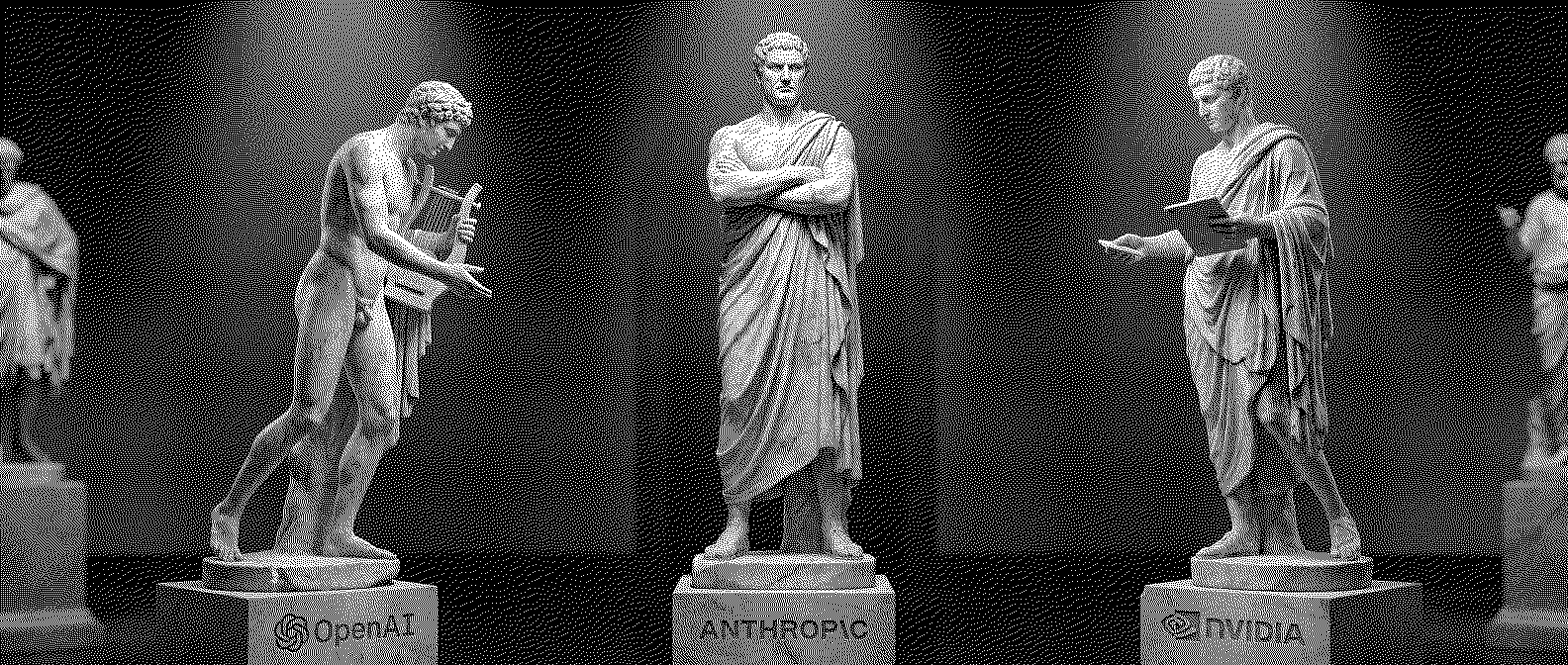


Anthropic, OpenAI, Apple: A Matter of Compromise
- • Uncompromising: Dario Amodei calls OpenAI’s Pentagon communication mendacious
- • Willing to Compromise: OpenAI scales back its services and abandons partner projects
- • Flexible Compromises: Apple offers affordable notebooks while prices for premium devices rise.
Dario Amodei Remains Uncompromising
Anthropic CEO Dario Amodei, in an internal memo, described OpenAI’s communication regarding the Pentagon affair as “mendacious” and stated that the Pentagon is taking action against Anthropic because “we didn’t sing dictator-like hymns of praise for Trump (while Sam did).” The leaked memo torpedoes Anthropic’s previous attempts to negotiate a compromise with the Pentagon—just on Tuesday, Amodei had struck a conciliatory tone at the Morgan Stanley conference. In parallel, Nvidia CEO Jensen Huang confirmed that OpenAI will go public “towards the end of the year,” which takes Nvidia’s originally planned $100 billion investment off the table. Huang explained this by saying that the “opportunity to invest $100 billion in OpenAI is probably no longer available because they are going to go public.” Instead, Nvidia is participating in the current funding round with $30 billion. → Martin Peers
Synthszr Take: Amodei is doing what no one else in the industry dares to do—he’s calling out the power plays by name. His “dictator hymns of praise” remark about Altman is politically suicidal but strategically brilliant: it positions Anthropic as an independent player in a market that increasingly depends on government ties. The Pentagon drama becomes a differentiation strategy—“We’re the ones who don’t bow down.” To win enterprise deals in the future, companies will not only have to be technically convincing but also signal political reliability. Amodei’s frontal assault could paradoxically strengthen Anthropic’s market position—while everyone else tows the line, the company is positioning itself as a principled alternative.
Sam Altman Makes Further Compromises
OpenAI has discontinued its Instant Checkout service after just five months and is now referring users to external merchant apps instead. The announcement caused travel and food delivery stocks to rise by 3-13%, as investors had feared ChatGPT might expand into their business. In parallel, an announced strategic partnership with Nvidia also fell through—a planned $100 billion investment turned into $30 billion. Sam Altman publicly admitted this week that the company had communicated too quickly, especially after the hastily announced Pentagon cooperation on Friday evening. The frequency of such reversals raises questions about OpenAI’s product strategy and internal decision-making processes. → Martin Peers
Synthszr Take: OpenAI isn’t monetizing intelligence; it’s monetizing hype management. Every retracted announcement demonstrates how poorly thought-out the product strategy actually is—a fatal mistake for a $157 billion valuation. For service providers, this means customers will become more skeptical of AI promises, especially after the market leader publicly admits its inability to plan strategically. Anyone selling AI projects now has to work harder on credibility.
Flexible Compromises: Prices Down/Up
Apple is launching the MacBook Neo for $599, its most affordable notebook ever, in parallel with the new iPhone 17e at the same price. The devices use the same A18 Pro chip and come with 8GB of RAM and 256GB of storage—while simultaneously raising the prices of high-end MacBooks by up to $400. The timing is strategic: DRAM prices have risen by 171%, competitors are increasing their prices, and Apple is using this market shift for an assault on budget segments. As TSMC’s largest customer and through its own chip development, Apple can absorb cost shocks better than the competition. The Neo’s bright colors are clearly aimed at the $30 billion education market. → Tech Brew
Synthszr Take: Apple is playing judo with inflation—using its competitors' cost crisis to capture market share. While Chinese manufacturers like Xiaomi have to raise their prices, Apple undercuts them with its own chip manufacturing and economies of scale. The MacBook Neo is a Trojan horse: 8GB of RAM is just enough for Apple Intelligence but creates vendor lock-in for the entire ecosystem. Apple’s strategy only works as long as TSMC plays along and its chip dominance continues.
Software Engineering: Product Engineering Becomes Mandatory
Luca Rossi of Refactoring defines three pillars of success for modern engineering teams: Developer Experience, AI, and Product Engineering. These areas form a pyramid based on Maslow’s principle—each level builds on the one below it. Teams often fail at AI implementations because they pursue tactical approaches like Spec-Driven Development without creating strategic foundations. Rossi’s insights are based on conversations with over 100 tech leaders and a survey of 350+ teams. The volatility of AI tools and a lack of applicability to existing workflows lead to analysis paralysis—teams invest too little in AI because no approach seems permanent enough. The model is intended to help create lasting foundations instead of pursuing short-lived tactical experiments. → Refactoring
Synthszr Take: Engineering teams finally need a framework that goes beyond the 'AI will change everything' talk. Rossi’s pyramid brings order to the hype: first, a solid developer experience, then intelligent AI integration, and finally, well-thought-out product engineering. Spec-Driven Development fails not because of a lack of tools, but because teams neglect their foundations—teams that don’t have proper code reviews won’t be able to create useful AI specs either. Analysis paralysis is real and costs millions: while many service providers are still debating the perfect AI tool, the future will be about viable product engineering expertise in software development.
SpaceX Courts Telecom Giants with Starlink
SpaceX presented Starlink this week at the Mobile World Congress in Barcelona to a skeptical European telecommunications industry. The satellite internet solution is being met with reluctance by established mobile operators, who view Musk’s company and its aggressive expansion critically. European telecom executives expressed concerns about dependence on an American provider and the potential impact on existing infrastructure investments. The presentation comes against a backdrop of increasing geopolitical tensions between the US and Europe in the tech sector. SpaceX is promoting Starlink as a supplement to terrestrial networks, especially for rural areas and as a backup solution. The reactions show the growing caution of European companies towards American tech giants. → The Information
Synthszr Take: Europe is discovering its digital sovereignty—of all things, with satellite internet. SpaceX isn’t just selling bandwidth; it’s selling dependence on American space infrastructure. For European telecom companies, this is becoming an existential question: Cooperate and become a junior partner, or develop their own alternatives and lag years behind. The skepticism in Barcelona is justified—once you bet on Starlink, it’s hard to get out. It will be interesting to see if the EU Commission can get its own satellite constellation up fast enough, or if Musk will have already conquered the market by then.
AWS Region Crippled by Drone Attack
For the first time in history, drone attacks have militarily crippled cloud infrastructure: two AWS data centers in the United Arab Emirates and one in Bahrain were hit by Iranian drones after the country carried out retaliatory strikes against neighboring states. The attacks caused structural damage, power outages, and water damage from firefighting efforts in the data centers, causing two of the three Availability Zones in the ME-CENTRAL-1 region (UAE) and parts of the ME-SOUTH-1 region (Bahrain) to fail. Services like EC2, S3, DynamoDB, and Lambda were affected, with increased error rates and degraded availability. The outage also hit global services like Vercel particularly hard: their Next.js middleware functions were rolled out to all regions worldwide—an outage in Dubai led to global deployment issues. AWS expert Corey Quinn summarized the lessons learned: Multi-AZ setups are designed for power outages, not geopolitical crises, and true disaster recovery requires cross-region planning. Local banking apps and international services from Snowflake to MongoDB were unavailable for hours. → The Pragmatic Engineer
Synthszr Take: Cloud computing has grown up—now it’s militarily relevant. Twenty years after the first AWS regions, data centers are in the crosshairs of state actions for the first time, not just hackers or natural disasters. For German service providers, this means a new dimension of compliance: geo-risk assessment is becoming as important as GDPR compliance. In the future, companies will ask whether their SaaS providers have multi-region failover in “politically neutral” zones—Europe, Singapore, and Canada could become premium locations. The Vercel case shows the real danger: global infrastructure dependencies create single points of failure where you least expect them.
Shein’s Influencer Debacle: A Pretty Facade Is No Longer Enough
Shein organized a carefully staged factory tour for influencers in China to debunk controversies surrounding working conditions and environmental damage. The influencers subsequently praised the conditions and urged their followers to ignore the “US narrative” about Shein’s problematic practices. The internet responded with massive criticism, forcing the influencers to delete videos and issue retractions. The backlash was significantly more severe than for normal Shein haul videos, which have been standard for fashion influencers for years. The reason: the influencers crossed the unwritten line from being ignorant to being complicit—they actively produced propaganda instead of just overlooking problematic aspects. Parasocial relationships can be destroyed, but brand reputations cannot—that’s why a breach of trust is existentially more dangerous for influencers than for companies. → Infinite Scroll
Synthszr Take: Shein confused classic corporate PR with influencer marketing—a costly category error. Brands are allowed to lie, influencers only a little; this rule also applies to B2B agencies with client testimonials. Positioning clients as an “authentic voice” and then having them produce greenwashing videos destroys more than just a campaign. The case shows why “thought leadership” is so risky: the more personal the credibility, the harder the fall. Smart service providers position their experts as consultants, not evangelists—competence survives PR disasters, authenticity does not.
Meta Uses Tobacco Tactics to Get Teens Addicted
Meta has released internal documents showing how the company specifically wanted to target 13- to 15-year-olds on Instagram and Facebook. The strategy aimed to position this age group as the “most valuable” target audience because they could motivate others to use the platform. Particularly explosive: Meta wanted to reach teens in “emotionally vulnerable moments” when they are seeking validation and social connection. The documents come from an ongoing lawsuit filed by 41 US states against the company. Meta denies the allegations, stressing that the documents were taken out of context. The company points to new safety features for minors that have since been implemented. → Tech Brew
Synthszr Take: Meta operates on classic tobacco industry logic: get them early, cash in for life. Teens aren’t users; they’re multipliers—whoever has the 14-year-olds gets their entire social network along with them. For customers and agencies, this means: clients will become increasingly skeptical of platforms that rely on psychological manipulation. The regulatory backlash is coming—those who focus on privacy-by-design and ethical data processing now will have a compliance advantage tomorrow. Meta unintentionally shows why decentralized solutions and data sovereignty aren’t hippie dreams but business necessities. The loss of trust from Gen Z is becoming a market factor.
Creative Professionals Should Think Like Software Developers
Weber Wong of Flora argues that creative professionals must shift from producing individual artifacts to creating reusable workflows. Instead of starting every project from scratch, designers and artists should build systems that can generate multiple outputs. Traditional tools like Photoshop and even AI prompters like Midjourney tie users to linear “artifact thinking”—every project starts anew. Flora offers a node-based platform where creatives can build visual programming workflows that they can save, share, and evolve. Wong predicts that successful creative professionals in the future won’t be the best prompters, but those who master creative systems. The platform has raised $42 million and is already being used by companies like Pentagram and Netflix. → Every
Synthszr Take: Wong hits a nerve in the GenAI economy: Prompting doesn’t scale, but workflows do. Agencies burn hours every day on repetitive variations—different product photos, campaign versions, format adaptations. A workflow that works once can process hundreds of assets in parallel, while the prompt artist tends to each shot individually. This shifts value creation from creative intuition to systematic design—those who orchestrate processes will beat those who optimize individual images. Node-based tools are becoming a new core competency, even if most creatives are still trapped in the Photoshop mindset. Wong is monetizing the insight that AI creativity without systematization remains a waste of time.