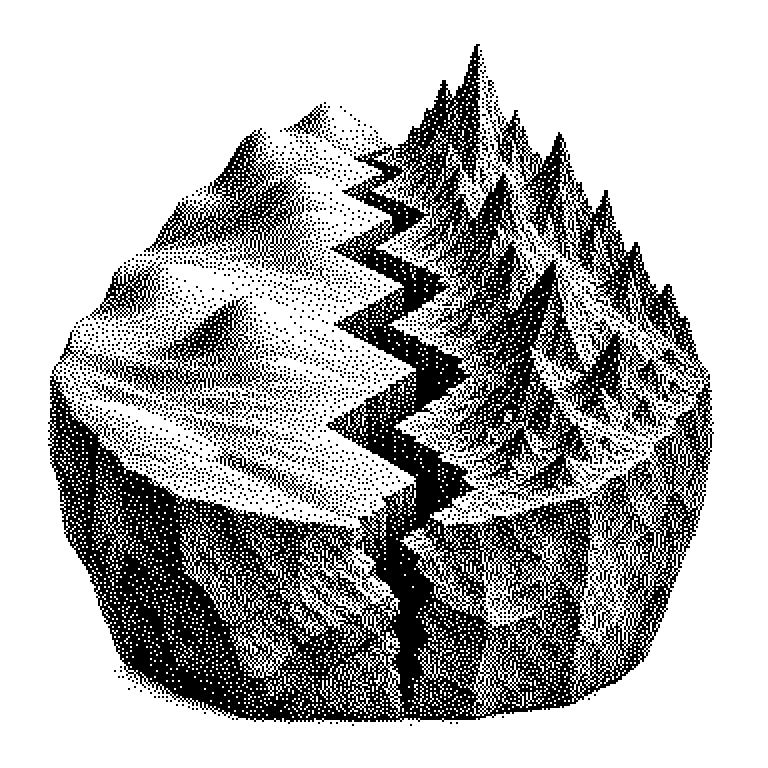
Jagged Frontier
Jagged Frontier describes the pattern whereby AI systems perform astonishingly well on some tasks and surprisingly poorly on seemingly similarly difficult tasks. The boundary of their capabilities does not run smoothly along our notion of "easy" and "hard," but rather jaggedly.
When a human solves a difficult task, we assume they can also handle the easier ones. For programs that write texts and answer questions, this assumption does not hold. Such a program can meaningfully summarize a legal contract and then fail at a simple arithmetic problem. The term Jagged Frontier describes exactly this pattern. One imagines the machine’s capabilities as a map: inside the boundary everything works, outside it does not. But this boundary is not a smooth line—it has deep indentations and sharp, far-reaching spikes.
Why you can’t tell from the outside where the machine will fail
The real problem is not that AI systems make mistakes. The problem is that you cannot predict their mistakes. With a human, we infer from one performance to another: someone who speaks fluent Chinese can presumably also count to ten. With a language model—a program that has learned language patterns from vast amounts of text—this inference does not work.
On top of that, the systems sound just as confident where they are wrong as where they are right. They deliver an incorrect answer in the same assured tone as a correct one. For users, this means you cannot tell from the phrasing which side of the boundary you are currently on. This is precisely what makes deployment in businesses tricky.
The term originates from a widely noted 2023 study in which consultants worked with and without AI support. On tasks within the boundary, AI users became noticeably faster and better. On tasks just outside it, they actually performed worse than the comparison group—because they trusted the machine.
Where the jagged edges come from
Language models do not learn according to a curriculum, but from whatever happens to be in their training data. For some topics, millions of texts exist; for others, almost nothing does. Where a lot of material is available, strong capabilities emerge. Where little is available, gaps remain—even if the task seems trivial to us.
Then there is the way the models are built. They predict, word by word, what would plausibly come next. This method is excellently suited to language, summaries, and style. For exact counting, precise calculation, or adherence to hard rules, it is inherently poorly suited. This is why the famous question about the number of certain letters in a word often falls outside the boundary.
Importantly: the boundary shifts with each new model generation, but it does not become smooth. Some indentations disappear, new ones appear elsewhere. A common mistake, therefore, is to infer from an old list of failures what today’s systems cannot do.
What this means for practical use
In everyday life, one encounters this effect constantly, usually without it being named. A chatbot explains a physics topic flawlessly and then, two sentences later, invents a source that doesn’t exist. A translation sounds perfect but contains a wrong date. Anyone who knows the pattern checks the vulnerable spots specifically instead of trusting blindly.
In companies, the term leads to a clear way of working. One systematically tests which specific tasks a model handles reliably, and uses it only for those. For everything else, a human remains in the review loop. Consultants often speak of mapping the frontier: try it out, document it, retest regularly.
The topic also comes up in financial and business news. When a company announces that an AI achieves top scores on a test, this says little about its everyday usefulness. A high score on a benchmark only proves a single spike, not the whole surface. This explains why enthusiastic test results and sobering real-world reports often exist side by side.