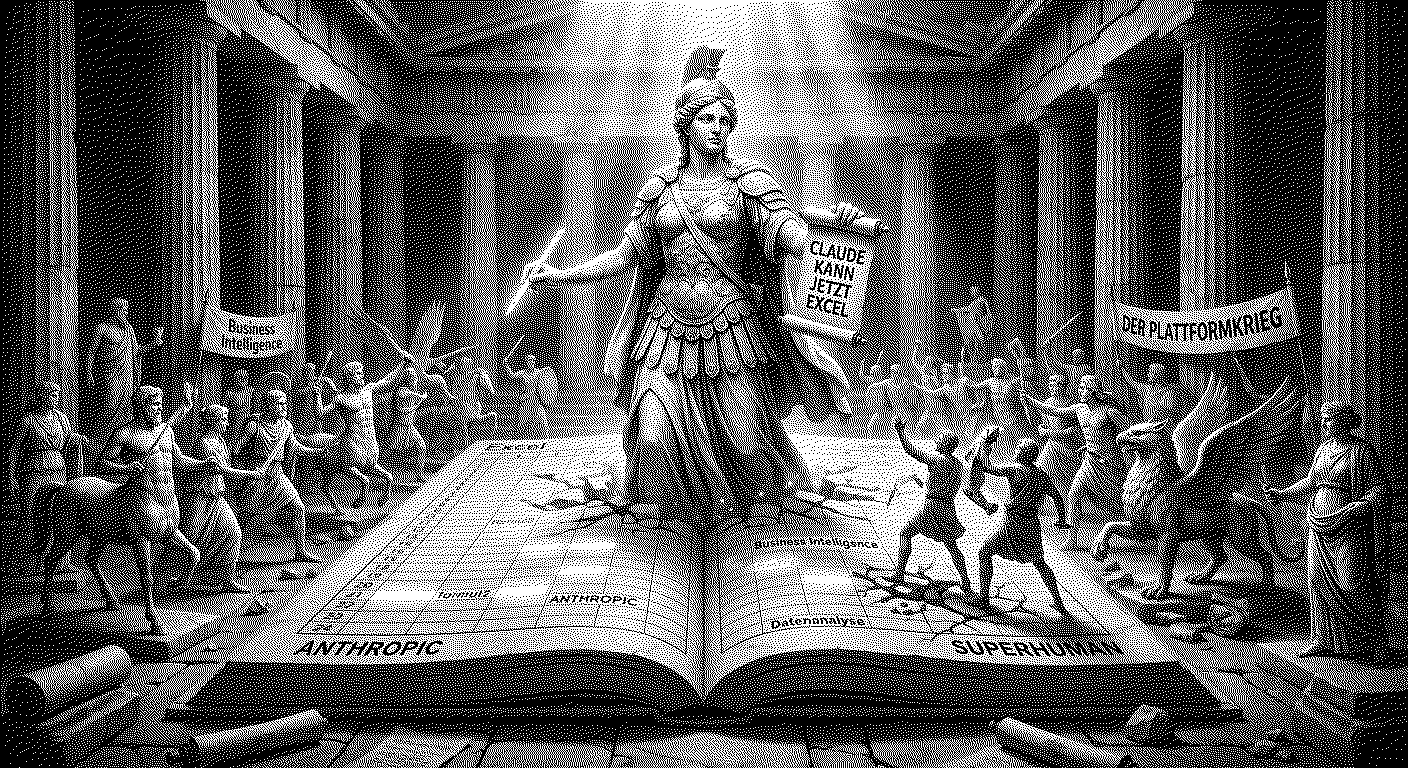


Claude Can Now Do Excel, AI is Building Itself, Minnesota Memes
Anthropic has made Claude available for Excel users with a Pro subscription, the next generation of AI chips is designed by AI, and in Minnesota, we are seeing state-sponsored fake narratives at scale.
Claude Can Now Do Excel
Anthropic has made Claude for Excel available to Pro subscribers. The tool allows users to ask questions about cells, test scenarios, and debug errors, all with cell-level references to verify the logic. Claude reads the entire workbook context, including nested formulas and cross-sheet dependencies. This step follows the trend of integrating AI functions directly into existing productivity tools rather than offering them as separate chat applications. → Superhuman – Zain Kahn
Synthszr Take: The real news isn’t the feature, but the platform war. AI is leaving the chatbox and embedding itself where business value is created (and billed). For decades, Excel has been the low-code platform for the entire business world. Injecting an AI model directly here isn’t a feature update; it’s a direct assault on the entire business intelligence and data analytics market.
Claude Again: The Oppenheimer Question
In a detailed essay, Anthropic CEO Dario Amodei issued a stark warning about the upcoming risks from advanced AI. He describes the current phase as 'technological adolescence,' in which humanity is gaining unimaginable power without the necessary maturity to control it. Amodei fears massive job losses, the concentration of power in AI companies and authoritarian states, and the potential for biological attacks. He compares the imminent existence of AI systems to the sudden arrival of a 'nation of geniuses in a data center.' Despite his concerns, he remains optimistic that the challenges can be overcome but calls for an urgent 'awakening' of society. → Techmeme
Synthszr Take: This is the Oppenheimer moment for the AI generation. Amodei is positioning himself as a responsible creator wrestling with the implications of his creation. However, this is less altruism and more strategic positioning: whoever defines the debate on 'safety' and 'responsibility' shapes the inevitable regulation and erects high barriers to entry for competitors. The true message of the essay is not for the public, but for the regulators in Washington and Brussels: Let us write the rules before someone else does.
The Recursive Dream of Silicon Valley
Two new startups, Recursive and Ricursive, are pursuing the goal of developing self-improving AI systems. Ricursive Intelligence, founded by two former Google researchers, has raised $335 million at a $4 billion valuation to use AI to optimize the design of specialized computer chips. The thesis is a positive feedback loop: better chips lead to better AI, which in turn designs better chips. This concept of recursion is a long-standing obsession in Silicon Valley and is now receiving massive financial support amidst the AI boom. → Techmeme
Synthszr Take: The recursion narrative is as old as AI itself, but now it’s backed by a 10-figure valuation. The idea of AI designing its own hardware is the ultimate feedback loop. This isn’t just about faster chips; it’s about the complete collapse of the hardware-software development cycle into a single, self-accelerating process. When the infrastructure optimizes itself, the ability to control that loop becomes the ultimate strategic resource.
Minnesota: Murder as a Meme
The killing of Alex Pretti by ICE agents in Minneapolis has led to a government disinformation campaign. Pro-Trump influencers and government officials spread false narratives and manipulated images on platforms like X to demonize the victims. This incident highlights how state actors use social media to control the public perception of violence. At the same time, the widespread outrage shows that the disinformation had limited success this time, as verified videos clearly documented the events. → Casey Newton
Synthszr Take: The state’s monopoly on violence is being expanded to include a new capability: the monopoly on narrative, orchestrated and amplified by digital platforms. The goal of state disinformation is not to convince everyone. It’s about muddying the information landscape to such an extent that doubt is sown, the opposition is paralyzed, and reality becomes a matter of political affiliation.
Agents Become 'Communities of Thought'
New research shows that advanced reasoning models like DeepSeek-R1 improve their performance not just through longer computation chains, but by simulating interactions between multiple agents. This 'community of thought' allows for diversification and debate between internal cognitive perspectives with different 'personality traits.' The models exhibit a greater diversity of perspectives, leading to internal conflicts and ultimately to better problem-solving. This mechanism is similar to collective intelligence in human groups. → Techpresso
Synthszr Take: This is the technical realization of Marvin Minsky’s 'Society of Mind' concept from the 1980s. AI is moving from monolithic computation to structured, orchestrated thought processes. It’s increasingly about exploring a solution space through internal discourse. This is a paradigm shift: away from pure information processing, towards synthetic cognition. The quality of the results will in the future depend on the quality of the internal debate.
Standardization for AI Agents
OpenAI, Anthropic, and Google have agreed to jointly develop standards for AI agents. At a time when the industry's focus is shifting from pure chat applications to the commercialization and deployment of autonomous systems, this is a remarkable step in coordination. The initiative aims to create interoperability and possibly also safety guidelines for a future where agents perform complex, multi-step tasks across different platforms. This development points to a maturing of the market. → The Information
Synthszr Take: This is an attempt to define the ISO/OSI layer for the coming agent economy before the market fragments. The major players know that siloed systems won’t work for agents that need to interoperate across the entire web. This is a preemptive move to shape the protocols of the next internet and thus secure their own dominance. Whoever controls the standards controls the market: a cartel in statu nascendi.
China: AI and Hardware Merge
Chinese LLM unicorn StepFun has raised over $720 million in a Series B+ round, backed by investors like Tencent. The company focuses on integrating its models into consumer products such as smartphones and smart vehicles. Partnerships with brands like OPPO, Honor, and Geely Auto are already in place. StepFun expects to integrate its LLMs into over a million vehicles this year, highlighting the rapid pace of AI commercialization in China. → Techmeme
Synthszr Take: While Silicon Valley debates the risks of AGI in essays, China is shipping AI in cars and smartphones. The 'AI plus terminals' strategy is designed for maximum speed in implementation and massive-scale data collection. The West is focused on developing frontier models; China is merging its models with its unbeatable manufacturing capacity.
Creatives Ban AI Art
Following massive protest from artists, San Diego Comic-Con has changed its guidelines and completely banned AI-generated art from its exhibition. Originally, the plan was to allow such works under certain conditions, but this led to an immediate outcry from the community. The artists argued that allowing it would normalize an exploitative technology that threatens their livelihoods. The organizers' quick reversal shows the growing cultural tension and the resistance of established creative communities to synthetic media. → TLDR Design
Synthszr Take: This isn’t about the definition of art; it’s about community gatekeeping. Creative communities are redrawing their boundaries with synthetic media. The debate is not 'Is this art?' but 'Is this our art?'. This is a cultural immune response to a technology that threatens to devalue established signals of skill, effort, and originality. The ban is an attempt to maintain control over their own cultural production.
Everything Used to Be (Not) Better
An essay from a16z contrasts the reality of life in 1776 with today’s to question widespread technological pessimism. The text argues that we are surrounded by 'invisible wonders'—from clean water and abundant food to instant global communication. The difficulty lies in perceiving this progress because it has become normal. The author describes the current situation with David Foster Wallace’s fish-in-water analogy and urges that, despite all challenges, the standard of living achieved is an immense accomplishment. → a16z
Synthszr Take: The core problem of our time is not a lack of progress, but a failure of narrative. We have 21st-century technology but try to understand it with 20th-century mental models. This leads to a pervasive sense of dislocation and pessimism. Progress hasn’t disappeared; it has just become so commonplace that, like gravity, it’s invisible until it fails.
The Decay of Institutions
A recent roundup analyzes the self-destructive behavior of global superpowers. The US is suffering from a MAGA movement that is increasingly anti-science and undermines the rule of law, as shown by the ICE killings. China is weakened by Xi Jinping’s autocratic purges, which are now affecting even the most experienced military leaders. Russia is losing an entire generation of young men in Ukraine in senseless 'meat assaults.' In contrast, India is positioning itself as a rising power focusing on economic growth and technological progress. → Noahpinion
Synthszr Take: The analysis is correct but overlooks the underlying mechanism. It’s not simply foolishness; it’s institutional decay. The US political system is at a standstill, China suffers from the pathologies of autocracy, and Russia is in a demographic death spiral. The 'foolishness' is a symptom of systems that are no longer fit for purpose in a rapidly changing technological landscape. The real question is what new systems will emerge from this decay.