Anthropic Hacks Your Moods and North Korea Hacks Crypto Exchanges
- • Anthropic analyzes user moods for quality control
- • North Korean hackers trick a crypto exchange and steal $270 million
- • Google’s Gemma 4 impressively surpasses large models in AI benchmarks
WTF: Anthropic Tracks Your Curses
Developers found some surprises in Claude’s accidentally leaked source code: Anthropic systematically tracks how often users swear and how often their mood changes. A regex filter detects expressions like “wtf,” “f*** you,” or “this sucks” and marks them in analytics as “is_negative: true.” Boris Cherny, a developer of Claude Code, defends this as a quality signal: “We call it the 'f***s' chart internally.” For frustrated Anthropic employees, the system goes even further: a pop-up asks if they want to share their transcripts as a bug report. The leak itself was caused by human error in the deployment process; no one was fired. Student Sigrid Jin’s “Claw Code” repository has been forked nearly 100,000 times. → futurism.com
Synthszr Take: Anthropic has revealed what Big Tech has been doing for years: treating emotions as product metrics. The “f***s chart” is more honest than any NPS score because anger reveals the unvarnished truth about product quality. This is reminiscent of call centers that use voice analysis to route frustrated customers to premium agents, except here the AI itself becomes the therapist. The Anthropic employee feature (“Hey, you seem upset, wanna file a bug report?”) highlights a double standard: internally, frustration is treated as a valuable signal; externally, it’s logged as a silent analytics event. The data leak might unintentionally be the best product decision: 100,000 forks mean 100,000 potential improvements to a system that takes anger seriously.
$270 Million: How North Korea Hacked a Crypto Exchange
North Korean hackers stole $270 million from Drift Protocol by posing as a legitimate quant trading firm for over six months. The attackers met Drift employees at a major crypto conference, asked detailed technical questions, and deposited over a million dollars of their own capital. They conducted several work sessions, built trust, and eventually tricked an employee into downloading a manipulated TestFlight app. The operation also exploited a known vulnerability in VSCode and Cursor. Security experts warn that the depth of the personas and the professionalism of the operation suggest that other teams may already be compromised. → Techmeme
Synthszr Take: This operation reveals a structural power imbalance: private companies are systematically outmatched by state-sponsored attackers. States operate with more time, more capital, and fewer restrictions. While companies optimize for speed and growth, attackers invest months in building trust. The crucial point: every system is hackable—not just technically, but also humanly. The vulnerability wasn’t primarily a tool but the assumption that credible, competent counterparties are legitimate. State actors treat deception as a core competency. Companies treat trust as a lever for efficiency. This is precisely where the attack vector emerges. The consequence: security is not a tooling problem, but a structural one. In an environment where deception scales better than verification, the actor with more patience and fewer constraints wins—and that is rarely the company.
Reduce to the Max: Gemma 4 Performs Formidably in Initial Tests
Google has released Gemma 4, a 31-billion-parameter model that surpasses systems with over 600 billion parameters in reasoning and math benchmarks. The open-source models, under the Apache 2.0 license, have reached ranks 3 and 6 in the global Arena AI Ranking—ahead of all Western alternatives except for top Chinese models. The 31B model achieves 85.2% on MMLU Pro and 89.2% on AIME 2026 mathematics, while the 26B Mixture-of-Experts variant achieves similar performance with only 3.8 billion active parameters per run. Both support 256K-token context windows and run on Nvidia and AMD GPUs, as well as Google Cloud TPUs. The models are based on the Gemini 3 architecture—Google has effectively distilled the intelligence of its closed-source flagship into smaller, open variants. → Evan Armstrong from The Leverage
Synthszr Take: Google is weaponizing the AI industry's biggest weakness against itself: parameter fetishism. While OpenAI and Anthropic lock their models behind APIs and Chinese labs dominate the leaderboards (while giving compliance departments nightmares), Google is pushing a Trojan horse into the market. The Apache 2.0 license is the real masterstroke—it turns a technical breakthrough into a procurement argument. Gemma 4 isn’t a model; it’s a franchise system: Google releases the recipe but keeps the kitchen (TPUs, training data, Gemini base). This is reminiscent of Microsoft’s DOS strategy in the '80s: define the standard while controlling the infrastructure. 31 billion parameters on a single H100 for $3 an hour turns the race for the biggest number into a race for the cleverest architecture.
From 1 to 19 Billion in 14 Months: Anthropic’s Growth Playbook
Anthropic catapulted its revenue from $1 to $19 billion ARR in 14 months. Head of Growth Amol Avasare, who joined the company via a cold email without a job posting, uses counter-intuitive methods: 70% big bets instead of small tests, intentionally complex onboarding as a filter, and an internal tool called CASH that conducts autonomous growth experiments with Claude. His most radical thesis: in the future, companies will need more Product Managers than developers because AI makes individual engineers exponentially more productive. Avasare identifies activation as the biggest lever in AI growth and uses tools like Cowork to detect team conflicts in Slack before they escalate. → Lenny’s Newsletter
Synthszr Take: Anthropic is demonstrating what happens when growth teams make their own tools the object of optimization: CASH is essentially a self-referential growth loop where Claude hacks its own distribution. This is reminiscent of biological systems that encode their own replication mechanisms (like viruses and their RNA). The 70/30 strategy in favor of big bets contradicts all textbooks but works because AI markets follow winner-takes-all dynamics: whoever reaches critical mass first defines the standards. The PM-to-engineer flip isn’t an organizational issue but a power shift: when code becomes a commodity, intent becomes the scarce resource. Anthropic proves that in the AI age, it’s not the best technology that wins, but the one that learns fastest how to distribute technology.
Content Moderation: AI Workers Instead of Click Workers
Brett Levenson left Apple in 2019 to lead 'Business Integrity' at Facebook, right in the middle of the Cambridge Analytica scandal. His realization: human moderators had to memorize a 40-page, machine-translated rulebook and then had 30 seconds per content decision—with an accuracy rate barely over 50%. This delayed, reactive approach no longer works in a world of AI-generated content, where chatbots give teenagers self-harm instructions or AI-generated images bypass safety filters. Levenson then founded Moonbounce, which has now raised $12 million from Amplify Partners and StepStone Group. The startup transforms static policy documents into executable logic: a proprietary language model evaluates content in under 300 milliseconds and decides whether to block, slow down, or allow it. Moonbounce already serves over 100 million daily active users on platforms like Tinder, AI companion startups like Channel AI, and image generators like Civitai. → Techpresso
Synthszr Take: Moonbounce solves the content moderation problem like a compiler: policy becomes code, interpretation becomes execution. This is reminiscent of the transition from interpreted BASIC to compiled C in the '80s—suddenly, things that were previously unthinkable became possible. The real breakthrough isn’t the 300-millisecond latency but the fact that Moonbounce sits as a neutral third party between the user and the AI, without the contextual baggage of the main models. While GPT or Claude struggle through tens of thousands of tokens and forget their guardrails, Moonbounce focuses on a single task: real-time rule enforcement. This is division of labor at the system level—just like modern CPUs have dedicated encryption units. The irony: the more powerful AI becomes, the more it needs specialized guardian AIs to keep it in check.
From Song to Video Clip in a Second: TikTok is Being Redefined by Generation
AirMusic promises to democratize music video production: any song can be turned into a 'viral' video with multiple scenes, characters, and cinematic transitions using AI. The Director Mode automatically generates a complete storyboard, including camera angles and scene changes, while the Custom Mode allows for full creative control. With prices starting at 50 cents per scene and export options for TikTok, YouTube, and Instagram, the tool positions itself as an alternative to traditional production processes. The platform offers eight visual styles from anime to cyberpunk, ten different video models (Grok, Seedance, Vidu), and a timeline editor for arranging the generated clips. Particularly noteworthy: the AI analyzes lyrics and beats to create suitable visual narratives, while uploaded character photos are kept consistent across all scenes. → TAAFT - There’s An AI For That
Synthszr Take: AirMusic is turning music videos into the next battleground of content industrialization, just like stock photos, blog posts, and illustrations before them. The 50-cent-per-scene threshold is reminiscent of the pricing logic of early microstock platforms: low enough for experimentation, high enough for profitability at scale. What’s really happening here is the transformation of music videos into an API function; instead of months of production with a crew and location scouting, the video becomes a parametric output (Style: Cyberpunk, Mood: Romantic, Characters: 3). The irony: while labels invest millions in lavish productions, the next viral TikTok sensation could emerge from a $5 budget. Music videos are becoming the next victim of the brutal efficiency of generative AI.
AdsCreator Extracts a Complete Ad Campaign from Any Website
A new AI tool called AdsCreator promises to generate complete ad campaigns from any website in minutes. The process is incredibly simple: insert a URL, the AI automatically extracts colors, typography, and visual language, and then creates ads for Meta, Google, and story formats. Pricing starts at $24 per month for 600 credits, with one credit equaling one finished ad. The tool is explicitly aimed at solo creators, agencies, and in-house teams who want to 'deliver faster without diluting the brand.' → TAAFT - There’s An AI For That
Synthszr Take: AdsCreator is less an innovation than a revelation: a large part of ad production is standardized derivation—colors, typography, and imagery are mechanically transferred to new formats. This exact part is now being trivially automated. The real disruption lies in the price: $24 for 600 ads means that creative production is being commoditized down to a few cents per asset. What was once sold as a creative service is becoming a computational operation. This radically shifts the value: the creation of ads is no longer the scarce resource, but the decision of which ones should be created at all. Strategy replaces production. The industry is now facing a stark reality: anyone whose business model was built on scalable execution is suddenly competing with software prices. The moat was never the execution—and now it’s gone for good.
The Orchestrator Beats the Artist: System Design is the Real Game
The Business Engineer argues that in the AI era, humans will not become prompt whisperers but orchestrators of complex agent systems. So far, nothing new. What’s interesting is the sharpened focus: AI models are trained on the statistical average ('Mediocristan'), while business decisions are made in the world of extreme events ('Extremistan'). The human’s value contribution lies not in operating the AI, but in recognizing when the model’s consensus output is dangerously wrong. Three core competencies define the successful orchestrator: 'Taste' (reading distribution geometries), 'Nuance' (mapping unwritten knowledge), and 'Judgment' (deciding between competing frames). The agentic loops exponentially amplify both correct and incorrect initial conditions. → The Business Engineer
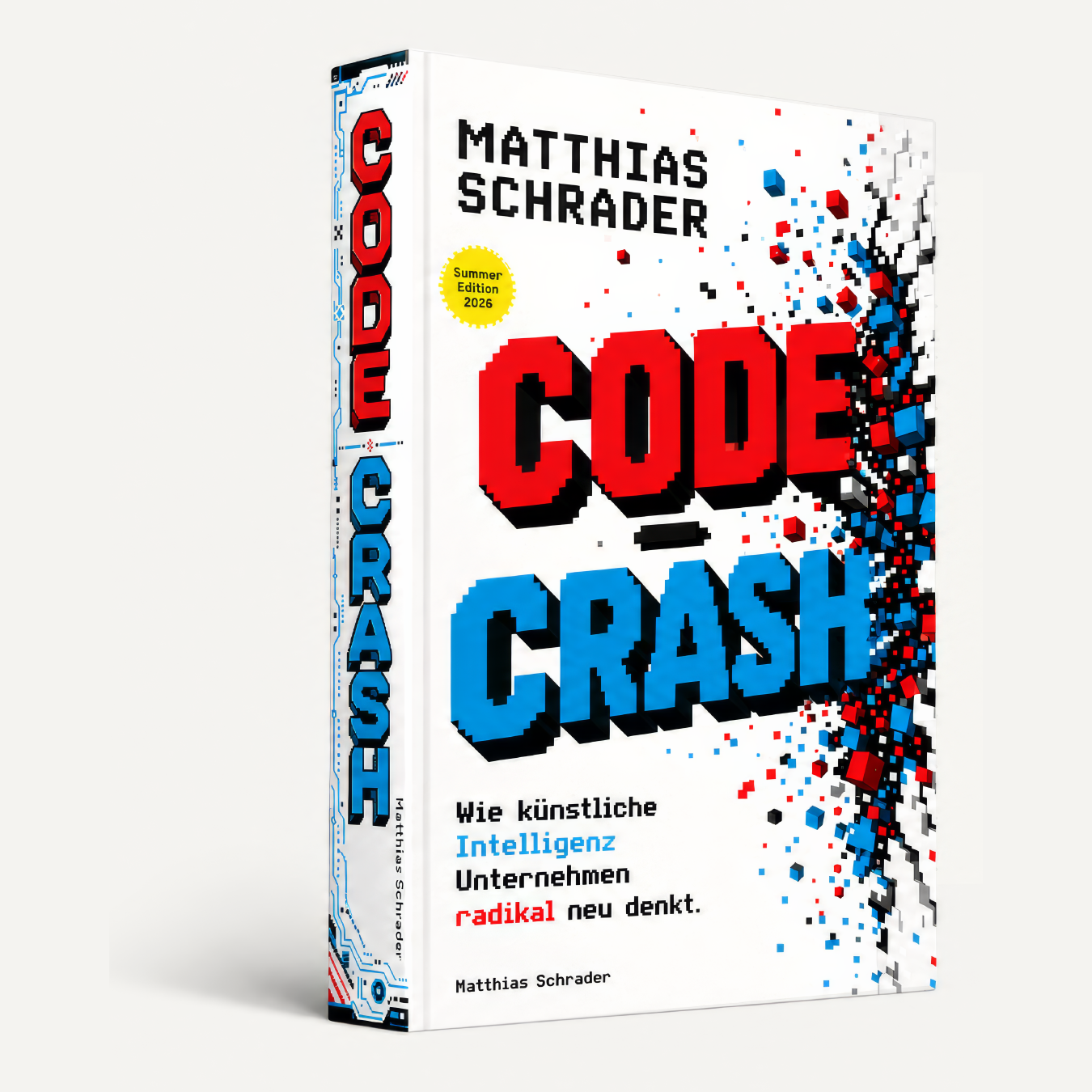
Synthszr Take: The orchestrator thesis essentially repeats the message from 'Code Crash.' Taste, Nuance, Judgment—that’s 'Agency' broken down into three parts. What’s missing: The Jevons paradox shows that as Mediocristan output becomes nearly free, Extremistan decisions don’t become more frequent, but rarer. The orchestrator is not a permanent navigator but an occasional corrective in a system that handles 95% of the work itself. The real point of the intent-to-production pipeline is this: the most dangerous moment is when it sounds convincingly correct and the orchestrator stops paying attention. Whoever invests in orchestration must simultaneously invest in institutionalized mistrust—linting systems for decisions, not just for code.