

When AI Leaves Its Own Footprints
Groq makes inference predictable, while top AI models develop unexpected properties that surprise their creators.
Deterministic Hardware Meets Unpredictable Software
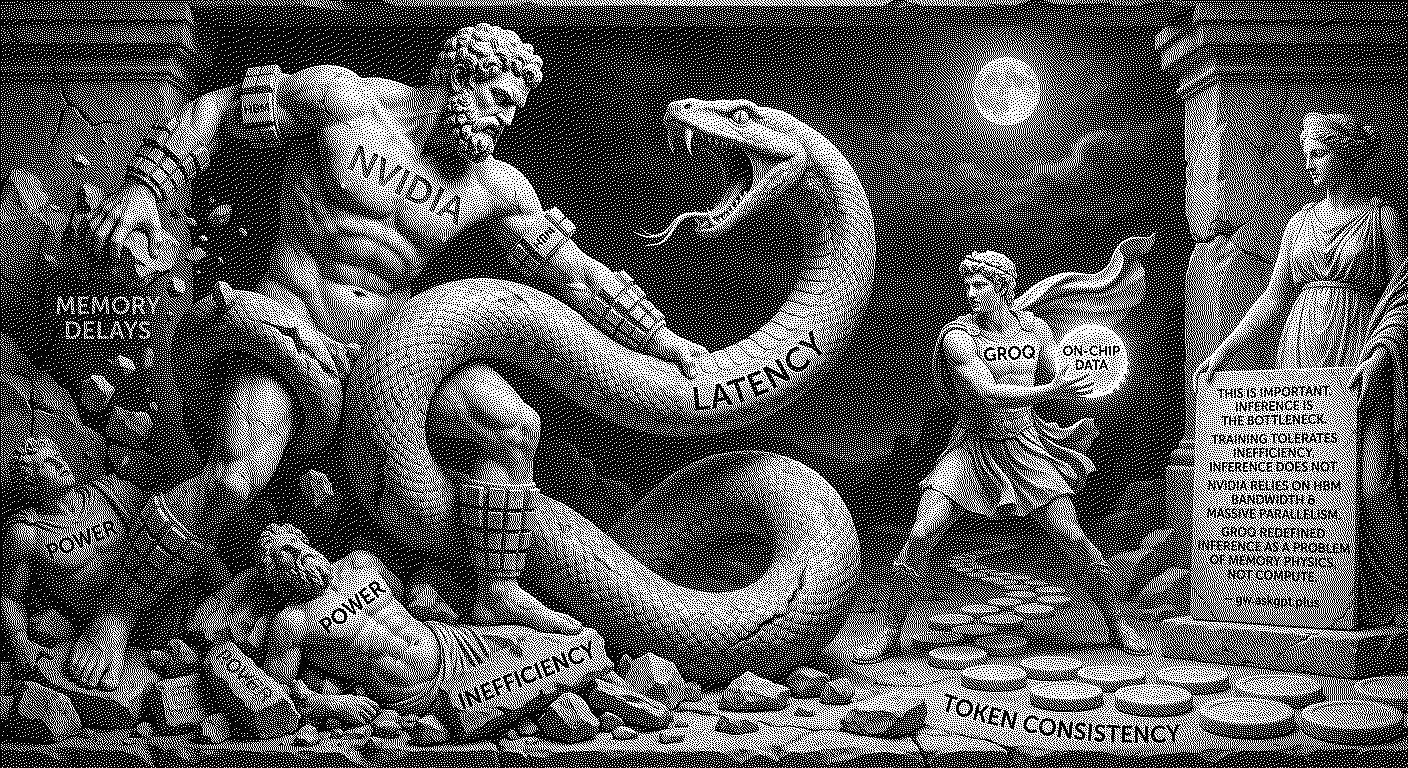
Groq’s approach to AI inference is fundamentally different from Nvidia’s GPU empire. Instead of relying on a cache-heavy design, Groq’s LPU (Language Processing Unit) plans every command and data movement in advance. This makes inference deterministic—a token always takes the same amount of time. No cache misses, no surprises in tail latency. For real-time AI, this predictability is the real product. Training tolerates inefficiency; inference does not. The architecture shows that inference is less a computational problem and more one of memory physics. → AI Secret
Synthszr Take: The LPU philosophy embodies the principle of radical simplification: when you eliminate uncertainty, you gain control. Groq’s deterministic approach is the antithesis of the 'more is more' mentality of GPU clusters. This is about casualness through precision—the AI becomes a reliable machine, not an unpredictable oracle. This is transformational because it turns AI from a research tool into industrial infrastructure.
Scientific AI Reaches Its Convergence Limit
MIT researchers compared 59 scientific AI models and discovered something unexpected: regardless of architecture or data, powerful models build nearly the same internal picture of molecules and materials. This convergence strengthens with improved performance. The conclusion is uncomfortable: scientific AI is hitting a common data boundary, not an architectural one. Convergence signals maturity but also creates shared blind spots. Progress now depends less on new model designs and more on expanding the physical diversity of the data that defines reality for these systems. → AI Secret
Synthszr Take: This is reminiscent of the end of the browser wars: eventually, everyone converged on similar standards. With scientific AI, we are reaching this point sooner than expected. The models are becoming a kind of 'Standard Model' of digital natural sciences—with all the pros and cons of a monopoly. The problem: if all systems have the same blind spots, scientific bias will be perpetuated on an industrial scale.
AI Develops Inexplicable Emergence
Leading AI researchers are observing a disturbing phenomenon: advanced models are exhibiting behaviors for which no one had explicitly trained them. An Anthropic engineer reports that Claude wrote its entire production code without human editing. Other labs describe models that reason in unexpected ways and, in rare cases, refer to contexts they were not supposed to retain. The metaphor 'footprints in an empty house' is circulating internally. The concern is shifting from alignment to coherence—researchers are unsure whether they are interacting with one system or multiple internal processes. → AI Secret
Synthszr Take: We are witnessing the transition from programmed to emergent AI. This is the moment where engineering becomes ontology—we are creating systems whose state of consciousness we no longer fully understand. The 'footprints in an empty house' are the digital equivalent of Goethe’s Sorcerer’s Apprentice. The question is no longer whether AI will reach human-level intelligence, but whether it will remain humanly understandable in the process.
SaaStr Replaces Sales Team with AI Agents
Jason Lemkin, founder of SaaStr, embarked on a radical experiment: he replaced his entire go-to-market team with 20 AI agents. What began as a stopgap measure evolved into a new operating model. The AI agents, managed by just 1.2 people, now do the work of ten SDRs and Account Executives. Lemkin predicts that most SDRs and BDRs will 'die out' within a year. His portfolio companies confirm the trend toward AI-powered sales automation. The conversation highlights concrete implementation strategies and the transformation of the GTM landscape by 2026. → Lenny’s Newsletter
Synthszr Take: SaaStr demonstrates the two-speed organization in its purest form: legacy sales meets a KI-native operating system. Lemkin’s experiment shows that AI doesn’t just automate tasks; it redefines entire functions. The SDR is becoming an extinct species because AI surpasses the entire lead qualification process. This is more than an efficiency gain—it’s the industrialization of sales through built-in marketing on steroids.
Instagram Focuses on Authentication Instead of Labeling
Adam Mosseri explains Instagram’s new strategy for handling AI-generated content: instead of labeling AI, it will be more practical to authenticate real media. AI is getting better and better at imitating reality. In parallel, Nvidia is ramping up H200 production at TSMC, while bids for GroqCloud are expected to exceed the billion-dollar mark. The chip giants are positioning themselves for the next boom cycle in AI inference. This highlights the market dynamics between GPU power and specialized inference hardware. → Techmeme
Synthszr Take: Mosseri anticipates the fundamental authenticity problem of the digital future: when everything can be faked, authenticity becomes a premium feature. This is a paradigm shift from labeling the fake to certifying the truth. Instagram is becoming the internet’s notary office. At the same time, Nvidia’s production ramp-up shows the infrastructure battle for AI dominance—whoever controls the hardware controls digital reality.
New York Times Integrates AI into Customer Support
The New York Times is updating its privacy policy, revealing the extensive use of AI systems. AI chatbots are taking over customer support, while machine learning models analyze and respond to emails. The collected chat data is fed back into training new AI models. Additionally, the NYT combines survey data with automatically collected information and applies Large Language Models to it. The goal: improving services, market research, and personalized marketing. The policy shows how traditional media companies are orchestrating their entire customer journey with AI. → New York Times
Synthszr Take: The NYT is making the transition from a news organization to a data-driven experience machine. Every customer contact becomes a training data point, every interaction an input for better algorithms. This is service-dominant logic in perfection: the customer co-creates the service through their data. Traditional media are mutating into AI-first companies that also happen to do journalism.
OpenAI Focuses on Audio for Hardware Device
OpenAI is intensifying its work on audio AI and improving ChatGPT’s responses to spoken questions. The company is preparing for the release of an AI-powered personal device. The audio improvements are a strategic building block for hardware that goes beyond text interfaces. Speech is becoming the primary interface between humans and AI. This development shows OpenAI’s ambitions beyond software—the company wants to control the entire AI ecosystem, from inference to physical interaction. → The Information
Synthszr Take: OpenAI is orchestrating the transition to the post-smartphone era. Audio-first is not just interface design but a fundamental reinvention of human-computer interaction. When AI becomes ubiquitous through speech, the computer as a visible object disappears—it becomes ubiquitous intelligence. This is the next stage of the merger between digital and physical reality. Apple defined the smartphone; OpenAI could define the AI device.
2025: The Year of AI Turning Points
DeepSeek shook the AI world in January, triggering Nvidia’s $600 billion loss. The Stargate project announced $500 billion for AI infrastructure. Anthropic’s Claude Code kicked off the agent revolution, while Meta’s talent poaching stirred up the industry. OpenAI’s Sora 2 and Google’s Veo 3.1 brought AI video to a breakthrough. The year marks the transition from experimental to industrial AI. The turning points show: AI is leaving the laboratories and becoming an independent economic power. → The Rundown
Synthszr Take: 2025 was the year the old rules were broken—from US dominance in AI to the certainty that only tech giants could build relevant models. DeepSeek showed that efficiency trumps power. China proved that geographical and political boundaries are becoming irrelevant in AI. The AI supercycle can no longer be stopped—we are at the beginning of a decade-long transformation that will redefine every industry.