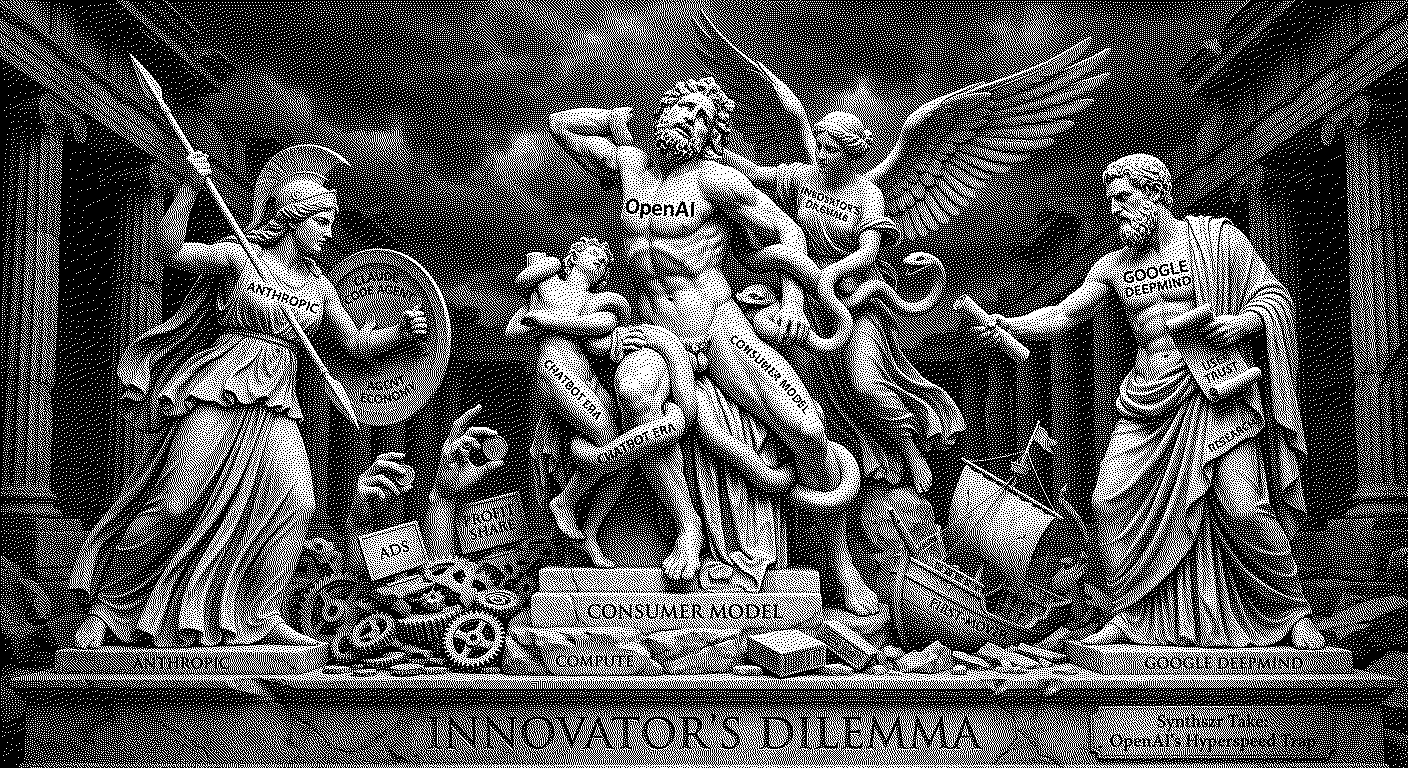


The New Stack: Agents, Skills, and Why OpenAI Is Now in the Innovator’s Dilemma
In Davos, the end of old fictions is being proclaimed while AI redefines the code and knowledge stack. Agents and alignment are becoming economic factors.
Davos and the Operating System of Civilization
At the World Economic Forum in Davos, Mark Carney spoke of the end of a “pleasant fiction,” which Azeem Azhar interprets as a fundamental shift in the operating system of civilization. This change leads away from scarcity to a system based on learning curves. The transformation is driven by advances in energy, intelligence, and biology, which are no longer extracted but constructed and iteratively improved. The old “Scarcity OS” was essentially a zero-sum game for control of limited resources. Azhar divides the responses to this change into three archetypes: the hoarders, the managers, and the builders. While the public debate is dominated by the first two, the builders are quietly creating a new, non-limited reality and redefining value creation. → Azeem Azhar, Exponential View
Synthszr Take: The transition from 'Scarcity OS' to 'Learning OS' is a powerful narrative, but it overlooks the crucial interface: AI is the API for this new operating system. It is not just another learning curve but the meta-layer that makes energy, biology, and intelligence composable in the first place. Viewing AI purely as an intelligence factor is like calling TCP/IP just a 'protocol'—a gross understatement of its systemic function. Leaders still thinking in the old OS are optimizing the horse-drawn carriage while the foundation for a new internet is being laid in the background.
OpenAI is Stuck in the Innovator’s Dilemma
OpenAI, once dominant in the chatbot era, now finds itself challenged by Anthropic in the emerging agent economy. Anthropic’s Claude Code, in particular, has quickly established itself as a leader. To open up new revenue streams, OpenAI plans to run ads in ChatGPT—a strategy that relies on network effects rather than pure token volume. Demis Hassabis of Google DeepMind commented critically on this, as an agent with third-party interests is, by definition, no longer acting in the user’s best interest. Additionally, OpenAI is exploring profit-sharing models for discoveries made with its technology and harbors hardware ambitions. The initial first-mover advantage is fading as the focus shifts from models to agents. → Azeem Azhar, Exponential View
Synthszr Take: OpenAI is in a strategic bind. Their early move defined the market, but it also tied them to a consumer-centric business model with massive compute consumption. Anthropic and Google can act more patiently, targeting the more lucrative enterprise segment with research-driven, trustworthy agents. OpenAI’s advertising experiment is a desperate attempt to monetize its consumer base but risks undermining the core promise of the personal agent. It’s the classic innovator’s dilemma trap, just in hyperspeed.
Alignment as an Economic Factor
The common assumption that AI safety (alignment) is purely a cost factor and a brake on development is increasingly being challenged by market dynamics. When users grant an agent far-reaching access to their systems, trust becomes the crucial currency. Paradoxically, it is the safety-focused lab Anthropic that grants its agents the most extensive autonomous capabilities. The reason is that their investments in alignment have produced a model that can be trusted with more autonomy. Trust enables autonomy, and autonomy unlocks real market value. In contrast, a lack of alignment, as seen with xAI, leads to scandals and hesitant enterprise customers. → Azeem Azhar, Exponential View
Synthszr Take: The market is beginning to price alignment correctly: not as an ethical fig leaf, but as a hardcore feature. An unreliable agent is not an asset but an incalculable risk. The realization that the most trustworthy model is ultimately the most productive one inverts the 'move fast and break things' logic. Safety is evolving from a checkbox to a performance criterion. This is the more mature phase of the technology, where reliability and predictability trump raw power.
The Flywheel of Robotics
Robotics benefits simultaneously from scaling laws and Wright’s Law, accelerating its development toward general applicability. Vision-Language-Action models are expected to show scaling effects similar to LLMs but still suffer from data scarcity. However, every robot deployed in the real world becomes a data generator, setting a positive flywheel in motion: more robots generate more data, which leads to better models, which in turn open up new markets. In parallel, Wright’s Law lowers costs with each doubling of production volume. The cheapest humanoid robots already cost only $5,000 per unit. The construction of AI data centers could be the catalyst for this positive feedback loop. → Azeem Azhar, Exponential View
Synthszr Take: The analogy to LLM development is apt but incomplete. Robotics has a crucial disadvantage: physics. A token costs almost nothing, but a failed grasping action has real-world consequences. This is precisely why data generation in the standardized environment of data centers is so clever. It’s the perfect petri dish for this growth effect: repetitive tasks, high error tolerance, and a customer (the hyperscalers) who understands the strategic necessity. Robotics won’t explode with a 'ChatGPT moment' but through the gradual automation of highly structured industrial niches.
Google DeepMind on a Shopping Spree
Google DeepMind has significantly expanded its talent and technology base through a series of acquisitions and partnerships. The company acquired Common Sense Machines, a startup specializing in converting 2D images into 3D models. In parallel, a licensing agreement was signed with Hume AI, which develops models for emotion detection in voices, with the CEO and key engineers moving to DeepMind. Additionally, Google invested in Sakana AI, a Japanese startup founded by former Google researchers, including a co-author of the original Transformer paper. These strategic acquisitions aim to strengthen Gemini and solidify Google’s position in the global AI competition, particularly in the Japanese market. → Techpresso
Synthszr Take: This isn’t a classic 'acqui-hire'; it’s a strategic repatriation of departed core IP and talent. Google recognizes that the next wave of innovation is happening outside its own walls, even if the innovators came from within. The deals with Hume (emotion) and Common Sense (3D) point to a future where Gemini is intended to operate multimodally and with context sensitivity. The investment in Sakana is particularly spicy: they are buying access to research that could potentially make their own Transformer architecture obsolete—a classic move to control their own disruption.
The Evolution of the AI Stack: Tools, MCPs, and Skills
The way AI models interact with the outside world is undergoing a rapid evolution from simple 'Tools' (Function Calling) to more complex architectures. Tools were the first step to let LLMs perform actions, but they scaled poorly as each integration was manual. The Model Context Protocol (MCP) emerged as a standardization layer, comparable to USB-C, to create interoperability between different AIs and services. The latest development is 'Skills,' which encapsulate not the capability itself but the procedural knowledge—the expertise on when and how to use a tool effectively. This three-tiered stack separates atomic capabilities (Tools), infrastructure (MCP), and application-specific knowledge (Skills). → Charlie Guo from Artificial Ignorance
Synthszr Take: This is the most important systemic development in AI in a long time. We are witnessing the emergence of the fundamental architectural layers for autonomous agents in real time. Tools are the system calls, MCP is the network protocol, and Skills are the libraries and frameworks. This level of abstraction is the moment AI ceases to be purely a 'model' problem and becomes a 'software engineering' problem. The most exciting companies in the coming years won’t necessarily build the best models, but the best Skills and the most robust MCP servers. Value creation is shifting from pure inference to orchestrated execution.
The Evaluator-Optimizer Pattern
For complex tasks where an LLM’s first answer is rarely the best, the 'Evaluator-Optimizer' pattern is becoming established. Instead of a single 'one-shot' call, the process is split into two roles: a generator LLM produces a solution, and an evaluator LLM critically reviews it against defined criteria. If the solution fails, the evaluator’s feedback is sent back to the generator to create an improved version. This iterative feedback loop continues until a quality standard is met or a maximum number of attempts is exceeded. This pattern is particularly suitable for code generation, legal documents, or mathematical problems where precision is crucial. → Machine Learning Pills
Synthszr Take: This pattern is nothing less than the formalization of the human creative process within an agent architecture: draft, critique, revise. The crucial point is the separation of concerns. A single prompt that tries to be both creative and critical at the same time is inefficient. By splitting the roles, we can use a specialized model or a highly optimized prompt for each task. This is the transition from monolithic 'super-prompts' to a microservices architecture for AI workflows. It not only increases quality but also makes the entire process more transparent, debuggable, and ultimately, controllable.
'Vibe Coding' and the Risks for Open Source
Generative AI is changing software production through a process known as 'vibe coding.' In it, developers use AI agents to find and assemble open-source software (OSS), often without reading the documentation or interacting with the maintainers. A new study argues that while this approach boosts short-term productivity, it undermines the OSS ecosystem in the long run. Since many OSS projects rely on user engagement (bug reports, contributions, sponsorship) to fund and improve themselves, the decoupled use by AI leads to a decline in contributions and quality. This could paradoxically lead to a decrease in the supply of high-quality OSS, even as demand increases. → Techpresso
Synthszr Take: AI agents are becoming the ultimate 'passive consumers' of open source, threatening to destroy the very social fabric that makes it possible. This is a classic 'tragedy of the commons' in digital form. The friction of manual implementation—reading documentation, encountering errors, asking in forums—was an unintentional but crucial mechanism for community engagement. If AI eliminates this friction, a new, explicit mechanism for value attribution and funding must be created. Models where AI agents pay 'micro-royalties' for using OSS packages or automatically generate qualified bug reports are conceivable.
YouTube Enables AI Clones for Creators
YouTube CEO Neal Mohan has announced that creators will soon be able to create short videos (Shorts) with their own AI-generated likenesses. This is part of a broader strategy to integrate generative AI tools like auto-dubbing and AI-generated clips into the creator platform. Paradoxically, YouTube is simultaneously fighting against unauthorized AI clones and has introduced technologies to detect deepfakes. This development underscores the balancing act platforms must perform: they want to accelerate content production through AI to remain competitive with TikTok, but they must prevent a flood of low-quality content ('AI slop'). → Matt from FutureTools
Synthszr Take: YouTube is opening Pandora’s box, believing it can control it. The distinction between 'authorized' and 'unauthorized' clones is a technical and legal fiction once the technology becomes widely available. The platforms are in an arms race for the means of content production. By giving creators the tools for mass production, they are sacrificing long-term quality and authenticity for short-term engagement growth. The endgame is a content economy where the signal-to-noise ratio approaches zero, and the only winner is the platform that controls the inference costs for generation.
The Shift in Code Review
The traditional process of code review, where every line of code is read manually, is being fundamentally changed by AI. Developer Kieran Klaassen describes a new approach where 13 specialized AI agents conduct a code review in parallel, while the human developer focuses on decision-making. This 'Compound Engineering' approach has proven more effective at finding critical errors that would have been missed in a manual review. The time required for code generation has collapsed due to AI, while the time for human review has remained constant. This disparity forces the adoption of new, agent-based review processes. → Every
Synthszr Take: Code review isn’t dying; it’s abstracting. Manually checking lines of code has always been a proxy for reviewing logic, architecture, and potential risks. AI agents can now perform syntactic and granular logical checks better and faster. This forces the human reviewer to operate at a higher level: Does the code implement the correct business logic? Is the architecture sustainable? What systemic risks does this change introduce? The human evolves from a proofreader to a system auditor. This is more demanding but also infinitely more valuable.