

The Great AI Disillusionment: Between Productivity Apps and a Profitability Crisis
AI tools promise efficiency, but their business models are faltering. The industry is looking to make the leap from simple helpers to transformational products.
The Flood of AI Productivity Tools
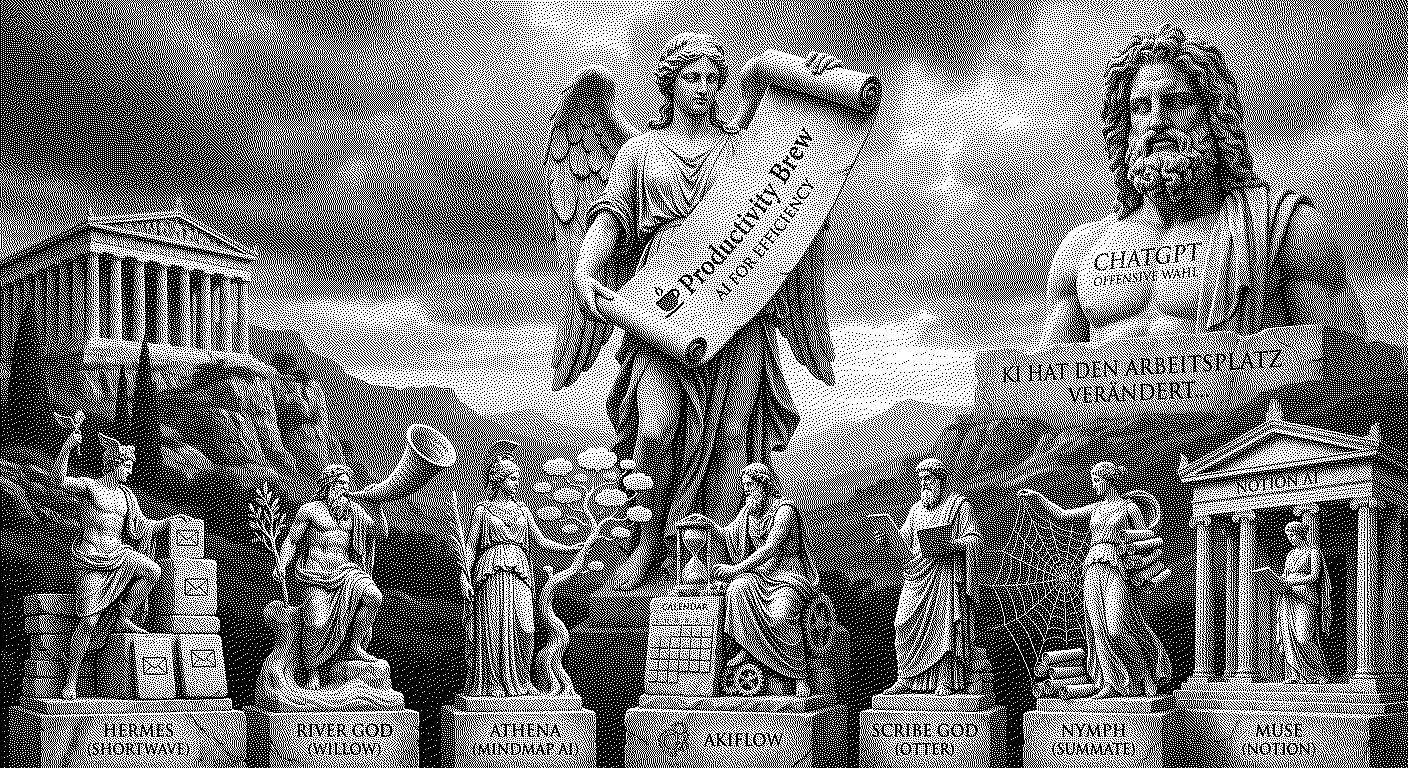
A growing list of AI applications aims to optimize everyday workflows. Tools like Shortwave for email management or Otter for meeting notes promise to boost individual productivity and are increasingly finding favor in companies. This trend reflects the common perception of AI as a personal assistant that incrementally improves existing processes. The focus is almost exclusively on increasing the efficiency of individual tasks, which leads to a fragmented market of point solutions. However, this approach treats AI more as a feature than as the foundation for fundamentally new products or services. The real challenge is not finding another app, but orchestrating these capabilities to create coherent value. → Morning Brew
Synthszr Take: The obsession with productivity apps is a classic case of a cargo cult, overlooking the real disruption. While we optimize our email responses, the underlying models cannot distinguish a fictional invasion of Venezuela from reality. This paradoxically creates a new 'digitalization dividend' in a negative sense: the time that must be spent verifying AI-generated content. The real business isn’t in selling more efficiency tools, but in building the synthesis and verification layers that can master this new complexity.
The Economics of AI Models Under Pressure
In the tech industry, a certain disillusionment is spreading regarding the business models of Large Language Models (LLMs). Wall Street is reacting with growing skepticism to the escalating investment costs amid meager revenues, leading to sell-offs in the sector. This financial pressure is forcing even the biggest players to act: Microsoft is pushing the integration of Copilot throughout its ecosystem, while xAI is bundling its Grok model with X Premium just to gain traction. Even market leader OpenAI is reportedly focusing on increasing the efficiency of its inference processes to improve its negative margins. The market is visibly shifting from pure performance demonstrations to the question of economic sustainability. → The Information Subscribers
Synthszr Take: The market is staring at the wrong metrics and missing the real game. The monetization of AI won’t primarily happen through software subscriptions, but through synthesis with hardware. OpenAI’s strategic moves in audio AI for upcoming devices indicate where this is headed: it’s about building the next iPhone, not the next Microsoft Office. The massive investments are not costs for a software feature, but a down payment on a new hardware supercycle—a dynamic that a market fixated on SaaS metrics cannot grasp.
Substack Bundles the Creator Economy
Substack has introduced a new app that integrates its services for writers and readers into a single platform. The application bundles newsletters, podcasts, video, and community features, positioning itself as a central hub for independent media creators. This step marks the transformation from a pure newsletter tool to a full-stack media platform. In doing so, Substack is challenging established social networks and content providers by creating a more curated and controlled environment. The strategy aims to create a stronger lock-in for creators and their audiences and to control the entire experience loop. It remains to be seen whether this bundled offering can capture users' fragmented attention. → Substack
Synthszr Take: Substack isn’t building a tech tool; it’s industrializing the business model of “The New Yorker” for the 21st century. It is the logical evolution from a pure service layer (email delivery) to owning the entire ecosystem of content, community, and commerce. This is the classic playbook for escaping commoditization: controlling the entire value chain instead of just being an interchangeable cog in the machine. While traditional media companies are trapped in their two-speed organizations, platforms like this are building the future from the ground up.
The Most In-Demand Skill in the AI Age: Distrust
A report suggests a seemingly paradoxical strategy for the 2026 job market. The crucial skill will not just be using AI, but above all, knowing when not to use it. As AI-generated applications, cover letters, and other forms of communication become the norm, they lose their value as a signal of competence. Human judgment and demonstrable authenticity will thus become scarce and correspondingly valuable assets in the recruitment process. This trend points to a growing awareness that over-reliance on automation can become a professional disadvantage. The future of knowledge work lies in the thoughtful orchestration of human and machine capabilities. → Business Insider
Synthszr Take: The market is beginning to price in the difference between stochastic parrots and true intelligence. An AI can formulate a perfect cover letter but hallucinates facts about current events—a fatal flaw for any serious knowledge worker. The premium will go to those who act as the 'human-in-the-loop,' not to the mere operators of a prompt. This isn’t Luddism; it’s the emergence of a new meta-skill: managing the inherent unreliability of a powerful but flawed technology.
When AI Becomes a Reality Machine
An experiment on Weibo demonstrated the creation of a completely synthetic news event. Under the title “Chinese Doom Scroll,” a fictional US invasion of Venezuela was depicted, visually and stylistically blending seamlessly with authentic news formats. This goes far beyond simple deepfakes; it is the synthesis of text, image, and context to construct a plausible alternative reality. The example illustrates the ability of generative AI to move from content creation to the creation of entire narratives. The implications for our information ecosystem are fundamental, as the shared basis of facts is called into question. As the marginal cost of producing high-resolution, synthetic realities approaches zero, the value of verified information sources will theoretically increase. → Weibo on Substack
Synthszr Take: We discuss AI in the context of efficiency, but the real disruption is the industrialization of reality itself. This isn’t about faking an image, but about creating a complete 'synthetic information product' charged with emotional resonance and context. This shifts the playing field from information access (Google’s domain) to reality curation. The next great gatekeeper will not just organize the world’s information but will define which version of the world you get to see—a far more powerful position.