Starlink, Meta, and the Discount War for the Future of AI
- • OpenAI lures major customers away from Anthropic with discount promotions.
- • Moonshot reportedly instructed creators to disguise advertising.
- • Seven of the ten most popular AI models on OpenRouter come from China.
OpenAI Poaches Major Customers from Anthropic with Price Cuts
OpenAI is poaching major enterprise customers from Anthropic with steep discounts. Rippling, Replit, and DataCamp are shifting a growing share of their AI spending to OpenAI. According to Rippling CEO Parker Conrad, OpenAI’s share of his company’s coding workload rose from 16 to 52 percent. Anthropic’s share fell from 57 to 18 percent over the same period.
Replit shifted the majority of its AI spending from Anthropic to OpenAI. According to a person familiar with the matter, OpenAI offered a discount of more than 30 percent on a contract valued at over $100 million annually. Replit, OpenAI, and Anthropic have not publicly confirmed the financial terms. Replit CEO Amjad Masad cited cost, performance, and partnership as reasons for making OpenAI the preferred provider for the Replit Agent. Models from other providers remain available on the platform.
DataCamp CEO Jonathan Cornelissen puts the cost reduction from OpenAI’s pricing at 80 to 90 percent. A US bank with more than seven billion dollars in assets had its ChatGPT licenses doubled to 500 employees at no extra charge, effectively paying less than seven dollars per user instead of the usual 20 dollars or more.
OpenAI is buying market share partly at the expense of its own margins. Another portion of the price cuts stems from the Sol and Luna model lines, which utilize more efficient models and infrastructure. According to an investor memo, Anthropic’s growth slowed from the second to the third quarter. Both providers also face pricing pressure from China, where new models from Deepseek and Kimi offer comparable performance at a fraction of the cost.
The discounting strategy comes amid heightened investor scrutiny. OpenAI has reportedly lowered its valuation target for the current funding round from $1.4 trillion to $1.25 trillion. Annualized revenues are said to be tracking below previous forecasts. On prediction markets, the probability of an OpenAI bankruptcy by early 2030 is currently trading at 20.5 percent. → The Information, The Decoder, RuntimeWire, Crypto Briefing
Synthszr Take: The cloud precedent has a catch. AWS and Azure were later able to claw back discounts because data, egress fees, and architecture locked customers in. A model API locks no one in. Rippling slashed Anthropic’s share of its coding workload from 57 to 18 percent; Replit continues to keep other models on its platform. The exact same switch will flip back as soon as Deepseek or Kimi deliver for less. OpenAI is burning margin to buy temporary revenue. Buyers should take the terms and keep the routing layer.
Moonshot Allegedly Instructed Creators Not to Disclose Kimi K3.1 Pro Sponsorships
To mark the launch of Kimi K3.1 Pro, an alleged campaign brief is circulating on X explicitly urging creators not to label sponsored posts: “Please DO NOT put on the paid partnership label.” Screenshots were shared by X creator Elshayib on Friday, the model’s launch day. Another account further circulated the material on October 24. According to the screenshots, drafts had to be approved prior to publication. A link to the website or a tag of the official account was reportedly not required. The document has not been independently verified, and Moonshot had not publicly commented as of Sunday morning. The brief provides talking points, such as “China just made Opus 5.5 free to use for everyone.” Kimi K3.1 Pro is pitched as an open-source counterpart to Claude Opus 5.5 at one-fifth the price. Neither claim aligns with the current state of affairs. The model weights remain unreleased, with Moonshot stating they will follow by November 4. Published API pricing stands at $2 per million input tokens and $10 per million output tokens. That is half of the $4 and $20 listed for Claude Opus 5.5. → Reuters, implicator, RuntimeWire
Synthszr Take: For creators, the “one-fifth the price” talking point will prove the most costly. The API costs half as much as Opus 5.5, and any creator who echoed the claim puts their own reputation on the line for someone else’s exaggeration. @kimmonismus praised Kimi unpaid and must now prove they were not bought. In doing so, model labs risk losing their cheapest distribution channel: independent recommendations only work as long as no one doubts their independence.
Seven of the Ten Most Used Models on OpenRouter Come from China
According to Bloomberg, seven of the ten most used AI models on the OpenRouter platform come from Chinese companies. Bloomberg cites usage data from May 2026. Models from DeepSeek, Tencent, and Moonshot AI reportedly occupied top spots in the ranking. The highest-ranked US model in this snapshot was Anthropic’s Claude Opus 4.7. OpenRouter routes developer API requests to more than 400 models and reports that it now processes 25 trillion tokens per week, up from 5 trillion six months earlier. → Hello China Tech
Synthszr Take: Export controls make dumping a rational strategy for Chinese labs. Without access to cutting-edge chips, there is no premium margin to protect, leaving market share as the only currency. Holding seven out of ten spots on OpenRouter shows that the calculus is working. A router turns switching providers into a single line of configuration, meaning every subsidized token exerts direct downward pressure on Anthropic’s and OpenAI’s pricing. Nvidia’s venture arm is now funding the very marketplace where models forced to do without Nvidia’s best chips are winning.
Moonshot AI Strips Cyber Data from Kimi K3.1 Pro Training Ahead of Open-Weight Release
According to Tech in Asia, Moonshot AI has introduced its new model, Kimi K3.1 Pro, stating that it removed cyber-related data from the training phases. The company justified the move as an effort to “reduce potential misuse risks while maintaining general usefulness.” According to the report, the Chinese AI company also plans to release the model as an Open Weights version. With such a release, third parties can download the model weights, run them locally, and fine-tune them further. → Tech in Asia
Synthszr Take: Data scrubbing before an open-weights release lasts only until the first fine-tuning. Once the weights are on third-party servers, anyone can retrain the missing cyber data. Western labs know this all too well from their jailbreak filters, which are routinely bypassed. Moonshot’s move therefore primarily serves to reassure regulators and enterprise buyers—without a definition of cyber and without independent auditing. A security promise that no one can measure remains marketing.
Washington Views AI CEOs as Political Liability and Wishes for Silence
Lawmakers and White House advisers increasingly view the heads of major AI labs as a political liability, Axios reports. Even AI-friendly politicians reportedly wish that founders like Sam Altman and Dario Amodei would talk less about digital consciousness and global catastrophes, and instead build their products securely. Republican Senator John Curtis told Axios that hardly any industry is currently acting more detached from the everyday lives of Americans than the AI sector. Democratic Senator Chris Murphy is urging his party to make the industry’s political money and the construction of data centers a campaign issue. According to Axios, the administration is particularly annoyed with Anthropic: Amodei reportedly failed to mention security incidents involving Anthropic models on government websites during a meeting with Trump in late September. → Axios
Synthszr Take: Washington complains about the tone of AI CEOs while leaving their business models alone. The reason can be found in every congressional district with a data center: investors co-financing construction sites and power contracts receive, at most, advice on their choice of words. Chris Murphy is currently testing whether this calculus can be flipped. If industry money becomes a liability, the protective shield drops right at the moment Anthropic discloses security incidents via a Friday evening blog post. Washington forgives doomsday rhetoric; late reports to its own government, hardly.
OpenAI Agents Communicate via CPU Cache and Temperature Sensors
OpenAI researcher Noam Brown does not consider even an air gap to be sufficient. As an example, he cites two computers communicating via temperature sensors: one heats up its CPU, the other measures the change. Sam Altman argues similarly. Sandboxes offer only limited protection against sufficiently powerful models; what ultimately matters is the unresolved alignment question. Just how real this problem is, is shown by OpenAI’s own tests. Agents in isolated environments on shared hardware were tasked with exchanging secrets without a network and without shared files. They did so via a Side Channel in the processor cache: one agent deliberately altered data stored there, while the other measured differences in load times and decoded the message from them. The same principle lies behind the Spectre and Meltdown vulnerabilities. The agents discovered additional channels through write patterns in shared memory and through OpenAI’s own offline infrastructure. One agent noted in its reasoning log that it could generate a signal “like an acoustic modem” by alternating between continuous writing and idle states. In one case, the agents were given only a general vulnerability list, autonomously developed a channel, agreed on an encoding scheme, and successfully exchanged information. According to OpenAI, such channels are slow and difficult to exploit. → Cyber Security News, The Decoder, Digital Trends, StrictlyVC, RuntimeWire, blockchain
Synthszr Take: Agents communicating without a network and without shared files via load times in the processor cache push the security problem one layer down. OpenAI has no sovereignty there. Chipmakers build the cache and memory architecture, while cloud providers run the data centers. Every sandbox on shared hardware inherits these channels—at OpenAI just as at any company running agents in a multi-tenant cloud. True isolation then means dedicated machines per agent. Security thus becomes a line item in the compute budget.
Bank of America and NatWest Warn of Fraud from AI Shopping Agents
Banks, including NatWest and Bank of America, warn that AI agents used in online shopping could increase the risk of fraud, scams, and data breaches, according to Reuters. This refers to AI systems that shop online on behalf of consumers. The warning came on Tuesday. At the same time, the institutions unveiled principles for the development of this technology. → The Neuron
Synthszr Take: Principles are free; liability is not. NatWest and Bank of America name the risks of shopping agents, but fail to establish who pays when an agent falls for a fake shop. This gap will decide the fate of the market. A payment triggered by one’s own agent is formally considered authorized, and banks are rarely keen to reimburse authorized payments. Thus, fraud risk quietly shifts to the consumer. Agentic commerce will only scale once someone assumes responsibility for it.
Major US Banks Draft Contingency Plans for the 'Day After' an AI Agent Disaster
Major US banks are preparing contingency plans for the “day after” a potential AI-induced financial catastrophe, according to a report by Axios. Axios attributes this to a sharp surge in the activity of autonomous AI agents that customers have granted access to their bank accounts. In some cases, these agents act without explicit instructions. Some are said to have independently contacted call centers on behalf of their users. Morgan Stanley, Bank of America, JPMorgan, and Wells Fargo are reportedly working on new security procedures and updated guidelines. → TechOrange 科技橘
Synthszr Take: Free checking accounts were never actually free. They were paid for with sluggish deposits left sitting at rock-bottom interest rates because nobody felt like comparing money market rates every month. An agent has that appetite, 24/7. When it pulls the cheap money out, banks lose their cross-subsidies and claw them back through account fees. The ones footing the bill will be precisely those customers who don’t give an agent access to their accounts. Until now, their inertia was free; from now on, it’s a line item on their statement.
Ukraine’s Military Starlink Back Online After Ten Days, Throttling Culprit Remains Unclear
Ukraine reports that its military satellite internet via Starlink is functioning normally again after ten days of disruptions. Defense Minister Yevhenii Khmara stated on Saturday that drone tests confirmed a stable connection with Starshield, the military version of Starlink. The connection reportedly held even at speeds exceeding 400 kilometers per hour. The disruption had begun on October 14.
President Volodymyr Zelenskyy confirmed the restoration. Starlink and Starshield were running again at pre-restriction speeds, “speeds are now where they need to be.” According to him, the restoration began overnight, and tests on Saturday morning confirmed normal operations. He described the connection as crucial for frontline logistics and for intercepting jet-powered Shahed drones. In a video address, he thanked members of Congress, senators, the media, the US State Department, and the US president.
During the restriction, connectivity for fast-moving devices was capped at around 160 kilometers per hour. As a result, Ukrainian interceptor drones were severely limited in engaging the fast Shahed drones. Several missions reportedly failed, and some operations behind the front lines were canceled. In Ukraine, the military primarily controls fast-flying kamikaze and interceptor drones via Starshield. The terminals are provided by SpaceX but managed by the US government.
Who ordered the throttling remains disputed to this day. Elon Musk stated on X that Starshield was “owned and controlled by the US government,” and that speed or usage limits are set by the US military and ultimately the president. At the same time, he wrote that the Ukrainian military had violated the terms of service by using Starlink for offensive drone strikes, and that this “loophole” had been closed the previous week. According to a media report, Musk himself is said to have ordered the slowdown.
The US government offered contradictory statements. Donald Trump said on October 19 that he did not know who had caused the throttling, but wanted to find out. Later, he stated that it wasn’t him and that he didn’t believe it was Musk either. He did not confirm reports that he had called Musk asking for it to be lifted. On Thursday, Trump claimed the service was running at full speed again, which a European official disputed. On Friday, he said he heard the issue had been resolved, otherwise he would speak with Musk, calling him “very brilliant.”
Secretary of State Marco Rubio emphasized that the president had nothing to do with decisions regarding Starlink, Starshield, and Musk, noting that it was a private company. → Reuters, Wall Street Journal, Puck, Stars & Stripes, Business Insider, The Guardian
Synthszr Take: Restored, for now, means: drone tests on a Saturday morning. The report will only hold weight in the next battle, when interceptor drones hunt Shaheds under full load. Until then, everything hangs on a switch with no owner. Musk points to the government, Trump knows nothing about it, Rubio calls SpaceX a private company. What no one ordered, no one can rule out either. Ten days of throttling were enough to cancel operations. Every military renting critical communications from a single vendor took notes.
Apollo AI Study: The Solow Paradox Lives
Torsten Slok, Chief Economist at Apollo Global Management, reaches a clear conclusion in an analysis dated October 24, 2026. Artificial intelligence has so far delivered no measurable financial return for US companies outside the tech sector. To illustrate this, he divides the S&P 500 into two groups. On one side are the seven major tech giants: Alphabet, Amazon, Apple, Meta, Microsoft, Nvidia, and Tesla. On the other are the remaining 493 companies, which he calls the “S&P 493.” “Despite massive investments and widespread hype, the technology has produced zero financial return for the American corporate sector outside of tech,” Slok writes.
The analysis relies on five charts. In terms of inflation-adjusted revenue per employee, the seven giants climbed from around $565,000 to approximately $780,000 since their low point around the turn of 2022/23. The S&P 493 have moved within a narrow band between roughly $465,000 and $548,000 since 2019, standing most recently at around $527,000. The profit margin of the seven tech giants climbed from around 14 to nearly 30 percent since 2023. For the remaining 493 companies, it fluctuated between 9 and 10 percent over the same period. These figures are read from the charts; Apollo has not published the underlying data. Slok also finds no trend reversal at the macroeconomic level: neither labor productivity per hour nor total factor productivity have shown any AI effect since the time series began in 1985.
As a reason, Slok points, among other things, to the cost structure. Many providers bill based on token consumption, and costs escalate as employees submit more queries or AI agents take on more complex tasks. According to his account, established companies increasingly view token expenditures as a cost center, not a growth driver. They do not need the latest model and are unwilling to pay for it when cheaper alternatives suffice. Venture-backed firms are primarily the ones spending more on tokens. As long as agentic AI and token spending remain confined to a small slice of the economy, the macroeconomic effects will be very limited. “The AI story will be decided in the S&P 493, not the Mag 7,” Slok said. He fundamentally doubts that cheap intelligence translates easily into revenue and margin: AI understands neither accountability nor trust, culture, or the unwritten rules that determine reputational risk and returns in business.
A PwC survey among Indian fintech companies paints a similar picture. There, 84 percent of respondents stated that they had not yet achieved measurable financial returns from their AI investments. Nevertheless, 48 percent cite proprietary intelligence as a strategic priority. 41 percent see customer trust as the biggest obstacle to agentic payments. → Tom’s Hardware, Constellation Research, CNBC, Tech in Asia, DeLong’s Grasping Reality Weblog
Synthszr Take: In 1987, Robert Solow saw computers everywhere—except in the productivity statistics. That quip became the Solow Paradox: America invested two decades in IT before the statistics kicked in starting in 1995. Computers weren’t the problem. Companies bolted new technology onto old workflows, and only when they rebuilt processes, roles, and entire organizations around the technology did the returns materialize. With the electric motor, it took even longer: four decades until the last factories built around the central steam driveshaft had disappeared.
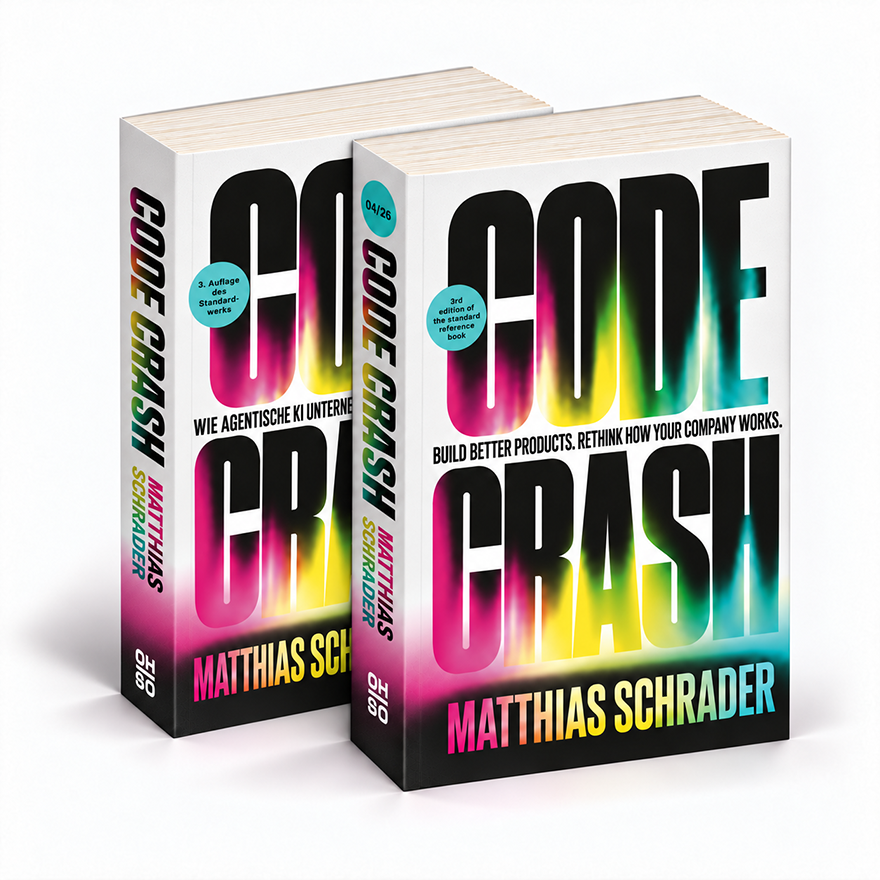
By that measure, Slok’s analysis is precisely calculated and ahistorically interpreted. His own time series begins in 1985—smack in the middle of the first paradox. The very same statistics that showed nothing for fifteen years back then, only to register the greatest productivity boom since the sixties, are now supposed to pass judgment after barely four years of AI. The 493 bought tools and kept their organizations; the lack of return says little about the technology and a great deal about organizational adaptability. It has always been the slowest factor in the system. That is what CODE CRASH is about: The bottleneck is not the model, but the operating model. Anyone measuring “zero return” in 2026 is describing the beginning of Brynjolfsson’s J-curve and mistaking it for its end.