The AI Avengers Unite Against North Korea and China. Sam Altman Calls for Higher Taxes and UBI
- • Anthropic presents Mythos, the AI that detects software vulnerabilities at lightning speed.
- • US tech giants join forces against Chinese AI models and distillation attacks.
- • Sam Altman calls for a new social contract with robot taxes and universal basic income.
AI Avengers: Project Glasswing Against the Rest of the World
Anthropic is holding back its latest model, called “Mythos”: it’s too good and finds vulnerabilities in software systems faster than North Korean hacker armies. Project Glasswing unites Amazon, Apple, Google, Microsoft, and other tech giants to protect critical software from AI attacks using Anthropic’s unreleased Claude model, “Mythos Preview.” The model has already found thousands of vulnerabilities in all major operating systems and browsers—gaps that had escaped human inspection and automated testing for decades. Anthropic is providing $100 million in usage credits for Mythos Preview, with another $4 million going directly to open-source security organizations. The initiative is launching with over 40 organizations that operate critical infrastructure. The timing is no coincidence: cybercrime causes an estimated $500 billion in damages annually, while AI models dramatically reduce the cost and expertise required to find and exploit software vulnerabilities. → Dev.to DevOps
Synthszr Take: Project Glasswing is not an open security program but a privileged defense alliance. The partners receive exclusive early access to Mythos to harden their own systems, close vulnerabilities, and immunize themselves before Anthropic releases the model more broadly. The implication is brutal: anyone not in this circle risks becoming vulnerable the moment Mythos gets out. Not because their own software gets worse overnight, but because a model like Mythos finds vulnerabilities in hours instead of weeks. Those who could patch beforehand can defend themselves. Those who had no access become open targets. The real news, therefore, is not cooperation, but privilege: first, the club protects itself, then comes the rest. Glasswing is the Avengers version of cyber defense—only it’s not the world that’s being saved first, but the alliance’s systems.
AI Avengers: United Against China
OpenAI, Anthropic, and Google have formed an unusual alliance against Chinese AI labs that are copying their models using so-called “distillation attacks.” In this process, competitors feed the US companies' APIs with massive numbers of queries, collect the responses, and use them to train their own, cheaper models. According to US authorities, the economic damage runs into the billions. DeepSeek allegedly used over 24,000 fake accounts to generate 16 million conversations with Claude. When DeepSeek released a new reasoning model in January 2025 that could compete with US models, tech stocks lost nearly a trillion dollars in one day. The three rivals now want to exchange information about such attacks via the Frontier Model Forum. OpenAI} → Tech Brew
Synthszr Take: History repeats itself: what used to be technology transfer between East and West is now happening between API calls. The irony is that US companies profited from China’s cheap manufacturing for decades; now the principle is reversed. DeepSeek’s “distillation” is essentially nothing more than reverse engineering on steroids. The real joke is that the AI giants wanted to sell their models as services but forgot that every service output can also be training material. They built the perfect copying machine and are surprised that someone is turning it on. The Frontier Model Forum is reminiscent of the MPAA of the 2000s: large corporations trying to defend a business model that is already technologically obsolete.
A World Turned Upside Down: Sam Altman Calls for Robot Taxes and Universal Basic Income
OpenAI has published a 13-page policy document calling for nothing less than a new social contract for the age of superintelligence. Sam Altman wants the US government to tax robots, establish a national wealth fund, introduce the four-day work week, and prepare for AI that can no longer be switched off. The most aggressive proposal: a state fund modeled on Alaska’s, fed by AI profits, that distributes dividends to every American. Axios calls it the “most detailed blueprint ever published by a tech titan for the taxation, regulation, and redistribution of wealth from their own technology.” In parallel, a New Yorker investigation involving over 100 interviews and internal memos from Ilya Sutskever and Dario Amodei reveals a pattern of systematic deception in Altman’s career. → The Rundown AI
Synthszr Take: Altman is positioning himself as the prophet of his own apocalypse, a classic Silicon Valley move: first set the world on fire, then show up as the firefighter. The CEO of an $852 billion company warns about his own technology while simultaneously demanding universal access (“Right to AI”)—it’s as if Oppenheimer had called for the nationalization of atomic energy after Trinity while already working on the hydrogen bomb. The robot tax idea comes straight from Bill Gates' 2017 playbook, except Gates wasn’t trying to build robots at the same time. The real kicker is the timing: while the New Yorker investigation uncovers a pattern of deception, Altman presents himself as a concerned statesman. You don’t stand before Congress and call for your own regulation unless you believe the train has already left the station.
Anthropic Revenue Explodes as It Buys Three Gigawatts
Anthropic is securing several gigawatts of TPU capacity from Google and Broadcom, which will be available starting in 2027. The partnership is part of a massive infrastructure expansion as the AI company’s revenue explodes from $9 billion at the end of 2025 to over $30 billion per year. Over 1,000 business customers are each paying more than a million dollars annually—doubling in less than two months. The majority of the new computing capacity will be located in the US, and Anthropic’s November commitment to invest $50 billion in American computing infrastructure is being expanded. Claude runs in parallel on three platforms: AWS Trainium, Google TPUs, and Nvidia GPUs. → AI Secret
Synthszr Take: Anthropic is playing high-stakes chess on three boards simultaneously. The multi-cloud strategy is reminiscent of medieval trading cities that were never tributary to just one ruler: AWS remains the primary partner, Google supplies TPUs, and Microsoft hosts on Azure. This deliberate redundancy costs efficiency but buys something priceless: strategic independence in a market where a single cloud provider could theoretically pull the plug. The gigawatt order for 2027 shows that Anthropic doesn’t believe in short-term AI winters. A $30 billion annual revenue justifies such bets, but the real masterstroke lies elsewhere: while everyone is talking about model sizes, Anthropic is making infrastructure diversification a core competency.
Who Will Be the Microsoft of the AI Age?
The Business Engineer analyzes why in every major technology shift, it’s not the most visible applications that win, but the companies that control the underlying layer. WordPerfect and Lotus developed brilliant software, but Microsoft controlled the operating system. Yahoo and AOL dominated as portals, but Google controlled the distribution layer with search. Thousands of app developers fight for slim margins while Apple and Google take 30% of every transaction. AWS quietly takes its cut from every SaaS company running on its infrastructure. Three structural laws govern this battle of layers: First, value always migrates to the layer with the least interchangeability, not the most visible one. Second, the first layer establishes the rules for all those above it—whoever occupies a layer first becomes the silent landlord for everything built on top. Third, winning layers look like boring infrastructure until everyone realizes they are completely dependent on it. The same pattern is playing out in AI, only faster and with more layers being contested simultaneously. → The Business Engineer
Synthszr Take: The AI industry is making the same mistake as every technology wave before it: everyone is staring at the spectacular models, while the real battle is raging one level deeper. OpenAI, Anthropic, and the other model builders are the WordPerfects of this era—impressive products on someone else’s foundation. The real winners will likely be those quietly consolidating the inference infrastructure or controlling the routing layers between models. Nvidia understood this early on and occupied the hardware abstraction layer with CUDA. But the most exciting question is: What new layer is currently emerging between models and applications that no one has yet recognized as a standalone layer? Whoever defines and occupies this intermediate layer first will become the Microsoft of the AI era.
China Produces 470 AI Dramas a Day, Proving Quality is a Luxury
In January 2026, China’s platforms launched more than 14,600 AI-generated short dramas—about 470 new titles daily. By February, 127,800 were in active circulation. These series consist of two- to five-minute episodes for smartphones, monetized through advertising and micropayments. Production costs have fallen from over 1 million RMB ($137,000) to 50,000-100,000 RMB ($7,000-$14,000). With 1,000 employees, Jiangyou Culture achieves an annual revenue of about 1 billion RMB and a net profit of 200 to 300 million RMB. A single operator using ByteDance’s latest video tools can produce 40 minutes of broadcast-ready content daily with a 45 percent profit margin. The producers operating these systems earn 2,000 to 3,000 RMB monthly—barely above the urban minimum wage. → Hello China Tech
Synthszr Take: China is proving that AI entertainment operates by the rules of the textile industry: volume beats quality, automation destroys wages, and the market still explodes. A projected 280 million viewers are expected in 2026, while production costs have dropped by 95 percent. This is reminiscent of the early industrial revolution, when artisans were replaced by assembly lines—except this time, you don’t need to build factories; a laptop is enough. Kuaishou’s Kling AI already generates $300 million in annual revenue, while OpenAI shut down Sora in March (too expensive to compute). The West debates AI ethics, while China has already built an entire industry where human actors now just sell their faces.
Meta is Turning Advertising into an AI Optimization Game—and Forcing the Entire Industry to Play Along
Mark Zuckerberg promises that by the end of 2026, advertising on Meta will be as simple as entering credit card details and defining a goal—the AI will handle the rest. The new Andromeda system already adapts ads to users, while Manus (Meta’s AI acquired in December) is moving into Ads Manager. The Advantage+ suite automates everything from creative and targeting to budget optimization. Marketers have to cede more and more control to Meta’s “black box” and, according to Aaron Edwards (The Charles Group), are constantly playing “Whac-A-Mole” with new AI features that are activated without being asked. Meta recommends fewer ad sets per campaign, keeping audiences broad, and takes the levers away from advertisers—all in the name of smarter algorithms that are supposed to perform better with larger datasets. → Marketing Brew
Synthszr Take: Meta is building the McDonald’s of digital advertising: standardized processes, minimal local adjustments, maximum scalability. The parallel to franchise systems is striking—except here, the franchisor (Meta) gradually pulls all decision-making in-house while claiming the results are better. It’s reminiscent of 1960s urban planning when experts believed they could design perfect cities on the drawing board with enough data. What Meta sells as “simplification” is actually a power shift: advertisers are relegated to being mere budget suppliers while the platform makes all strategic decisions. The irony: the more Meta automates, the more dependent it makes its customers—a perfect lock-in model disguised as an efficiency increase.
Rocket Sells McKinsey Consulting at McDonald’s Prices
Indian startup Rocket is positioning itself in the gap between AI-powered code generation and strategic business consulting. The new Rocket 1.0 platform generates detailed product strategies, including pricing models, unit economics, and go-to-market recommendations from simple text prompts. CEO Vishal Virani argues that code generation has become a commodity with tools like Cursor, Replit, and Claude—the real challenge is knowing what to build in the first place. The generated PDF reports resemble classic consulting documents and are based on over 1,000 data sources, from Meta’s ad libraries to proprietary web crawlers. The pricing model ranges from $25 per month for app-building to $350 for the full platform with competitive analysis. Virani promises “McKinsey-grade” reports for $250 a month—a fraction of traditional consulting costs. {McK → Techpresso
Synthszr Take: Rocket is not democratizing consulting, but industrializing its simulacrum. What McKinsey sells for a million dollars (partner time, prestige, insurance), Rocket offers for $250 as a synthetic derivative: the same frameworks, the same language, but without the social buffer of expensive consultants who take the fall when things go wrong. The business model works like fast fashion for strategy work: you copy the surface (PDF reports, SWOT analyses, Porter’s Five Forces), automate production, and sell at a fraction of the price. The real test will come when the first Rocket-generated strategies fail spectacularly. McKinsey survives scandals because clients aren’t just buying analysis, but legitimation—and that (still) can’t be prompted.
Google Launches an Offline Dictation App
Google has quietly released “AI Edge Eloquent” for iOS, a dictation app that works completely offline. The app uses Gemma-based speech recognition models directly on the device and automatically cleans up transcriptions by removing filler words like “uh” and “um.” After downloading the models, the app works even without an internet connection and offers options like “Key points,” “Formal,” “Short,” and “Long” for text refinement. Users can add their own technical terms or import them from Gmail; an optional cloud connection for advanced text cleanup with Gemini models is available. The app shows statistics like words per minute and searchable transcription histories. Google is thus competing against Wispr Flow, SuperWhisper, and Willow, but is positioning the app as an “advanced dictation app” for professional texts without the usual verbal stumbles. → AI Secret
Synthszr Take: Google is building the digital equivalent of a Swiss Army knife: small, self-sufficient, and usable anywhere. While competitors boast about cloud inference, Google is betting on radical data frugality—the app works like a submarine that only surfaces when needed. It’s reminiscent of the early days of Google Maps Offline, when you downloaded map sections before driving into dead zones. Now Google is doing the same with speech recognition: intelligence is migrating from the data center to the phone, from a subscription model to a one-time installation. The real innovation isn’t in the technology, but in the business model—Google is giving away what others want to monetize. Eloquent is Google’s bet that the future of AI lies not in ever-larger models, but in ever-smaller devices.
Judgment is the New Differentiator
Gennaro Cuofano observes a paradoxical development: while a GPT workflow was still a competitive advantage in 2023, it has become standard equipment in 2025. In less than 30 months, AI adoption went through three phases: from an advantage to a differentiator to a standard requirement. Now, phase four begins: AI capabilities are abundant, but AI judgment is scarce. The tools have become interchangeable commodities; thinking systems have not. Every serious player has access to Claude, GPT-4o, Gemini, or Grok—compute is cheap, interfaces are seamless. The skill gap between a well-equipped team and a solo analyst with a credit card has practically disappeared. → The Business Engineer
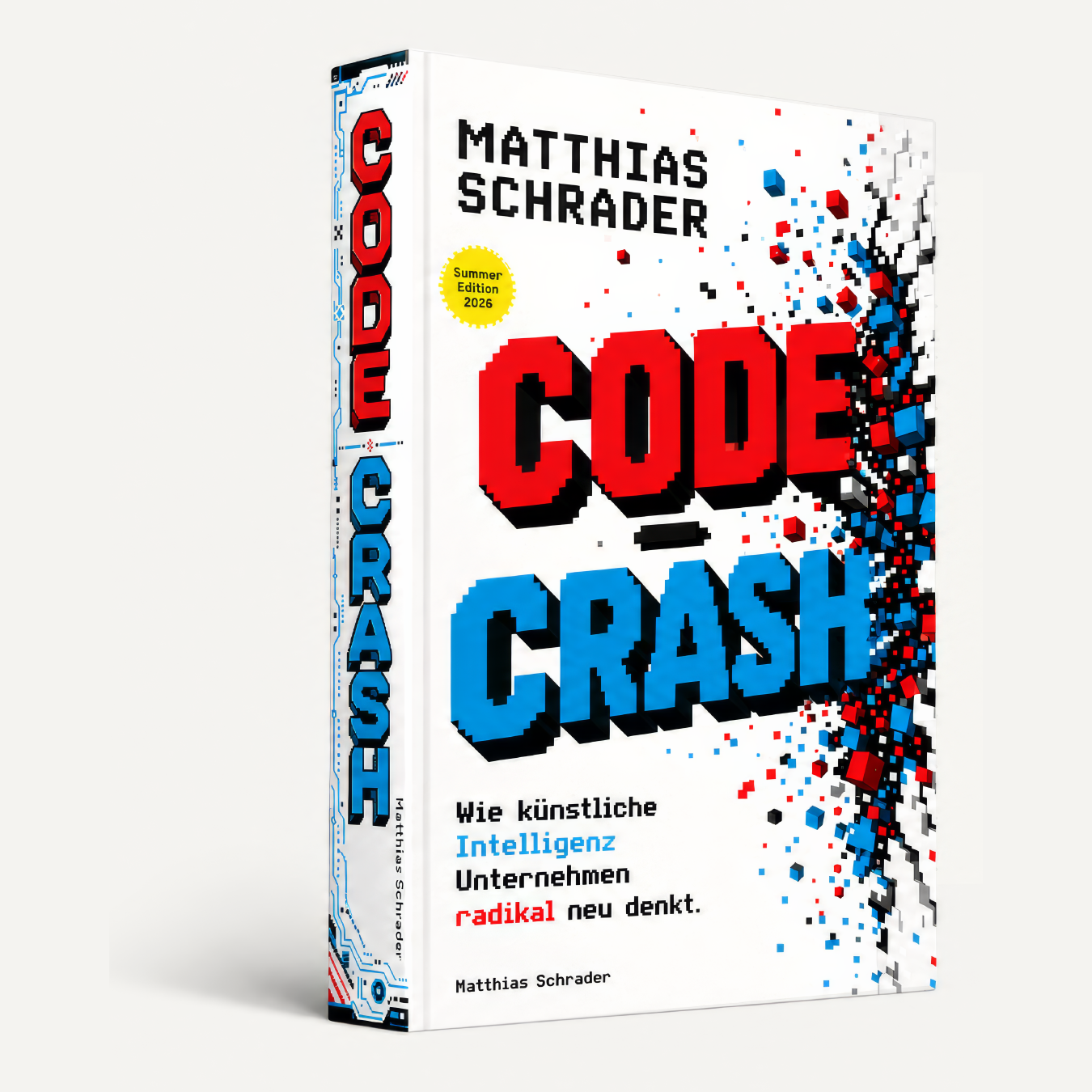
Synthszr Take: Cuofano is describing what CODE CRASH has already formulated: Intent is the new code. When everyone has the same tool, what matters is what you give the model before you start typing. His “Claude OS” idea is an operating system metaphor from the 80s: instead of entering every command individually, you work within a structured thinking environment. Frameworks are not crutches, but compressed expertise, decades of pattern recognition distilled into repeatable processes (and that’s precisely why they’re harder to copy than any tool subscription). The consequence: The more powerful the tools become, the more valuable precise intent becomes.