

AI Deployment Companies Are Set to Solve the Enterprise AI Adoption Problem
- • AI Deployment Companies are the new hot thing.
- • Mira Murati is revolutionizing AI interaction with real-time agents and a new architecture.
- • Apple’s AirPods with cameras bring new Siri features for smart analysis.
AI Deployment Companies Are the New Hot Thing
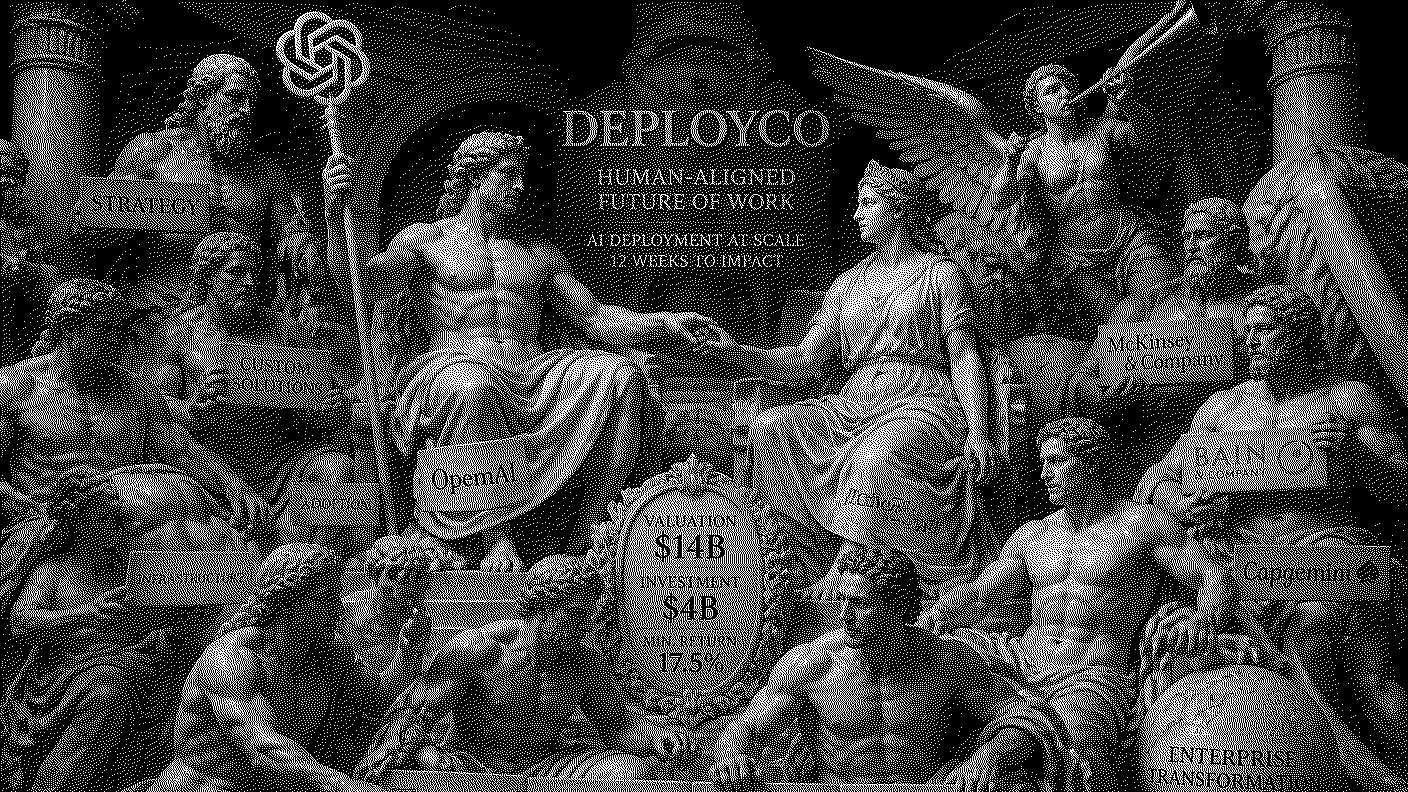
Tomoro.ai was acquired as the “Founding Acquisition” of the new OpenAI Deployment Company – an AI consulting firm founded in 2023 that positions itself as a partner for the “human-aligned Future of Work.” The company promises to make enterprise AI solutions production-ready in 12 weeks and offers the classic consulting portfolio: Strategy, Custom Solutions, Infrastructure, Adoption. The acquisition signals OpenAI’s expansion into the lucrative enterprise market, where companies are desperately seeking AI implementations. Tomoro brings access to large clients and implementation know-how, while OpenAI provides the technology and “early access” to new models. The new entity, named DeployCo, is a separate consulting unit valued at $14 billion with $4 billion in investments. Investors receive a guaranteed minimum return of 17.5% with capped profits, while OpenAI retains majority control. McKinsey, Bain, and Capgemini are among the investors – meaning the established consulting firms are potentially funding their own replacement. TPG is leading the investment round, joined by Advent International, Bain Capital, and Brookfield as co-lead partners. The timing is no coincidence: Anthropic has just set up a similar structure, and Goldman Sachs is investing in both. → Techpresso
Synthszr Take: The phrase “human-aligned Future of Work” functions like the washing instructions on a cashmere sweater – it signals quality through the mere mention of care standards, without anyone checking if the sweater is actually made of cashmere. Every other AI consultancy now adorns itself with this vocabulary, as if the industry collectively attended an ethics seminar and now has to hedge every sentence with moral assurance. OpenAI’s acquisition shows that even the AI giant needs this language to gain traction in the enterprise market – where CTOs don’t ask for the best technology, but for the least assailable one. The real innovation isn’t in the technology, but in perfecting a rhetoric that sounds both transformative and risk-free.
Ex-OpenAI CTO Mira Murati Introduces Real-Time Agents
Thinking Machines, the new startup from ex-OpenAI CTO Mira Murati and co-founder John Schulman, has unveiled an “Interaction Model” architecture that breaks the classic turn-based scheme of AI systems. Instead of waiting for user input, the 276-billion-parameter system (12 billion active) simultaneously processes 200-ms chunks of audio and video in real-time. The model achieves a turn-taking latency of 0.40 seconds (vs. 0.57s for Gemini-3.1-flash-live and 1.18s for GPT-realtime-2.0) and scores 77.8 on the FD-Bench V1.5 – almost twice as high as the competition. The architecture separates an Interaction Model for live dialogue from a Background Model for complex reasoning tasks. Particularly relevant: The system can proactively react to visual signals, such as detecting bugs in code or reporting security breaches in real-time. → VentureBeat
Synthszr Take: Thinking Machines' full-duplex architecture is like the switch from simplex to full-duplex communication in telecommunications – except here, it’s not just the direction of transmission but the entire perception of time that’s being rewired. In classic telephony, the shift was from push-to-talk to simultaneous bidirectional communication; for AI models, it means the leap from sequential to parallel reality processing. This is more than a technical upgrade: if agents are to negotiate with each other, monitor factories, or assist in medical procedures in the future, they can’t afford a 1.18-second reaction time. The division into an Interaction and a Background Model elegantly solves the dilemma between reaction speed and reasoning depth. Murati’s team is building the infrastructure for a world where AI systems no longer wait for humans, but set the communication pace themselves.
Apple’s AI-AirPods Get Eyes
Apple is on the verge of mass-producing AirPods with integrated cameras and enhanced Siri AI. The new headphones are intended to let users analyze their surroundings – from creating recipes based on the contents of their fridge to analyzing products in a store or capturing event information from posters. In parallel, Reactor is launching its world-generation platform for real-time AI worlds in the browser, positioning itself as an infrastructure layer. Prime Intellect is leaving beta with its Lab platform for custom models and self-improving agents. Resistance to data centers is growing: 20 projects worth $98 billion were blocked in three months, and 27 US states are working on regulations. → Superhuman – Zain Kahn
Synthszr Take: Apple’s AI-AirPods function like a Continuous Glucose Monitor for information – they constantly measure the environment and deliver contextual data without conscious retrieval. In diabetes management, this always-on sensor technology revolutionized treatment: patients no longer react to symptoms but navigate preventively based on continuous data points. Apple is thus shifting the human-machine interface from conscious interaction to passive perceptual augmentation. The smartphone is becoming a relic of a time when we still had to actively reach for information. The true disruption lies not in the technology, but in making computing invisible.
Note-Takers Undermine Attorney-Client Privilege
AI-powered meeting assistants are evolving from harmless productivity tools into legal minefields. What began as a way to document meetings faster is now making its way into board calls, M&A negotiations, and conversations with lawyers – leaving behind transcripts that attorneys may be required to produce. The New York City Bar published a checklist in December 2025: client consent, confidentiality, attorney-client privilege, accuracy, and tool competence must be verified. Companies are already reflexively removing AI note-takers from sensitive calls. Granola raised $125 million at a $1.5 billion valuation when the category looked like it was about faster meeting minutes. Now, the convenience software is becoming an information governance risk as soon as legal advice is involved. 40 percent of breach response cases at Experian already involve AI-powered attacks. → Marcus Schuler
Synthszr Take: AI note-takers function like court stenographers that nobody ordered, but whose transcripts can still end up in court. In traditional stenography, the court decides on recording and use; with AI note-takers, an unnoticed third party sits at the table, turning every offhand remark into a searchable, citable record. Attorney-client privilege doesn’t have default settings. What started as a productivity feature becomes a compliance problem when the bot can’t distinguish between a sales check-in and M&A due diligence. The only sensible default setting for legal calls is: bot out before the lawyer enters the room.
China’s Kuaishou Successfully Uses Generative AI for Real-Time Advertising
Kuaishou, China’s second-largest short-video platform after Douyin/TikTok, has completely switched its advertising system to generative AI. The system, called GR4AD (Generative Recommendation for Advertising), serves over 400 million users in real-time and has replaced the previous DLRM-based architecture (Deep Learning Recommendation Model). In large-scale A/B tests, the new system increased advertising revenue by up to 4.2%. The technical innovation lies in three components: UA-SID (Unified Advertisement Semantic ID) tokenizes complex business information, LazyAR reduces inference costs through relaxed layer dependencies, and RSPO (Ranking-Guided Softmax Preference Optimization) continuously optimizes based on real business values. The system dynamically adjusts the beam width according to server load and, despite its generative architecture, achieves the low latency required for real-time advertising. The scaling effects were evident in both model training and inference. → Techpresso
Synthszr Take: Kuaishou is treating its advertising system like a pharmaceutical company expanding the indications for an approved drug: the mechanism (generative AI) is known, but the delivery method must be completely redeveloped. While LLMs can take their time generating tokens, advertising requires millisecond decisions for millions of parallel requests. The solution is reminiscent of extended-release formulations: LazyAR loosens the sequential dependencies, much like a time-release capsule staggers the release of its active ingredient. The real signal is its deployment maturity: 400 million users isn’t a test group, it’s full market penetration. When generative models conquer the last bastion of machine learning (real-time advertising), the lines between prediction and generation disappear. The 4.2% revenue increase sounds marginal, but for a company of Kuaishou’s size, it translates to hundreds of millions of dollars. The business model of these platforms will become even more dependent on their AI infrastructure.
Caligra c100 Developer Terminal for Work Purists
Caligra builds computers for “experts like scientists, artists, engineers, designers, hackers, and painters” – a hardware terminal with no entertainment, shopping, or advertising. The c100 Developer Terminal comes with a Linux-based Workbench OS that uses Fitts' Law for task management and forgoes decorative elements. The case is milled from a solid block of aluminum, the keyboard has the number pad on the left instead of the right (for symmetrical operation), and the wired mouse doesn’t need a battery. Pentagram designed the hardware in the style of 70s/80s computers but with modern precision: a central magnetic axis allows the keyboard to be folded away, so experts can clear their desks for other materials. The terminal was unveiled at the London Design Festival in September 2025 and is available for pre-order on caligra.com. → The UX Collective Newsletter
Synthszr Take: The c100 functions like a cleanroom in semiconductor manufacturing: every contaminant is systematically excluded so that only the desired processes can run. Where normal computers carry entertainment particles and shopping molecules through every airflow, Caligra seals the system – no pop-ups, no distractions, no decorative elements that contaminate productivity like dust particles. The symmetrical keyboard design with a left-sided number pad follows the same logic: every millisecond of mouse movement is a potential contamination of the workflow. The question remains: who will pay premium prices for a computer that does less? The target audience of “scientists, artists, engineers, designers, hackers, and painters” sounds suspiciously like anyone who likes to see themselves as an expert. A cleanroom without a controlled substance ultimately produces only sterile air.
First AI-Generated Zero-Days in the Wild
Google has identified the first zero-day exploit confirmed to have been developed with AI. A prominent cybercrime group used an AI model to find and exploit a vulnerability in an open-source administration tool – the exploit bypassed two-factor authentication. The Python script contained characteristic AI features: an excessive number of docstrings, a hallucinated CVSS score, and the typical structured formatting of LLM training data. Chinese and North Korean state actors are particularly active: UNC2814 uses persona-based jailbreaks for firmware analysis, while APT45 fires off thousands of recursive prompts to analyze CVEs and validate exploits. Working with the affected vendor, Google was able to prevent mass exploitation. → Techpresso
Synthszr Take: The problem isn’t the AI-generated exploit – it’s the attribution crisis it triggers. Like counterfeit banknotes, the real danger isn’t the single fake bill, but the collapse of trust in the currency itself: if central banks can no longer distinguish between real and fake notes, every note becomes suspect. Google had to rely on circumstantial evidence here – docstring patterns, formatting, statistical anomalies – because direct proof is lacking. The exploit itself was technically mediocre (even featuring a hallucinated CVSS score), but it marks the moment when attribution shifts from a technical to a forensic discipline. State actors like APT45 are already industrializing exploit discovery with thousands of parallel prompts. This forces defenders into an impossible position: they must defend against both human and machine attackers simultaneously, without knowing who is who.
'Made in Germany' Becomes 'Made in China'
Mercedes CEO Ola Källenius says, “I am Chinese,” VW’s China chief admits that young customers see the brand as “their parents' car,” while a Shanghai analyst observes, “German brands are being 'murdered' by their own legacy and their resistance to rapid change.” The numbers from Auto China 2026 are brutal: the market share of German manufacturers in China fell from 26% (2019) to 16% today. For pure electric vehicles, the German share is 1.6%. The German exhibition stands physically show the divide: one side for internal combustion engines (“old world”), one for EVs (“new world”) – while Chinese manufacturers only know the new world. Software is the new battlefield: it already accounts for 30-40% of a car’s total cost, and here, local players like BYD define what premium means. VW celebrates the development of the ID. UNYX 09 on an Xpeng platform in 24 months as a milestone – yet Chinese manufacturers are still twice as fast at 8-12 months. → Philipp Raasch
Synthszr Take: The German auto industry is currently experiencing its own version of the Bauhaus emigration of the 1930s: the center of innovation is moving east, this time voluntarily and out of economic necessity. Just as the Bauhaus principles were reinterpreted in Tel Aviv and Chicago back then, new standards of automotive excellence are now emerging in China – except this time, the Germans are tagging along as junior partners. Mercedes and VW are not just buying components, but entire platforms from Xpeng and Huawei. In China, “Made in Germany” is increasingly read as “not smart enough.” The irony: German manufacturers must now use Chinese technology to be considered modern in China. Those who don’t develop with Chinese partners lose not only market share but also the authority to define what constitutes a premium car.
10 Days in Chinese AI Labs: Cots, Robot Pharmacies, and American Fear
A delegation of American tech journalists spent ten days in Chinese AI labs – and returned with a clear picture: while researchers at Moonshot, MiniMax, and Z.ai sleep on cots and work through holidays, they are battling a structural inferiority in computing power. Every researcher complained about the same problem: a lack of GPUs. Nvidia’s Blackwell chips, which are just now being rolled out in the US, remain unattainable for Chinese companies. One developer showed his chronic skin rash – the result of overtime since DeepSeek R1 in January. The offices were a quarter full even on the Labor Day holiday, and piles of packages in the lobbies testified to the fact that employees practically live there. Despite this hardship, Chinese labs continue to pursue their AGI dream, but compensate with early productization: MiniMax is building lucrative AI companions, Z.ai is focusing on B2B solutions with generous token limits that compete with Claude Code. → AI Valley
Synthszr Take: Chinese AI labs operate like an economy under a hard currency policy: when the central bank keeps the money supply tight, every investment is scrutinized, and bad capital is driven from the market. The lack of Blackwell chips acts like a restrictive discount window for compute: every training run, every inference token must justify its utility. DeepSeek has already converted this discipline into algorithmic efficiency; MiniMax and Z.ai are driving it into the product world. AI companions and generous token limits are the consumer products that the tightening money market allocatively forces. The cots are the personnel component of this hard-currency economy. Those who work with less are inevitably forced to refine their tools. The open question: whether the American labs, with their soft-money compute strategy, will end up with the structurally more inefficient balance sheet.